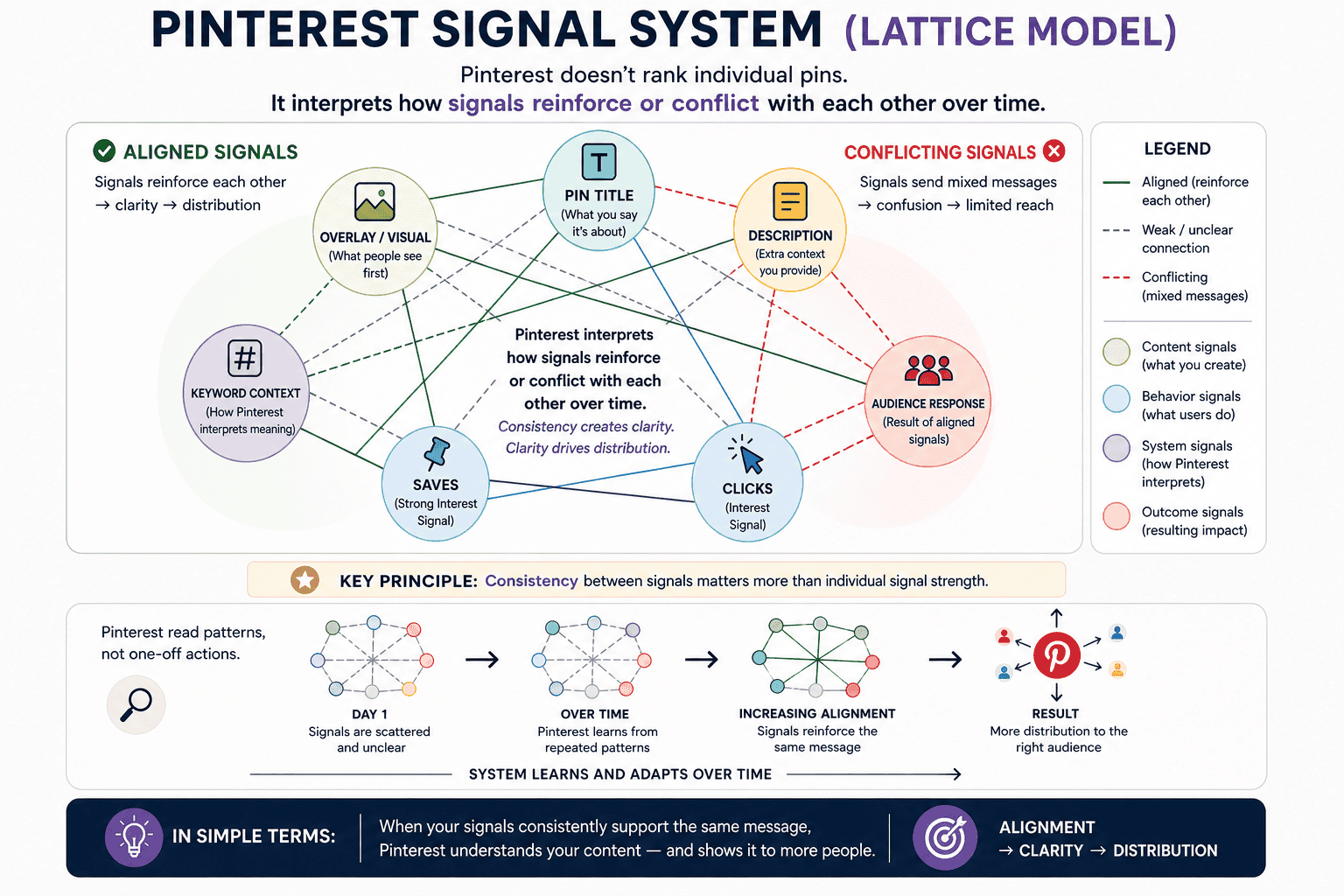
Pinterest doesn’t “read” your pins the way you do.
It dissects them — breaking each one into data points like object shapes, text overlays, dominant color zones, scroll behavior, and click-through paths — then ranks your content in a silent test you never see.

The pins that succeed don’t just look good — they signal relevance in the right ways at the right time. The ones that fall flat aren’t necessarily failures. Often, they’re placed in lower-distribution “buckets,” quietly held for future resurfacing when seasonal demand or related content makes them more clickable.
If you’ve ever felt like Pinterest’s logic is hidden behind a curtain, you’re not wrong.
But it’s not random — it’s just layered. And once you understand what the platform is looking for, you can stop guessing and start responding with more innovative, more intuitive strategies.
That’s what this blog (and my upcoming course) is all about: decoding Pinterest’s inner workings and giving creators tools to think critically, adapt easily, and grow confidently.

Who Am I, and What Do I Do?
I’m a solo Pinterest geek — just me, behind my keyboard and curved desktop screen, managing client accounts by day and reverse-engineering Pinterest by night.
Yes, I’m a Pinterest manager. But in my so-called “downtime,” I’m dissecting the platform — running tests, tweaking strategies, and following the breadcrumbs Pinterest leaves behind. I’m not just interested in what works. I want to know why, how, and what’s changing next.
Pinterest’s AI is constantly evolving — reshuffling what it surfaces, how it annotates your pins, and what it rewards. If you’re not adapting, you’re falling behind.
Sound exhausting?
Only if it’s not your jam.
For me, this work is energizing. It’s like decoding an endless, shape-shifting puzzle — one that, when solved even partially, unlocks powerful long-term results for creators who thought they were invisible.
That’s the mindset that will shape this course — not plug-and-play shortcuts, but curiosity, pattern recognition, and strategy you can apply as the platform evolves.
Why This Course Will Be Different
This won’t be another “just follow these steps and go viral” course.
It will offer a layered, strategic breakdown of how Pinterest works — and how to meet it with curiosity, not canned advice.
Two Levels, One Mission
The course will be divided into two tiers, so you can choose what fits your goals:
➤ Foundational Level
For creators who are tired of guessing and want a clear, practical understanding of how Pinterest operates.
➤ Strategist Level
For those who think in frameworks and love asking “why?” — ready to dive deeper into:
- The psychology of scrolling
- The AI behind annotations
- The subtle behavior shifts that separate underperforming pins from long-term wins
What You’ll Learn
You’ll learn how to:
- Reverse-engineer what Pinterest sees when it scans your pins
- Understand why specific pins take off (even if they’re ugly)
- Recognize why polished designs sometimes flop
- Analyze what makes a scroll-stopping visual work
- Design with both humans and the machine in mind
The course will explore not just design principles — but also the emotional and behavioral triggers that make people stop, click, or save.
This will be a strategy grounded in real-world testing, not just Pinterest-approved aesthetics.
A/B Testing on Pinterest: The Who, What, Why, and When
Let’s talk about just one example of the kind of thinking this course will teach: A/B testing.
Who is A/B testing for?
Anyone serious about Pinterest strategy. Whether you’re a food blogger, product seller, or content creator, A/B testing is how you move from guessing to knowing.
What is it?
A/B testing means publishing two variations of a pin — same URL, duplicate content — but with one changed variable (like overlay text, image layout, or keyword phrasing). You’re observing which version performs better based on actual user behavior.
Why does it matter?
Because Pinterest doesn’t care what looks pretty.
It cares what gets clicks.
Your audience won’t always respond the way you expect — and testing is how you learn what actually works for your niche, your boards, your timeline.
It’s not just about pleasing the algorithm.
It’s about training it to understand your content — and boosting your odds every time you hit publish.
When should you do it?
Frequently — especially:
- When launching new content
- When refreshing seasonal pins
- When reworking pins that underperformed the first time
Pinterest rewards novelty, iteration, and clarity. A/B testing gives you all three.
What Will Be Inside the Course
This course will walk you through:
- How to set up your A/B tests with purpose
- What variables are worth testing (and what’s just noise)
- How to track results without spreadsheets taking over your life
- How to interpret the results to sharpen your strategy
You won’t need a data science degree.
Just a system, a starting point, and the willingness to look closer.
The course will guide you through all of it.
What’s Coming: A Smarter Pinterest Course, Built to Adapt
This course will be built for long-term thinkers — creators who want to understand what’s happening under the hood, not just follow another fleeting trend or repin someone else’s success.
You’ll learn how to:
- Understand how Pinterest AI sees and scores your content
- Decode what annotations are (and why they matter more than hashtags)
- Batch, repin, and board with purpose instead of autopilot
- Forecast pin performance by reading real platform signals
- Stop spinning your wheels — and start making confident, strategic moves
But the Bigger Goal?
This won’t just teach Pinterest theory.
It will teach you how to observe, track, and analyze the platform — even after the course ends.
Because Pinterest will keep changing — and you’ll be ready for it.
I want this course to equip you with tools to think critically, test smartly, and grow with clarity long-term.
It won’t be a quick-fix formula.
It will be a foundation you’ll build on for years.
Whether you’re managing your blog or building Pinterest strategy for clients, this course will help you adapt to the platform — not chase it.
Ready to Dive In?
👉 Want first access or curious if this course is for you? Reach out via [my contact form] — I’ll personally reply and keep you in the loop.