What Food Bloggers Are Seeing — and What It Actually Means for 2026
If you have been studying Pinterest search results in the food niche lately, you have probably noticed something unsettling.
AI-generated food images are increasingly visible.
They are crisp. Hyper-clean. The lighting is flawless. Garnish is perfectly placed. Textures appear sharpened just enough to feel irresistible.
Meanwhile, many human-shot food photos — even beautifully styled ones — look warmer, softer, and more lived-in. They look real.
And sometimes, they appear to be losing ground.
It raises a serious question.
Is this temporary? Or are food bloggers going to be forced to compete with synthetic perfection just to remain visible on Pinterest?
The answer is not panic.
It is process.
The “Too Perfect” Pattern
There is a specific kind of AI food image that stands out immediately to trained eyes.
The browning is uniform across every surface. A lemon wedge sits at a mathematically ideal angle. Seasoning appears evenly distributed in a way that feels deliberate rather than organic. Occasionally, shadows fall in directions that do not quite align. Garnish may look slightly suspended rather than resting.
To someone experienced in food photography, something feels subtly off.
To the average Pinterest user, however, it simply looks appetizing.
Most users are not analyzing light sources or garnish symmetry. They are reacting to golden edges, visible blueberries, glossy sauce, and textures that suggest taste.
They are thinking, “That looks good.”
Visual literacy around AI is still uneven. Some users immediately recognize synthetic precision. Others may not question it at all.
That awareness will grow.
And when it does, images that feel overly perfect may begin to trigger hesitation instead of trust.
On a platform where users actually cook what they save, believability matters.
Why Experience Still Signals Reality
For years, bloggers were told that no one reads the story. That readers scroll straight to the recipe card. That context is extraneous.
But context serves a purpose.
It signals that a real person made this dish.
That someone tested it. Adjusted it. Burned it once. Tried again. Noted the crumb. Swapped the pan. Changed the bake time.
AI can generate a convincing image.
It cannot replicate lived experience.
When a reader lands on a blog and sees step-by-step images that match the final dish, notes about storage or reheating, and commentary about how the recipe behaves the next day, that builds trust.
In food content, credibility is practical. It answers one quiet question:
“Can I actually make this?”
In a visual ecosystem filling with synthetic perfection, grounded experience becomes an advantage.
Pinterest’s Hyper-Aware Classification Layer
Pinterest, as a visual search engine, has a classification layer that is particularly hyper-aware right now.
Its systems read object signals, ingredient markers, structure, and visual patterns. It groups images by similarity and associates them with repeated behaviors across the platform. This is part of what I outlined in [Pinterest SERPs: The Missing Layer Between Ranking and Traffic] — ranking is not the same as distribution.
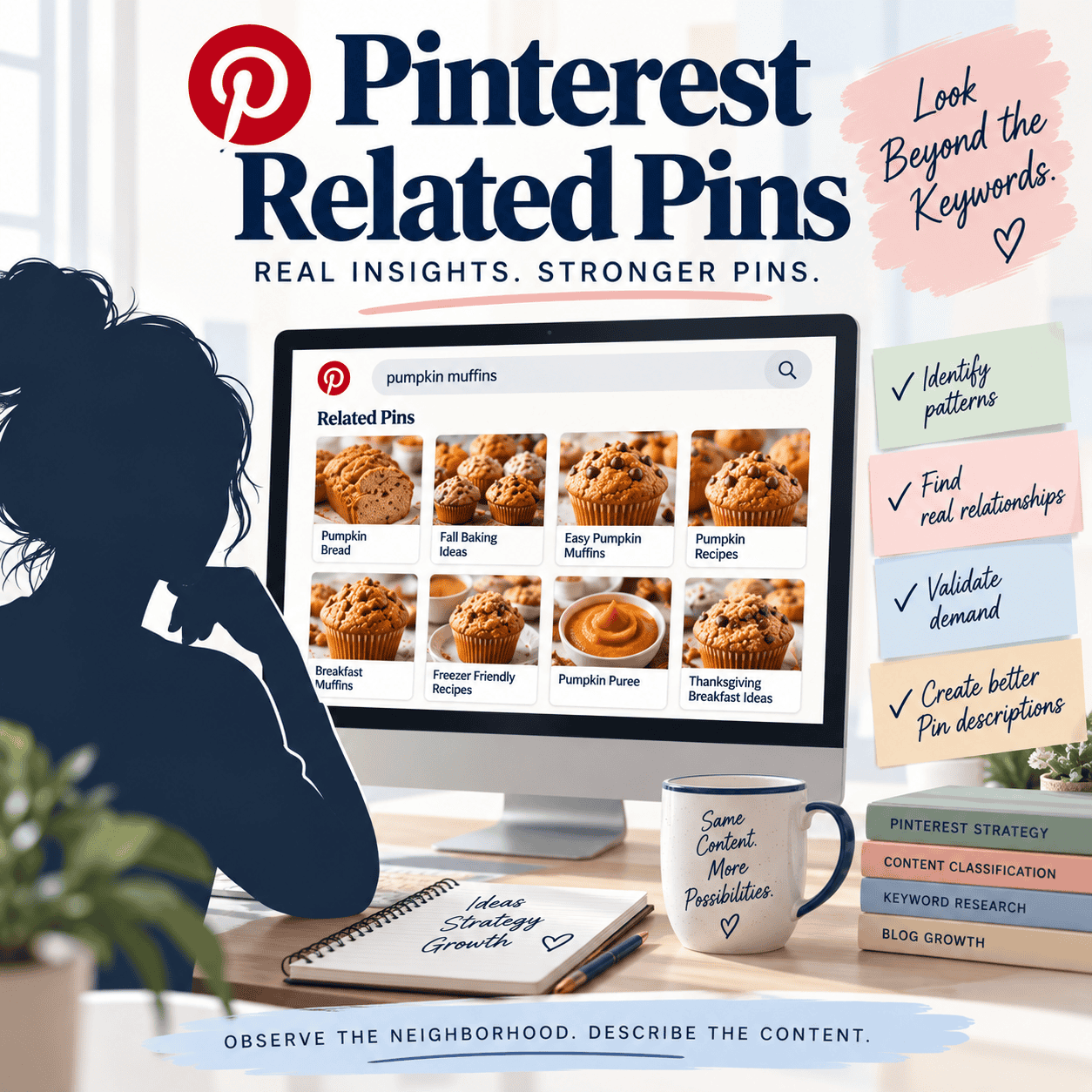
If you click into one of your pins and examine suggested pins beneath it, you will often see your own prior variations resurfaced. Different overlays. Different titles. The same base image.
That grouping behavior connects directly to how Pinterest annotations influence pin visibility, something I explain further in [Pinterest SEO Tips: How Annotations Affect Pin Rankings].
Pinterest does not just see your design.
It sees the image fingerprint.
And that fingerprint determines how your content is bucketed.
Understanding this changes how you photograph.
One Photo Cannot Carry an Entire URL
Take a blueberry muffin as an example.
A muffin sitting beautifully on a stylized plate works as an atmosphere shot. It communicates breakfast or tea time.
But it is limited as an anchor.
A muffin cut open, showing visible blueberries and a defined crumb, gives Pinterest far more to work with. The berries are obvious. The interior texture is visible. The bake structure is unmistakable. A few whole berries nearby reinforce the ingredient.
That image performs a different role.
The plated shot sets mood.
The cut-open shot shows proof.
Those roles are not interchangeable.
Variation Is Not Graphic Variation

Many creators believe they have achieved variation by creating thirty different pins from the same photograph.
To the human eye, those may feel distinct.
To Pinterest’s image reader, they are nearly identical.
The muffin on the plate will continue to be funneled into the same visual grouping repeatedly, no matter how creative the overlay becomes.
True variation requires new visual data.
Different angles.
Different compositions.
Different emphasis.
A tray shot suggests batch baking.
A cut-open shot shows what is inside.
A close crumb shot highlights texture.
A breakfast table shot suggests use-case.
Same recipe.
Different signals.
Show the Full Lifecycle
A recipe does not exist in one state.
It is baked. It is cooled. It is stored. It may be frozen. It may be reheated.
If your blueberry muffin recipe mentions freezing, show it frozen. Show it in a container. Show it wrapped and placed in the freezer.
If it reheats well, show that too. A muffin on a microwave plate. A muffin in an air fryer basket. A muffin split open after reheating so readers can see how it holds up.
These images communicate usability.
Pinterest surfaces behavior.
A freezer-friendly muffin connects to different searches than a brunch muffin.
This does not mean every one of these images must live inside your blog post.
But they do need to live in your Pinterest library.
Your blog serves readers.
Your Pinterest library serves distribution.
Expanding Distribution Without Changing the Recipe
Maybe you posted blueberry muffins because you found some in your freezer and uncovered a keyword that worked.
That is normal.
But if you are thinking like a Pinterest creator, the work does not stop there.
That muffin can serve holiday brunches. It can sit on a Christmas platter. It can appear in an Easter spread. It can live on a spring tea table. It might belong in a brunch “muffin board” because that is something people actively search for.
You are not changing the recipe.
You are expanding its Pinterest viability.
The ingredients stay the same. The method stays the same.
What changes is how you visually position it while strengthening what Pinterest’s classification layer can recognize.
When a muffin only ever appears on a neutral plate, Pinterest reads it one way.
When it appears in multiple believable contexts, Pinterest receives additional signals about where it belongs.
This is structured distribution thinking.
It is also how human creators remain competitive against glossy AI shots currently dominating parts of the feed.
AI imagery may win short-term attention because it is hyper-polished and unmistakable at a glance.
Structured distribution wins longevity.
Working With a Strategist Changes the Outcome
This is where collaboration matters.
A Pinterest strategist should not simply ask for more pins.
They should help identify legitimate distribution angles before seasonal windows close.
Does this recipe belong in more than one gathering context?
Does it travel? Freeze? Reheat? Cross seasons?
Are there overlooked situations that expand its surface area?
If a strategist builds layered distribution plans but the creator only has one hero image, the image becomes the bottleneck.
Pinterest reads what it sees.
If what it sees is limited, distribution remains limited.
Structured photography and structured strategy must work together.
Beyond the Lens: Process
The same applies to something like macaroni salad.
It is not just a summer barbecue side.
It belongs at church suppers, potlucks, buffet tables, graduation parties, and family celebrations.
If your photography only ever shows it beside a grill in July, you narrow its potential.
Beyond the lens, there needs to be a checklist.
Where else does this belong?
What situations suit it?
Does it serve multiple seasons?
Maybe you do not photograph every angle immediately.
But you note it.
You revisit it.
You schedule retakes.
You build the asset library over time.
This is not a requirement.
It is a suggestion for creators who want to strengthen their Pinterest performance and compete in an AI-heavy environment.
Casual posting may be enough for some.
For those wanting more distribution, more longevity, and more resilience, structured thinking becomes essential.
The 2026 Reality
AI images may dominate certain surfaces right now because they are hyper-structured.
Human creators can compete without becoming artificial.
Document the real lifecycle of food.
Photograph the multiple believable contexts.
Expand the situations in which your recipe can live.
You are not changing the recipe.
You are expanding where and when it can surface.
That is structured distribution thinking — the same long-game approach I discuss in [Pinterest Traffic Dropping? Why Most Strategies Fail]. Short-term polish may win attention. Structured distribution sustains visibility.
Depth — not a single perfect frame — is what carries weight on Pinterest over time.
If you understand how Pinterest surfaces content across boards, seasons, and behavior layers — as outlined in [Pinterest Board Strategy for 2026] — you begin to see why visual expansion matters more than aesthetic perfection.
If you’re a food creator navigating this AI-heavy Pinterest landscape and want your content structured for long-term visibility rather than short-term spikes, working with a Pinterest strategist can make that difference.