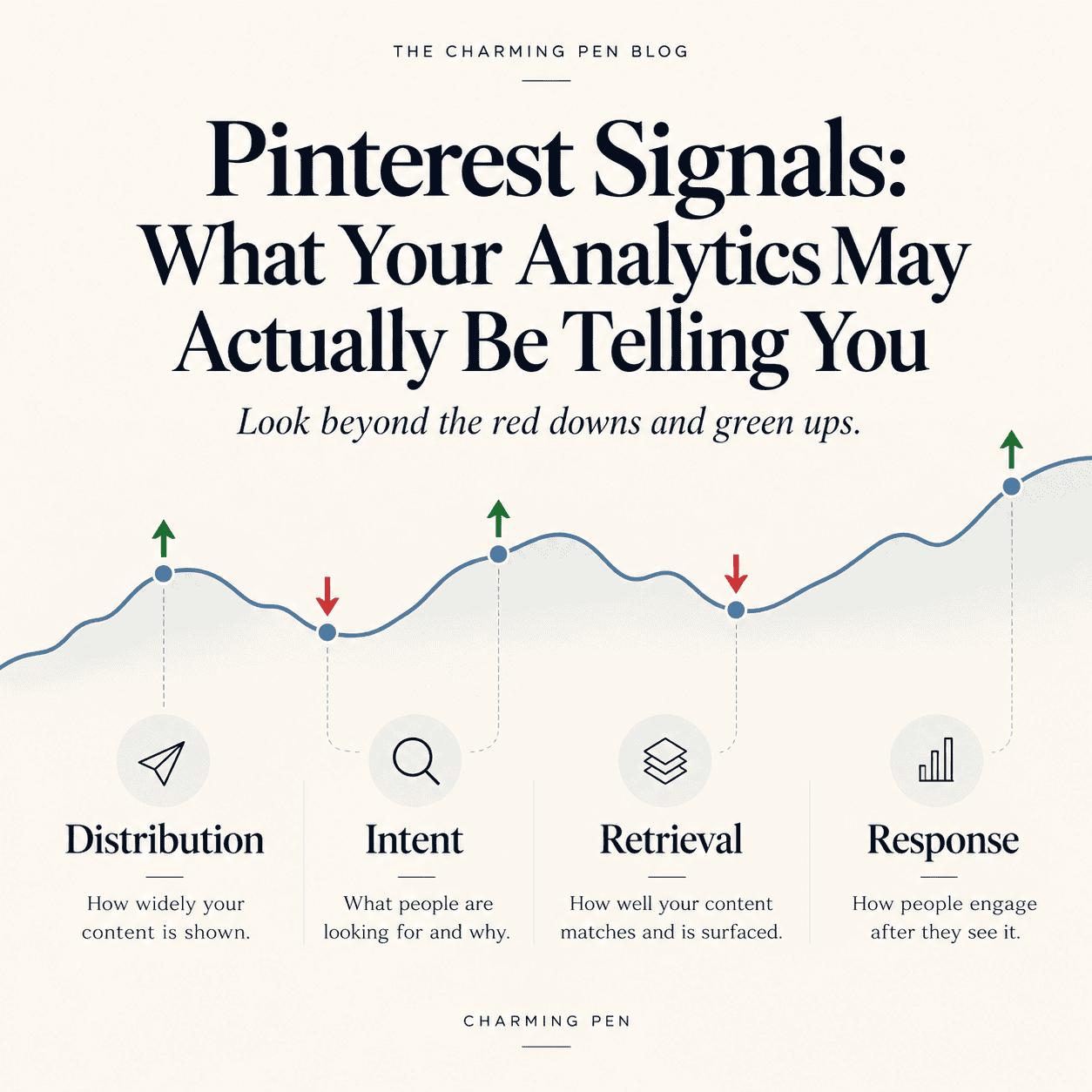
Pinterest is evolving — again.
And if you’ve felt like your best content is being “ignored,” pins are ranking slower, or platform behavior feels inconsistent lately… you’re not imagining it.
What’s happening isn’t a fluke. It’s an AI recalibration, and it’s going to widen the gap between content creators who rely on quick tactics and those building long-term search equity.
The AI Shifts Behind the Glitches
Pinterest has been slowly overhauling how it reads, classifies, and ranks content — not just visually, but structurally.
What we’re seeing:
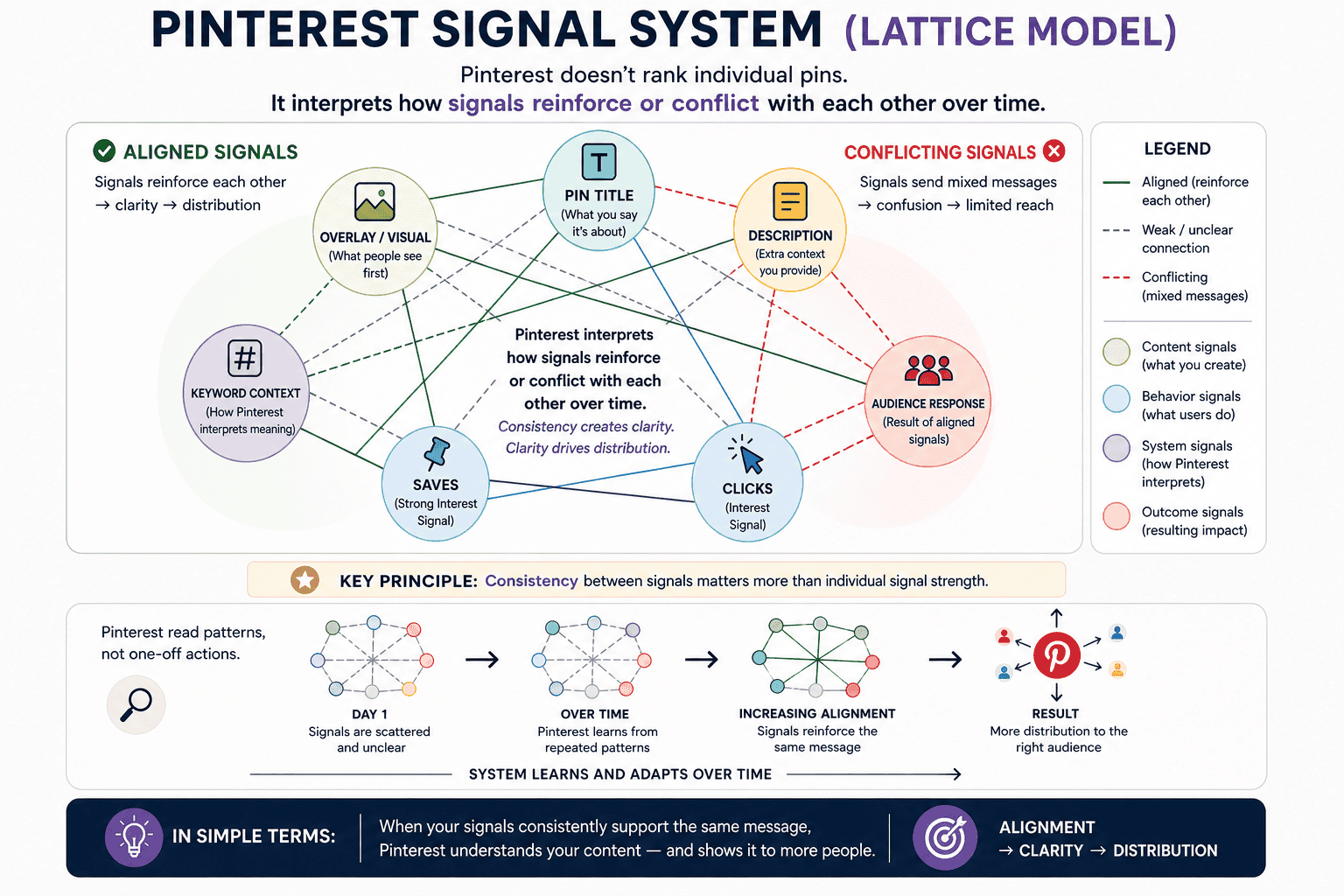
- Heavier annotation dependence: Pins are being indexed based on increasingly specific annotation matches — which means even mild misalignment between your pin title, image text, and board context can delay or suppress ranking.
- Aggressive spam suppression: Some pins are being flagged (or throttled) as AI-generated even if they’re wholly original — especially those with highly stylized fonts, too-clean overlays, or repetitive structures.
- Lagged seasonal indexing: Pinterest’s seasonal content ramp-up is now reacting to multi-year engagement cycles. This means content might take 3–6 weeks to index even when timed “perfectly.”
These aren’t bugs. They’re signals that Pinterest is prioritizing contextual trust and content behavior history over flash-in-the-pan performance.
NEW: Algorithm Update: Taste Graph + Pin Testing
Pinterest’s latest changes include Taste Graph mapping — assigning every Pin to a hyper-specific interest cluster — and a first-wave testing phase that trial-runs Pins to a small audience before deciding whether to scale. If your first design underperforms but you don’t follow up with more variations, Pinterest may not revisit that topic for months.
These shifts make annotation alignment and multi-design batching even more important, especially in slow seasons when most creators pause.
What Most Creators Do (and Why It Backfires)
When Pinterest traffic slows or seasonal content doesn’t hit right away, most creators default to one of three reactions:
- Pause or reduce pinning
- Shift focus to faster platforms like TikTok or Reels
- Assume their content flopped and start over with something “trendier”
But here’s what that teaches Pinterest’s AI:
“This account is unstable. It doesn’t reinforce its categories. Don’t anchor future search behavior around it.”
Pinterest doesn’t reward bursts of novelty. It rewards repeated structure Pinterest can trust.
And here’s where it gets more surgical:
If a batch of pins doesn’t perform immediately, and the creator bails before publishing round two or three?
Pinterest assumes it wasn’t a high-confidence signal and may suppress that annotation pairing in future batches — not because the content was harmful, but because the creator failed to confirm it.

Add to that the emerging URL trust loop behavior:
Pinterest is starting to evaluate not just pin engagement, but how frequently and consistently a domain reinforces key themes across boards and time. Disappear for a few weeks, and your URLs drop out of the trust cycle — especially if you don’t have a strong evergreen foundation to fall back on.
In short? Pinterest isn’t ignoring your content.
It’s waiting to see if you believe in it long enough to confirm its predictions.
Creators who panic and pivot too soon are sending mixed signals. Strategists who stay — who train the AI with annotation-aligned content, clever URL stacking, and repeated patterns — are laying the groundwork for Q4 search dominance.
This isn’t about traffic today. It’s about visibility next season, next launch, next wave of Pinterest search AI maturity.
📌 Sidebar: Is Pinterest Really Suppressing Underperforming Batches?
Let’s clarify something: Pinterest has not publicly confirmed that it suppresses annotation pairings when a batch of pins underperforms and the creator doesn’t follow up. There’s no formal rule saying, “If your first three pins flop, the rest get buried.”
But here’s what is confirmed:
- Pinterest relies heavily on annotation consistency and reinforcement to classify and surface content.
- The algorithm uses non-engagement signals like board context, domain trust, and content structure to determine whether your content is worth ranking — especially in seasonal or search-based placements.
- If you pin once and walk away, you’re not supplying enough data for the system to trust that annotation pairing. It’s not penalizing you — it’s just moving on to higher-confidence sources.
So while there’s no direct suppression mechanic, skipping batch follow-ups means you never confirm the pattern Pinterest’s AI is trying to test.
Strategist Insight:
Inconsistent pinning after a low-performing batch doesn’t get you punished — it just leaves your content in limbo. And in a system designed to rank high-confidence, annotation-aligned results? Limbo means lost ground.
Why the Strategists Who Stay Win
Consistency on Pinterest isn’t just about “showing up.” It’s about feeding the system the exact data points it needs to build confidence in your content’s role within the ecosystem. That’s what the algorithm is doing right now — testing, mapping, reinforcing patterns. And it’s doing it whether you show up to participate or not.
Strategists who stay through slow cycles are actively training Pinterest’s AI with:
- Recurring annotation clusters
- URL-level topical reinforcement
- Board-to-pin consistency signals
- Visual overlay and text predictability
In plain terms? You’re teaching Pinterest where to file you — not just your latest pin, but your entire content library.
And because Pinterest is moving away from pure engagement metrics and toward trust-based indexing, that training carries cumulative weight. The longer and more clearly you feed the system, the faster your pins get placed, and the more future content rides the wave of that past clarity.
This is what short-term creators miss. They chase the spike.
Strategists build the structure that makes spikes inevitable — and repeatable.
So when fall content ramps up and Pinterest’s search and browse systems go looking for high-confidence, annotation-aligned pins?
They’ll favor the creators who never stopped training the machine.
That’s why staying consistent through the slump isn’t optional.
It’s the strategy.
Strategist’s Takeaway: The Down Season Is When the Work Counts Most
Pinterest doesn’t forget. It’s watching what you do when traffic dips.
If you ghost the platform now — even with the plan to “pick it back up in the fall” — you’re burning the exact signals Pinterest needs to rank you in the fall.
This isn’t about staying busy. It’s about staying reliable. The algorithm is training on account-level trust, annotation consistency, and URL stability — and if you’re absent during your slow season, Pinterest will hand your spot to someone who stayed.
📌 Why This Matters Even More Now
With Taste Graph mapping and small-scale Pin testing in play, Pinterest is keeping tabs on how consistently you reinforce your topics. Skip follow-ups, and you’re not just missing short-term engagement — you’re cutting the thread that trains Pinterest to trust your content long-term.
Creators clock out.
Strategists show up when others don’t — and dominate when it counts.
Just coming off a Pinterest slump?
If you’re still in the frustration phase and need tactical re-alignment before long-game strategy, read this first: Feeling Done With Pinterest? Read This Before You Quit.
Once you’re back on your feet, this post will show you how to move from recovery to domination.