If your Pinterest traffic isn’t growing—or feels inconsistent—it’s usually not a content problem.
Most Pinterest users assume this is a content or keyword problem.
It’s a mismatch between what you’re doing and how Pinterest is interpreting your signals.
And because the system reacts faster now, those mismatches don’t just stall growth—they compound.
That’s why strategies that worked before suddenly stop.
That’s what most advice misses.
You’ll hear:
- post more
- use better keywords
- try different pin styles
Sometimes those work.
Other times they don’t move anything at all. Or worse—they push you in the wrong direction.
That’s not random—it’s mismatch.
How Pinterest Traffic Actually Works (It’s Not Linear)
Most people treat Pinterest like a checklist:
- do X → get Y
But it doesn’t behave like that.
It behaves more like a search engine—interpreting content based on patterns, intent, and user behavior. As a visual search engine, Pinterest connects pins to search results based on how content is structured and reinforced.
Which means:
- the same pin can perform differently at different points
- the same strategy can work one month and fail the next
- more effort doesn’t always equal more growth
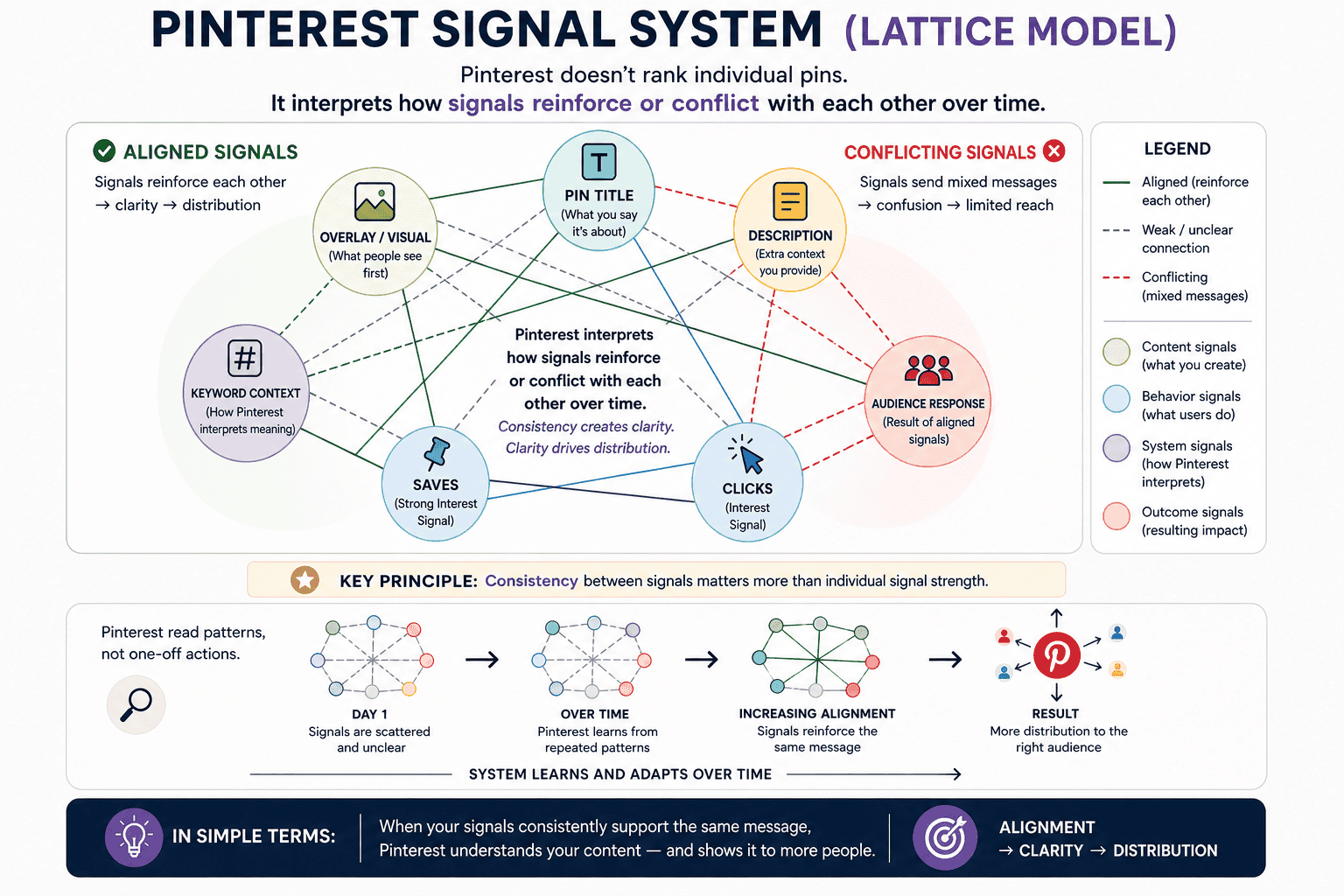
Because Pinterest isn’t reacting to one action—it’s interpreting patterns over time.
This is also why Pinterest behaves more like a machine learning system than a traditional social platform.
It isn’t distributing content evenly—it’s learning from patterns.
Every interaction—clicks, saves, engagement—feeds back into how your content is understood and where it’s shown.
That’s the same underlying behavior you see in search systems.
Which means:
performance isn’t just based on what you post—it’s based on how the system learns from it over time.
Why the Pinterest Algorithm Feels Different Now
Pinterest didn’t suddenly change—it’s continually improving how it reads your signals.
As its models improve, it recognizes patterns more clearly and reacts faster to what you’re showing it.
That has two effects:
- alignment gets rewarded sooner
- misalignment gets suppressed sooner
A year ago, you could be a bit inconsistent and still get traction.
Now, inconsistency gets read as confusion—and confusion limits distribution.
So this isn’t about doing more.
It’s about correcting faster.
This is also why what worked a few years ago no longer works the same way.
As the system has evolved, its ability to interpret patterns has improved.
Tactics that relied on inconsistency or volume used to slip through.
Now, the system recognizes those patterns faster—and filters them out just as quickly.
That’s where a lot of the frustration comes from.
It feels like the rules changed.
In reality, the system just got better at reading what you’re doing.
Why Most Pinterest Strategies Fail (Phase Mismatch)
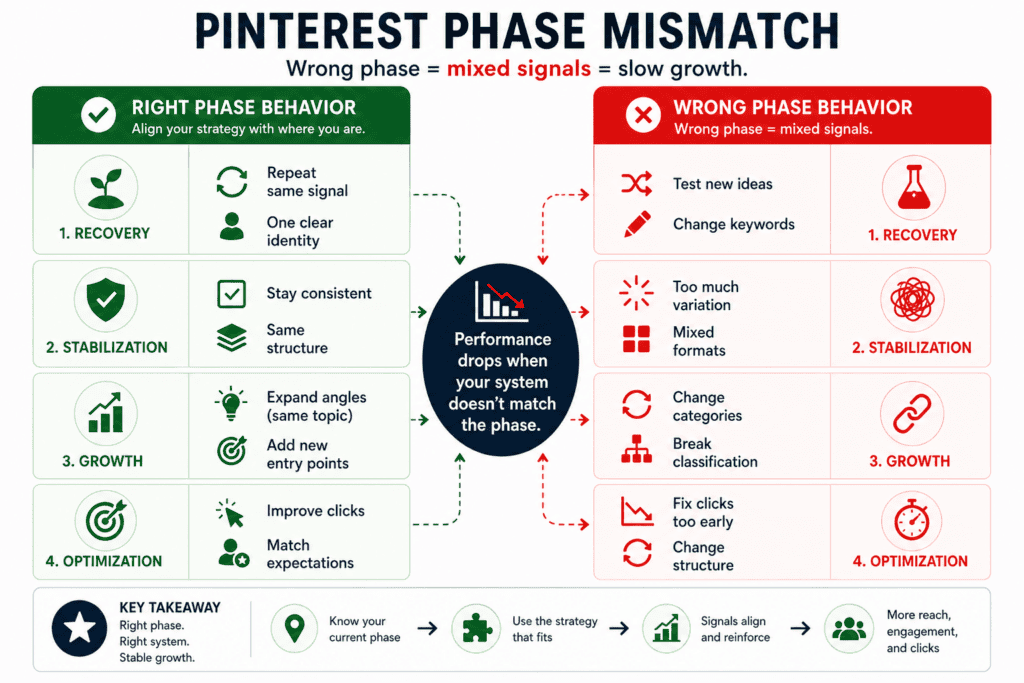
What I see over and over is this:
People are applying:
- growth strategies to accounts that need recovery
- variation strategies to accounts that need repetition
- click optimization to content that isn’t even fully understood yet
Not because the strategy is bad—
but because it’s being used at the wrong time.
Example:
- You start testing new pin styles and angles…
but Pinterest hasn’t even locked in what your content is yet - You tweak titles constantly…
so the system never stabilizes classification - You focus on improving clicks…
but impressions are inconsistent to begin with
And when the system reacts quickly, running the wrong setup doesn’t just stall you—it pushes your signals further off track.
What most Pinterest strategy advice gets wrong
A lot of Pinterest strategy advice focuses on surface-level tactics:
- pin design
- keyword placement
- posting frequency
- board organization
And those things do matter—but not in the way most people think.
They only work when the underlying signals are aligned.
For example:
You can create high-quality pins, but if your titles and descriptions don’t reinforce the same idea, Pinterest struggles to classify them.
You can use relevant keywords, but if they change too frequently across pins, the system never stabilizes.
You can follow “best practices,” but if they’re applied at the wrong phase, they won’t produce consistent results.
This is why two accounts can use the same Pinterest strategy and see completely different outcomes.
It’s not just what you’re doing—it’s how clearly your content is being interpreted.
This is where Pinterest SEO actually works—not at the level of individual pins, but at the level of consistent signals.
It’s about creating consistent signals across:
- pin titles
- descriptions
- visual overlays
- and the content those pins lead to
When those elements align, Pinterest can connect your content to search results more effectively.
When they don’t, even well-designed pins can underperform.
This is also why Pinterest analytics often looks uneven.
Some pins take off, others don’t—not because of quality, but because of how clearly those signals are understood.
So instead of asking:
“What’s the best Pinterest strategy?”
The better question is:
“Is my content being interpreted consistently?”
This is where most people get stuck.
They assume there’s one “right way” to do Pinterest.
There isn’t.
There are different systems depending on what your account is doing right now.
The key isn’t constant change.
It’s recognizing misalignment early—and correcting before it compounds.
How Pinterest Reads Your Content (Signals, Pins, and Patterns)
I don’t look at individual pins or isolated tactics—I look at how signals interact.
The account functions as a lattice:
a structure of connected signals that either reinforce each other or break down.
Every pin, title, keyword, click, and save feeds into that structure.
Those signals don’t just stack—they shift, strengthen, weaken, or conflict depending on the phase your account is in.
Where those signals actually come from
This is the part most people overlook.
Signals don’t come from Pinterest alone—they come from what you put into the system and how users interact with it. (this is explained more fully in the Lattice System™)
Every pin creates inputs through:
- title
- overlay text
- description
If your title, overlay, and description don’t say the same thing, Pinterest doesn’t know what to do with your content.
These aren’t formatting choices—they’re classification signals.
Your title defines what the content is.
Your overlay reinforces (or conflicts with) that signal visually.
Your description builds context through keywords, related phrasing, and search intent.
That’s how Pinterest understands meaning—by connecting those inputs into a consistent signal.
When they align, classification becomes clear.
When they don’t, the system receives mixed signals—and distribution becomes inconsistent.
That’s why something appears to “randomly stop working.”
It didn’t stop working.
The signal environment around it changed—and the system responded.
So when you see performance issues, it’s not just the content or the phase.
It’s how clearly your pin inputs are feeding the system.
How this actually shows up
This isn’t theoretical—you can see it in your account.
Example:
A pin spikes, then dies → classification wasn’t stable
Impressions are steady, clicks are low → behavior mismatch
Some pins take off, others don’t → inconsistent structure
Traffic drops after “testing new ideas” → signal conflict
It’s the lattice reacting.
The 4 Pinterest Traffic Phases (And What Works in Each)
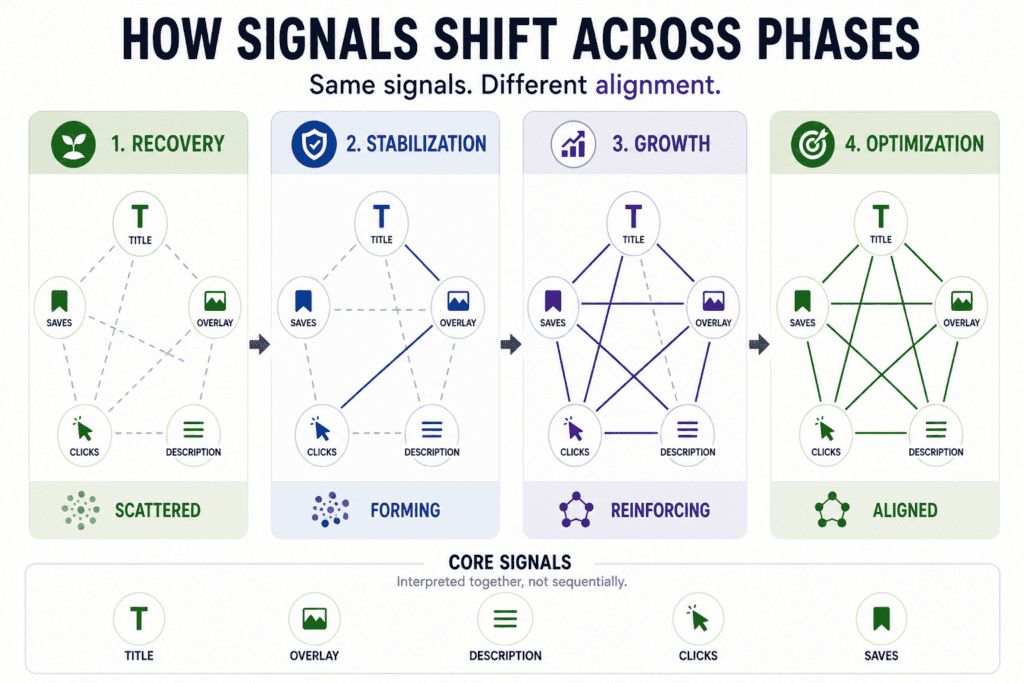
You don’t need more strategies.
You need the right one for where you are.
1. Recovery / Trust Phase
Pinterest Pins in the Recovery Phase
low or dropping impressions
inconsistent indexing
Pinterest isn’t confident in classification
What works here:
**clear identity and repetition**
(one signal, reinforced consistently)
Example:
Posting 5 different recipe types → slows recovery
Changing keywords every pin → breaks classification
Mixing formats (how-to + recipe + tips) → confuses signals
👉 You don’t need more content here—you need clearer signals.
2. Stabilization Phase
Pinterest Strategy During Stabilization
- pins are indexing
- impressions exist but aren’t consistent
- signals are forming
This is where consistent pinning starts to influence distribution patterns.
What works here:
**consistent pinning and structure**
Example:
Pins index, but some don’t → structure isn’t consistent
One title works, next doesn’t → variation too early
Slight keyword drift → uneven distribution
👉 This is where small corrections matter most
3. Growth Phase
Growing Pinterest Traffic Without Losing Structure
impressions increase
saves stabilize
Pinterest understands your content
What works here:
**controlled variation**
Example:
Same recipe, different angles → works
Same recipe, different category → breaks reach
New formats introduced too fast → causes drift
👉 Growth isn’t adding more—it’s expanding correctly
4. Click Optimization Phase
Optimizing Pinterest Traffic for Clicks (Not Just Reach)
- impressions are there
- traffic isn’t converting
At this stage, user experience and alignment between pin design and landing page matter more than reach.
What works here:
**behavior alignment**
Example:
High impressions, low clicks → weak hook or mismatch
Saves high, clicks low → informational, not actionable
Traffic drops after layout changes → UX issue
👉 This is not a Pinterest problem—it’s a conversion problem
In simple terms:
Each phase changes what Pinterest expects from your content.
If your signals don’t match that expectation, performance becomes inconsistent.
The rule that holds all of this together
One recipe = one identity = one repeated signal
When that breaks, everything else becomes unstable.
When that’s clear, Pinterest gets easier to work with.
Using Pinterest Analytics and AI to Fix Signal Misalignment
AI doesn’t replace strategy.
What macro misalignment actually looks like
This is where people get tripped up.
Example:
You run a growth-style macro on a recovery account → no traction
You introduce variation too early → signals scatter
You “optimize” pins before they stabilize → resets performance
And because the system reacts faster now, those mistakes don’t sit quietly—they compound.
When you track your account over time, you start to notice:
- where signals are breaking
- where Pinterest is misclassifying
- where behavior doesn’t match reach
And once you see that clearly, you stop guessing.
You don’t need more tactics.
You need better alignment.
This is where data becomes useful.
Pinterest analytics doesn’t just show performance—it shows how the system is responding to your signals over time.
Patterns in impressions, saves, and clicks aren’t random.
They reflect how consistently your content is being understood.
Why Your Pinterest Traffic Isn’t Growing (Even When You’re Posting More)
Pinterest isn’t changing its rules—
your signals are changing how the system responds to your content.
And if your system is even slightly off, you’re not just slowing growth—you’re reinforcing the wrong pattern.
Because the system reacts faster now, those patterns lock in sooner.
That’s why this isn’t about finding the perfect strategy.
It’s about refining your system, watching how the signals shift, and correcting before misalignment compounds.
You’re not testing content.
You’re testing how the system interprets your signals.
How Pinterest connects your content to the right audience
At a basic level, Pinterest is trying to match content to the right people.
But it doesn’t do that manually—it does it through pattern recognition across your account.
Every Pinterest account builds a profile over time based on:
- the type of content you publish
- how your pins are structured
- how users interact with your content
This is what determines where your pins appear in search results, feeds, and recommendations.
For Pinterest users, this process is invisible.
But for content creators, it shows up as:
- some pins getting traction while others don’t
- inconsistent impressions across similar content
- sudden changes in distribution
This is where structure across your Pinterest boards, pin titles, and descriptions starts to matter.
Not because of “best practices,” but because those elements reinforce how your content is grouped and understood.
When your content signals are consistent, Pinterest can match your content to the right target audience more confidently.
When they aren’t, distribution becomes uneven—even if the content itself is strong.
Pinterest traffic depends on how your entire account is interpreted over time.
In simple terms:
Pinterest doesn’t push content—it matches it.
And matching only works when your signals are consistent.
Where keyword research actually fits into this
Keyword research on Pinterest isn’t just about finding popular terms.
It’s about understanding how people search—and how your content connects to that behavior.
The Pinterest search bar reflects what users are actively looking for, but those searches only work when your content is structured in a way the system can interpret clearly.
That’s why relevant keywords in your pin titles and descriptions matter—but only when they reinforce a consistent signal.
If your keywords shift too much, or don’t match your actual content, Pinterest can’t reliably match your pins to search results.
This is also where your Pinterest boards and overall profile structure come into play.
They don’t drive performance on their own, but they contribute to how your content is grouped and understood across your Pinterest boards and account structure.
So keyword research isn’t a separate strategy.
It’s part of how your signals connect to the right audience—and how Pinterest decides where your content belongs.
A Quick Reality Check About Pinterest Traffic
Most people don’t have a content problem.
They have a system mismatch.
Example:
“I posted more, nothing changed” → wrong phase
“This worked last month but not now” → phase shift
“Some pins do well, others don’t” → inconsistent signals
Pinterest isn’t ignoring you.
It’s responding to what you’re showing it.
This is the system underneath everything
At its core, Pinterest operates on a simple structure:
1. Signals must be consistent
2. Classification must stabilize before variation
3. Behavior must align with distribution
When those are aligned, content scales.
When they’re not, performance becomes unstable—no matter how much you post.
In simple terms:
If you don’t know what phase your account is in, you can’t apply the right system.
And if the system is wrong, the signals won’t stabilize.
Not sure what phase you’re in?
At this point, most people realize the same thing:
They don’t actually know what phase they’re in.
And if the phase is wrong, everything built on top of it is off.
That’s where most Pinterest strategies break.
If you want clarity on what’s actually happening in your account, I run what I call a Lattice Signal Audit.
It looks at how your signals are interacting, where they’re reinforcing each other, and where they’re working against you.
So instead of guessing, you know exactly what phase you’re in—and what system to run next.
Because Pinterest isn’t reacting to one pin at a time.
It’s interpreting a pattern.
If your traffic feels stuck, this is usually where things break.
Final thought
If your traffic feels stuck, it’s not always because you’re doing something wrong.
Sometimes it’s because you’re using the wrong system for where you are.
And now that Pinterest reacts faster, the advantage isn’t doing more.
It’s seeing the problem sooner—and correcting it before it compounds.