Editor’s Note (June 2026)
This guide has been reviewed and expanded to reflect the latest Pinterest research, ongoing testing, and observations gathered from analyzing thousands of pins across multiple accounts. While the core principles of Pinterest pin distribution remain the same, this update provides a more complete explanation of how Pinterest classifies content, builds topical authority, and expands distribution through retrieval pathways.
Most creators talk about the Pinterest algorithm as if it’s one thing.
It isn’t.
Pinterest pin distribution operates through two distinct layers: search-based classification and behavior-based reinforcement. Understanding how Pinterest pin distribution works in search results and the home feed is the key to predictable growth.

Fresh pins are first tested in small search pools based on relevant keywords, specific boards, and topic signals. If user behavior confirms the match, distribution expands. Mature accounts grow faster because accumulated engagement increases testing size. New accounts rely almost entirely on classification precision.
If you understand those two layers, a lot of confusion disappears.
This also explains why growth follows a timeline — expansion only happens after classification stabilizes.
Pinterest pin distribution is not driven by randomness or algorithm shifts alone. It is driven by how clearly your content is classified in search results and how consistently Pinterest users reinforce that classification through behavior.
What Pinterest Pin Distribution Actually Means
When we talk about the distribution of your pins, we are not talking about random exposure.
We are talking about how Pinterest decides:
- Where your pin appears
- How often it appears
- To which Pinterest users
- And whether that exposure expands
As a visual search engine, it categorizes your content first and expands it later. It does not start with expansion.
Pinterest pin distribution begins with classification in search results.
Understanding how Pinterest SERPs function clarifies why classification determines placement before traffic scales.
Only after classification stabilizes does reinforcement begin.
Those are two different processes.
In Pinterest pin distribution, classification controls entry into search results, while reinforcement controls expansion into the home feed. If classification is unstable, expansion never compounds.
Layer 1: Search-Based Classification (Where Fresh Pins Begin)
Every fresh pin enters a testing phase.
Pinterest uses:
- Relevant keywords
- Keyword-rich descriptions
- Specific boards
- The topic of the blog post
- The consistency of your own pins
- The visual context of the image
to determine what that pin is about.
Elements like rich pins and properly structured pin descriptions help reinforce classification signals inside Pinterest pin distribution, especially in search results.
This is not scale. This is sorting.
At this stage, Pinterest is deciding which search results your fresh pins belong in.
Fresh pins are placed into small search result pools tied to a specific topic, which determines the early distribution of your pins. I refer to these as buckets.
A bucket is a temporary testing environment. It’s where Pinterest evaluates how users respond to a pin within a defined intent group.
Pinterest Is Classifying More Than Keywords
When I originally published this guide, I explained Pinterest’s first layer as search-based classification. That foundation still holds true, but continued research suggests Pinterest is classifying something much larger than individual keywords.
Pinterest appears to build an understanding of the primary entity represented by each URL.
Instead of evaluating only isolated keyword signals, Pinterest combines multiple sources of context to determine what the content actually represents. These signals may include:
- the page itself and its semantic structure
- headings and supporting content
- image recognition
- overlay text
- pin titles and descriptions
- board placement
- relationships with other pins pointing to the same URL
- historical engagement around similar content
Each signal contributes to a broader understanding of the content rather than acting independently.
For example, a recipe for Protein Pancake Bowls is not simply associated with the words “protein” and “pancakes.” Pinterest is attempting to classify the complete concept behind the page. Once that entity becomes clear, it can associate the content with increasingly broader search intents while still maintaining confidence about what the page actually offers.
This explains why small inconsistencies often matter less than overall topical consistency. Individual keywords help reinforce classification, but they work together to support the larger entity Pinterest is trying to understand.
Buckets vs Nodes
A bucket is different from a node.
A node is a more stable classification anchor — a broader thematic structure your account becomes associated with over time. Nodes are long-term identity markers. Buckets are short-term testing containers.
A new pin enters a bucket.
An established account strengthens a node.
When a bucket performs consistently, it reinforces the larger node.
If signals are inconsistent, the bucket never stabilizes — and the node weakens.
If your new image matches that topic clearly, Pinterest observes user behavior.
If your intent drifts, classification slows.
Relevant boards matter more than most people think because boards act as classification signals inside Pinterest search. When you pin to broad or mismatched boards, you introduce ambiguity. Pinterest relies on specific boards to reinforce topic assignment.
Your Pinterest board strategy directly influences how those classification signals are interpreted.
Duplicate pins behave differently depending on intent consistency. A duplicate that reinforces the same topic strengthens classification. A duplicate that shifts framing fragments signals.
At this stage, the number of times your pin appears is small. That’s normal.
Classification determines initial placement. It does not guarantee growth.
In Pinterest pin distribution, this stage determines which search queries and relevant boards your content is associated with before meaningful impressions occur.

Retrieval Pathways Build on Stable Classification
Classification does not end once Pinterest understands what a page is about.
Once the primary entity becomes stable, Pinterest can begin expanding how that content is retrieved.
I’ve come to think of this process as retrieval expansion.
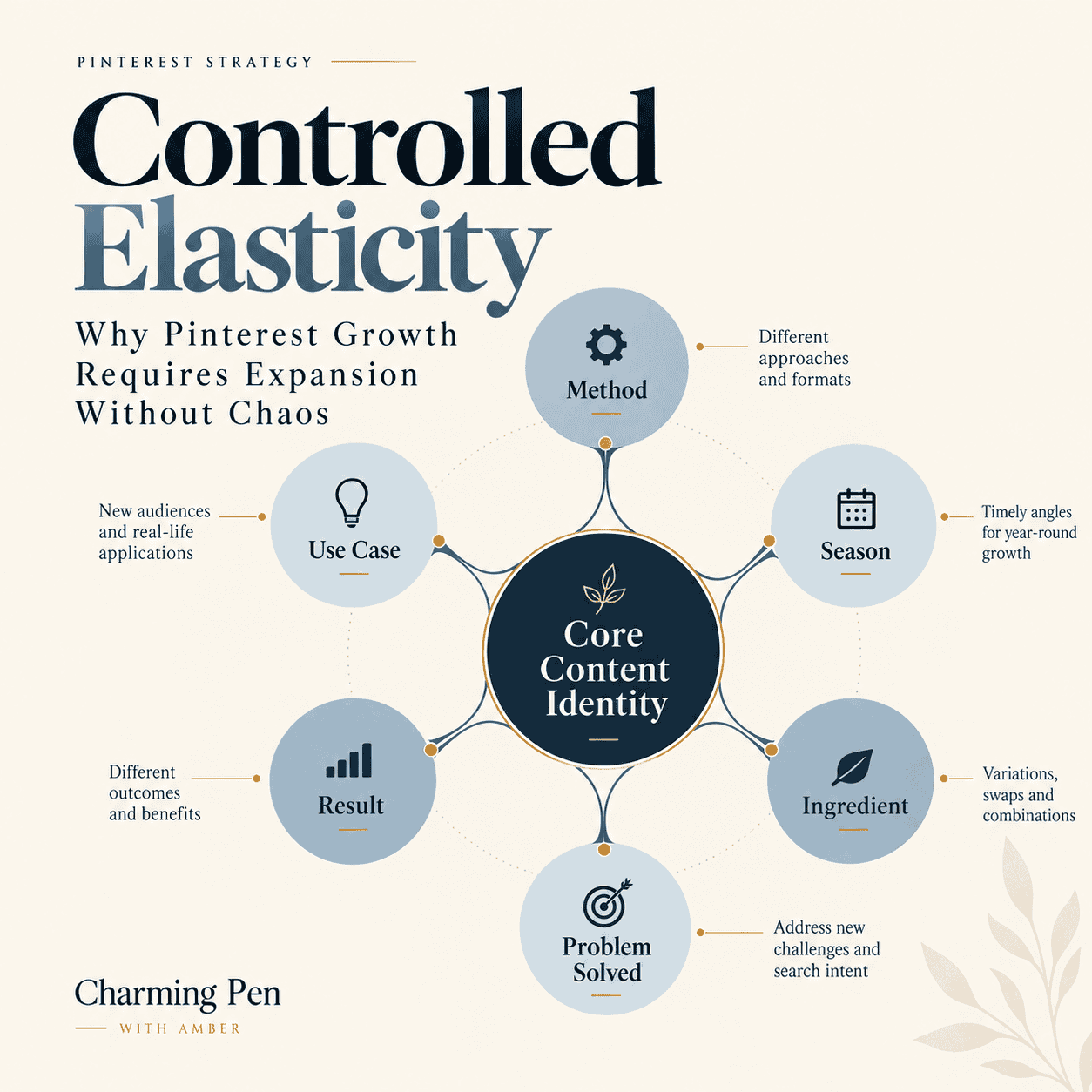
Some retrieval pathways move vertically by reinforcing broader versions of the same topic. A recipe for protein pancake bowls may eventually appear for searches involving high-protein breakfasts, healthy breakfast ideas, or meal prep breakfasts because those concepts expand naturally from the original entity.
Other pathways expand horizontally into related but distinct user intents. These pathways should remain closely connected to the original topic rather than introducing unrelated concepts that compete with the page’s identity.
Successful Pinterest strategies balance both forms of expansion.
Vertical retrieval strengthens authority around the primary topic.
Horizontal retrieval broadens visibility without changing what the page fundamentally represents.
When expansion remains consistent with the original entity, Pinterest gains confidence. When new pins introduce conflicting primary topics or unrelated search intent, classification becomes less stable and distribution may slow while Pinterest reassesses the content.
Layer 2: Behavior-Based Reinforcement (Home Feed Growth)
Once a pin has been categorized, Pinterest begins observing user behavior more closely.
This includes:
- Saves via the save button
- Pin clicks
- Click-through rates
- How often the pin is interacted with relative to exposure
Behavior does not replace classification in Pinterest pin distribution. It confirms and strengthens it.
When Pinterest users save a pin in context, that signals relevance. When saves scale proportionally to impressions, testing pools expand. When click-through rates remain stable as impressions rise, reinforcement increases.
This is how popular pins emerge.
Video pins and Idea Pins follow the same Pinterest pin distribution logic — classification first, then reinforcement — even though their engagement patterns may differ from static pins.
Pinterest pin distribution expands when engagement signals from Pinterest users align with the original classification signals.
Higher engagement from Pinterest users increases the size of the testing pool and expands Pinterest pin distribution. Larger testing pools create more consistent distribution. Over time, this creates a reinforcement loop.
This is why mature accounts behave differently.
Why Mature Accounts Can “Break the Rules”
Mature Pinterest accounts operate with accumulated engagement history.
They have:
Popular pins
Established audience insights
Broader testing pools
Stronger baseline visibility
Because their Pinterest analytics show repeated reinforcement over time, new pins from these accounts enter testing pools that are already larger.
Accounts operating under a Pinterest business account often see clearer analytics data, which makes diagnosing Pinterest pin distribution patterns easier.
That does not mean they can ignore relevant keywords or board alignment. It means variation is less destabilizing.
When a mature account experiments with creative framing or fresh content angles, reinforcement capital absorbs some instability.
New accounts do not have that cushion.
Sudden traffic drops often reflect distribution resets rather than algorithm penalties.
Why New Accounts Must Be Literal
New accounts rely heavily on classification stability.
Testing pools are small. Fresh content must be tightly aligned to one specific topic. Relevant pins should reinforce each other rather than scatter across multiple directions.
If you publish new content across completely different themes each week, Pinterest has no consistent pattern to classify.
For example, if you post:
- DIY projects one week
- Affiliate marketing tips the next
- A recipe blog post after that
- Then a random mindset quote
your Pinterest account sends mixed signals.
Instead of reinforcing one specific topic, you’re asking the platform to categorize you in multiple directions at once.
On a mature account with strong nodes, that variation may be absorbed. On a new account, it slows distribution because Pinterest can’t confidently group your content into a stable classification pattern.
Precision matters more than volume.
Fresh pins on new accounts should:
- Target one clearly defined topic per URL
- Use consistent relevant keywords
- Be pinned to specific boards that match the intent
- Avoid unnecessary creative drift in framing
This does not mean a food blog must publish only pasta for months.
It means each piece of content should stay internally consistent.
For example:
If you publish a pasta recipe, reinforce that pasta recipe through:
- Variations of the same angle
- Supporting pins tied to that specific topic
- Boards that match the dish category
Then your next recipe can target a different lane — but it should also stay internally stable within its own classification.
On new accounts, distribution expands through repetition of consistent signals within a topic.
Not randomness across unrelated directions.
Why A/B Testing Feels Different by Account Age
Many creators run tests and assume inconsistency means failure.
It doesn’t.
On new accounts, specific pins will fluctuate more because testing pools are small. A minor change in user behavior can dramatically affect pin stats.
On mature accounts, testing pools are larger. Key metrics stabilize faster because reinforcement history increases tolerance for variation.
If you are comparing your pin stats to someone with an older Pinterest account, you are not comparing equal conditions.
Testing size determines volatility.

How to Diagnose Which Layer Is Driving Your Growth
Use Pinterest analytics deliberately.
If you’re troubleshooting performance, reviewing why your Pinterest pins aren’t getting views can help identify classification issues early.
Ask:
- Are fresh pins getting impressions but no saves? That suggests classification without reinforcement.
- Are older popular pins driving most Pinterest traffic? That suggests reinforcement dominance.
- Are duplicate pins splitting impressions? That may indicate fragmented signals.
- Are relevant boards consistent across related content? If not, classification may be unstable.
- Are click-through rates steady as impressions rise? That indicates reinforcement scaling.
Audience insights can confirm whether your target audience matches the topic you believe you’re serving.
Distribution becomes predictable when classification and behavior align.
Inside Pinterest analytics, you can often see this progression clearly: fresh pins gain impressions in search results first, then reinforcement increases saves, pin clicks, and overall distribution.

What This Means for Your Pinterest Strategy
Pinterest pin distribution is more predictable than it first appears.
The platform begins by identifying the primary entity behind your content through the combined signals it receives from your page, images, boards, metadata, and user interactions.
Once that entity is understood, Pinterest classifies it into appropriate search environments where early testing begins.
User behavior then reinforces—or weakens—that initial classification. Saves, clicks, engagement, and continued relevance all help Pinterest determine whether distribution should expand.
As confidence grows, Pinterest broadens retrieval through additional search pathways while still preserving the original identity of the content.
For creators, this means sustainable Pinterest growth comes from reinforcing a clear topic before attempting to expand into adjacent ones.
Classification creates understanding.
Reinforcement builds confidence.
Consistent retrieval expands reach.
Viewed together, these three stages provide a more complete explanation of how Pinterest distributes content over time.
Frequently Asked Questions About Pinterest Pin Distribution
When both layers align, Pinterest pin distribution compounds.
When they conflict, testing repeats.
That is the difference between visible growth and stalled movement.