Last tested: September 18, 2026
Well, this is interesting.
Pinterest is testing a new Pinterest Business Assistant, and I recently got access to the beta on my account.
Naturally, I started asking it questions.
Lots of questions.
And because I work as a Pinterest strategist and manage Pinterest accounts for clients, one of the first things that crossed my mind was:
Where does Pinterest Business Assistant leave people like me?
Is Pinterest building an AI tool that could eventually do the work of a Pinterest manager?
After spending some time testing it, my answer right now is no.
Not even close.
But after Pinterest published more information about Business Assistant on September 18, I think there is an important distinction to make.
Pinterest Business Assistant is currently being built primarily as an advertising assistant—not as an organic Pinterest strategist.
That explains quite a lot about what I saw when I tested it.
And it also makes the future of this tool even more interesting.
What Is Pinterest Business Assistant?
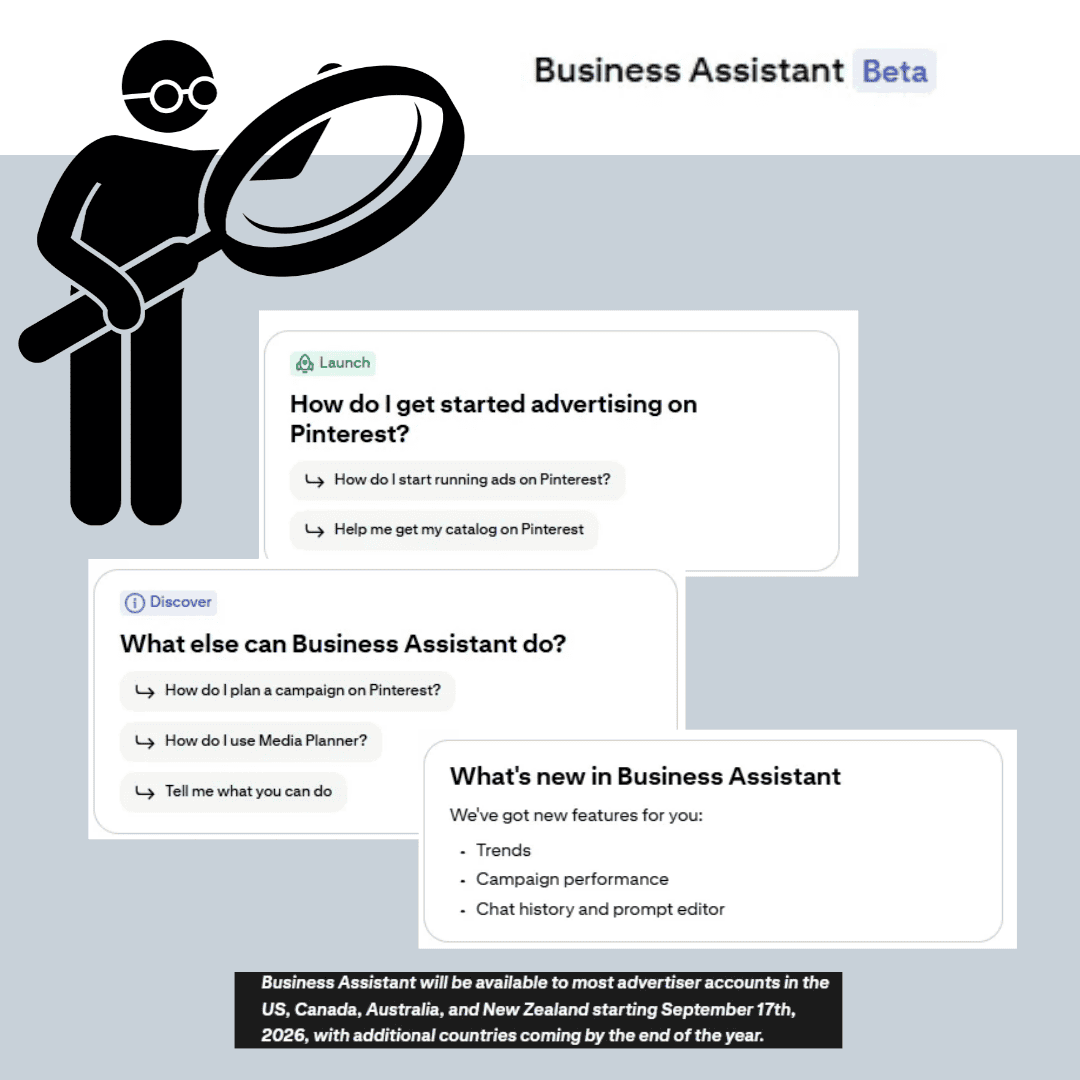
Pinterest describes Business Assistant as a new conversational AI tool for advertisers.
According to the Pinterest Business Community announcement, Pinterest began making Business Assistant available to most advertiser accounts in the United States, Canada, Australia and New Zealand starting September 17, 2026, with additional countries expected later in the year.
My own interface is still labelled Beta, which is certainly how the experience feels.
Pinterest describes Business Assistant as an intelligent, collaborative partner designed to help advertisers understand performance, decide what to do next and take action more confidently.
That wording matters.
This isn’t being introduced as:
“Ask us how to grow your organic Pinterest traffic.”
It is being introduced inside the advertising ecosystem.
And once I looked at it through that lens, many of the limitations I found made considerably more sense.
What Can Pinterest Business Assistant Actually Do?
Pinterest now provides a fairly detailed list of its capabilities.
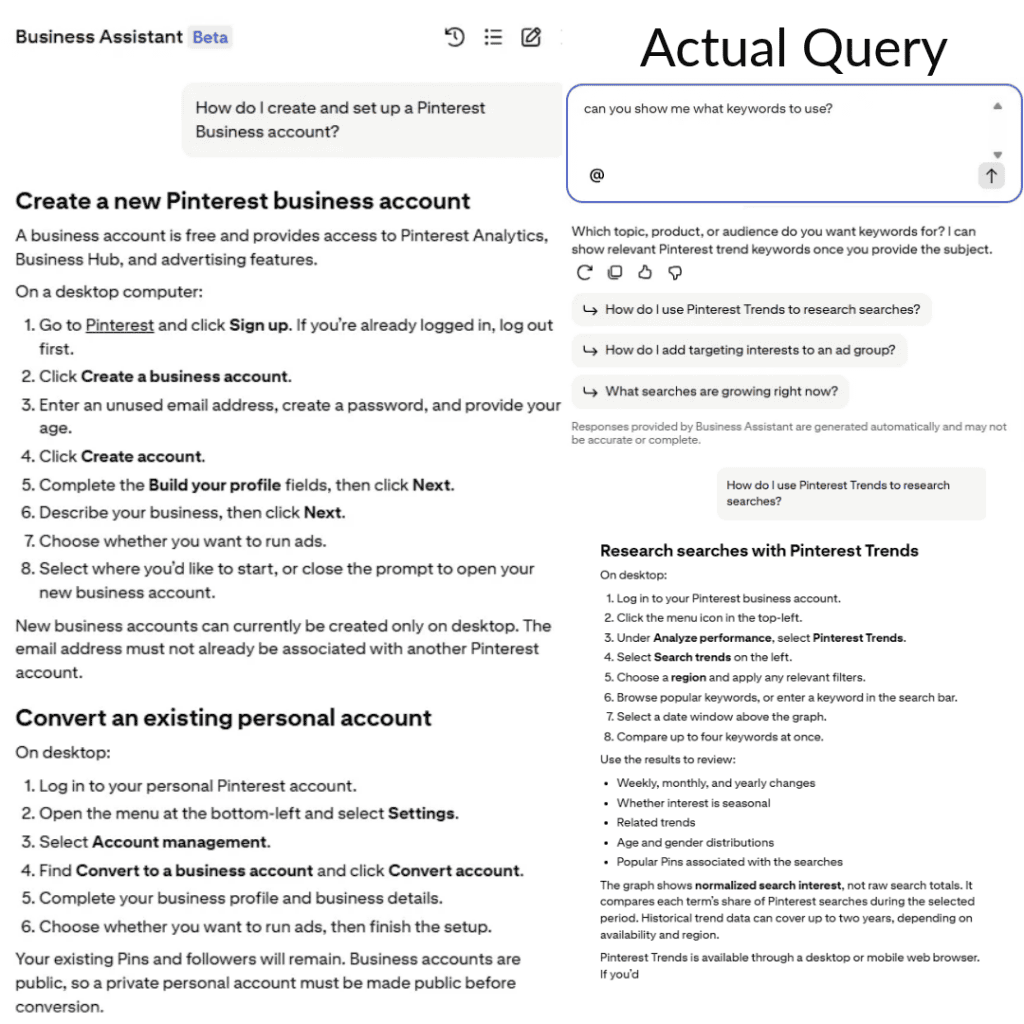
Business Assistant can currently help with areas including:
- account and campaign setup
- targeting
- advertising formats
- advertising performance
- catalogs and feeds
- shopping ads
- Pinterest Tag setup
- conversion measurement
- Event Quality Score
- campaign reporting
- Pinterest Trends
- merchant and catalog onboarding
- ad troubleshooting
- A/B testing
- billing and advertising policies
- advertising best practices
It can also save conversation history so you can return to previous discussions.
Advertisers can reference specific campaign entities inside a conversation, allowing Business Assistant to answer questions using the context of a particular campaign, ad group or ad.
That’s actually quite useful.
If you’re running Pinterest ads, I can see how Business Assistant could become a valuable tool.
But this is also where the difference between advertising assistance and organic Pinterest strategy becomes very obvious.
Pinterest Business Assistant Can’t Access My Organic Analytics
One of the first questions I asked was:
How is my content performing on Pinterest?
Business Assistant told me:
Pinterest Analytics performance metrics aren’t available here yet.
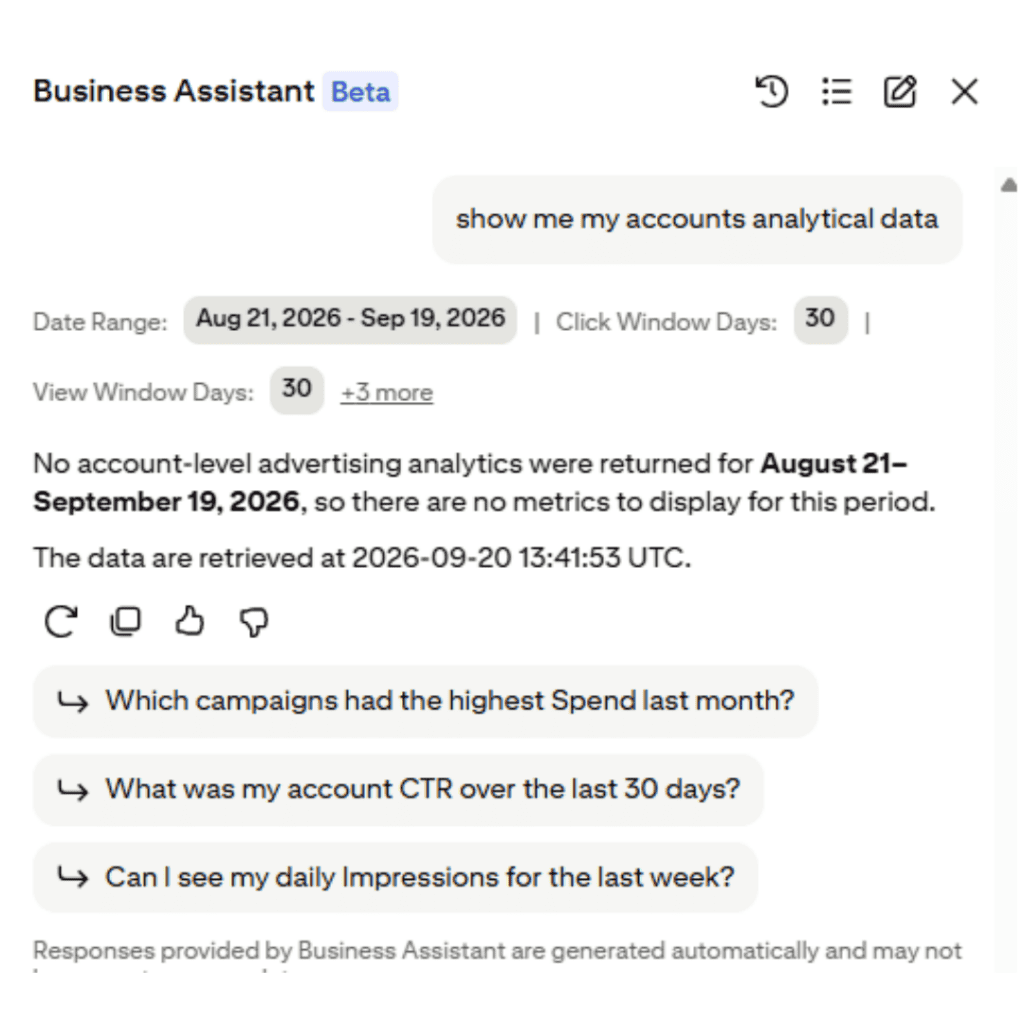
It could look at advertising performance.
It couldn’t analyze the organic Pinterest content I manage every day.
That means it couldn’t examine my organic impressions, saves, outbound clicks, audience insights or board performance.
I then asked:
Why are my impressions down when my outbound clicks are up?
Again, Business Assistant couldn’t investigate my organic data.
Instead, it offered to check whether the same pattern existed in my advertising performance.
That is a very important distinction.
There’s a difference between an AI being able to explain what could cause a metric to change and being able to investigate an account and determine what is actually happening.
For organic Pinterest strategy, I need the second.
And This May Be About Scope, Not Just Beta Limitations
Originally, I looked at the lack of organic Analytics and thought:
Well, it’s early. They’ll probably add it.
They still might.
Pinterest also says it is continually adding new capabilities.
But its September announcement makes me less certain that deep organic analysis is actually the immediate goal.
Business Assistant is specifically being positioned toward advertisers.
Even Pinterest’s troubleshooting capabilities are currently described as being limited to campaign delivery and spend diagnostics.
So I don’t think we should look at Pinterest Business Assistant today as an unfinished organic Pinterest manager.
It may simply be a different product.
That’s important for bloggers, creators and businesses primarily using Pinterest to generate organic outbound traffic.
Right now, Business Assistant doesn’t replace the work being done there.
Pinterest Even Lists Things Business Assistant Won’t Do
This was one of the most interesting parts of Pinterest’s announcement.
Pinterest doesn’t only tell us what Business Assistant can do.
It tells us what it can’t do.
That list currently includes:
- account-specific decisions or changes
- detailed backend investigations
- non-standard billing or policy exceptions
- legal or contractual questions
- competitor research
- out-of-policy or non-Pinterest advertising topics
That immediately puts some boundaries around the tool.
And several of those boundaries overlap directly with areas where human strategic judgment becomes important.
Competitor research, for example, is explicitly excluded.
That is also an area where a Pinterest strategist can still add real value. I offer competitor research as part of my Pinterest services, using additional research tools and public Pinterest data to look at what competing accounts and content are doing, where opportunities may exist, and how that information can inform a stronger strategy.
Business Assistant may be able to tell you more about your own advertising performance, but competitor analysis still requires looking outside the assistant, gathering the right information and then deciding what is actually useful for your account.
Business Assistant is also explicitly excluded from making account-specific decisions or changes.
That is another important distinction between an assistant and a strategist.
I offer Pinterest optimization and strategy services specifically for this kind of work: reviewing what is happening on an account, identifying where improvements may be needed, deciding what should be changed and what should be left alone, and building a strategy around the actual history and needs of that account.
Business Assistant may be able to provide guidance, but it is not currently making those account-level decisions for you.
That still requires someone to look at the full picture, weigh the evidence, and decide what makes the most sense for the business.
Business Assistant can give information and recommendations.
It doesn’t take over responsibility for the account.
I Tested Its Pinterest Trends Capabilities Too
Because my work involves organic Pinterest strategy, I naturally wanted to know how useful Business Assistant could be for trend and keyword research.
So I asked:
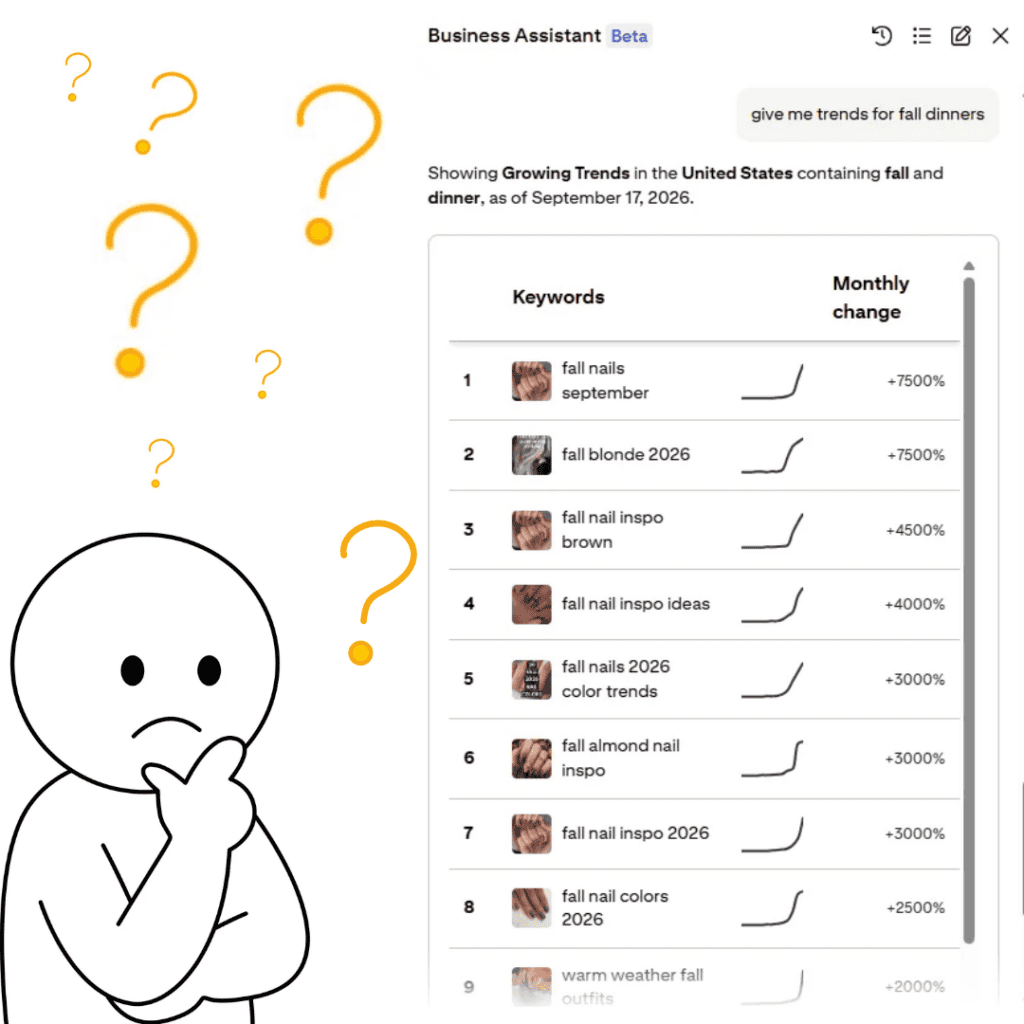
Give me trends relating to fall dinners.
The results?
- Fall nails.
- Fall blonde hair.
- Fall nail colours.
- Halloween nails.
- Western nails.
Not a fall dinner in sight.
I tried again with a broader request for the top monthly Food and Drinks trends and received more useful results, including terms such as:
- crockpot meals
- easy dinner recipes
- lunch ideas
- dinner recipes
- healthy dinner recipes
- meal prep ideas
Then I asked for something more specific:
Give me keywords for blueberry muffins.
Business Assistant told me that Pinterest Trends had no growing keyword results for blueberry muffins in the United States at that time.
Technically, that answered the request.
Strategically?
It wasn’t especially useful.
Why This Isn’t Close to the Pinterest Research I Do
This is where I think it’s important to distinguish access to Pinterest data from Pinterest strategy.
If I’m researching a recipe, article or other piece of content for Pinterest, I’m not simply asking whether its exact keyword appears on a current growing-trends list.
I’m looking at the entire retrieval environment around the content.
Depending on the account and article, that can include:
- the exact content identity
- primary Pinterest search terminology
- related searches
- Pinterest annotations
- broader and narrower search relationships
- seasonal retrieval opportunities
- historical keyword information
- historical content performance
- board context
- visual positioning
- Pin creative
- search intent
- URL history
- existing semantic associations
- competing content
- whether a new Pin should reinforce an existing topic or legitimately expand it
Then I have to decide what all of that means.
That’s a very different process from entering a keyword and receiving a list of trends.
And it requires something much harder to automate:
Judgment.
Pinterest Business Assistant Is Still Worth Watching Closely
None of this means I think Business Assistant is insignificant.
Quite the opposite.
Pinterest has something no outside Pinterest tool has:
Pinterest’s own information.
That gives Business Assistant enormous potential within whatever boundaries Pinterest chooses to give it.
Pinterest says the tool uses official sources and Pinterest insights rather than relying on generic advice.
It is designed to help advertisers understand not only what is happening, but also the why and how behind performance.
That’s where things get interesting.
If Pinterest continues expanding that type of reasoning, Business Assistant could become an exceptionally useful first-party tool.
And if Pinterest ever extends similar capabilities deeply into organic Analytics, that could have significant implications for Pinterest marketers and managers.
Imagine being able to ask:
Which URLs on my site lost organic distribution this month?
Or:
What Pinterest topics are associated with this recipe?
Or:
Which search queries are bringing people to this URL?
Or:
Why is this older Pin gaining distribution while my new Pin for the same article isn’t?
Or:
Which boards are helping Pinterest understand this content?
Or:
What changed before my outbound traffic started falling?
Those would be extraordinarily useful questions.
But we’re a long way from that today.
And I’m not convinced Pinterest would necessarily answer every one of them even if the technology eventually could.
Would Pinterest Ever Give Us Every Organic Answer?
This is where I think the bigger strategic question begins.
Pinterest has several interests to balance.
It wants creators, publishers, merchants and advertisers to succeed.
If people get results from Pinterest, they have a reason to continue creating content, uploading products, managing accounts and spending money on the platform.
But Pinterest also operates a recommendation system.
And Pinterest sells advertising.
So I have a hard time imagining Pinterest eventually handing every business account a completely transparent blueprint for maximizing organic outbound traffic.
To be very clear:
This is my own strategic interpretation. Pinterest has not said this.
But think about what complete transparency would mean.
Imagine being able to ask:
Exactly why is another piece of content outranking mine?
Which ranking signals should I change?
Which keywords will give this URL maximum organic distribution?
Which Pin should I publish next to generate the greatest possible outbound traffic?
What exact changes will allow me to outperform competing content?
If Pinterest could reliably answer questions at that depth, it would give marketers extraordinary visibility into a recommendation system Pinterest also needs to protect.
And we now know that Pinterest currently draws some explicit boundaries.
Competitor research is one of them.
Detailed backend investigations are another.
That doesn’t mean those limitations will never change.
But it does demonstrate that Pinterest is already making choices about what Business Assistant should and shouldn’t reveal.
There Is Also an Advertising Question
Then there is the commercial side.
Pinterest makes money from advertising.
I don’t think that means Pinterest wants organic publishers to fail.
That wouldn’t make much sense either.
Organic content is part of what makes Pinterest useful and keeps people using the platform.
But there’s still an obvious tension between helping businesses succeed organically and handing everyone a detailed roadmap for extracting the maximum amount of free outbound traffic possible.
There is a substantial difference between telling someone:
“Slow cooker meals are trending.”
and telling them:
“Here is exactly how our recommendation system views your content, why another publisher has greater distribution and precisely what you need to change to outrank them.”
The first helps marketers.
The second exposes considerably more of the machinery behind Pinterest.
I would be surprised if Pinterest ever went completely that far.
Pinterest Also Has to Protect Its Recommendation System
Advertising isn’t the only reason for maintaining some opacity.
If Pinterest published every signal and precisely how much each signal mattered, marketers would immediately optimize specifically for those signals.
Then you’re no longer necessarily optimizing for what Pinterest users want.
You’re optimizing for the algorithm.
Any recommendation platform has an incentive to prevent that system from becoming too easy to manipulate.
And Pinterest isn’t static anyway.
Search behaviour changes.
Competition changes.
Seasonality changes.
Creative performance changes.
Trends change.
Individual accounts develop different histories.
Pinterest changes its own systems.
Something that works extremely well on one account may behave very differently on another.
There may never be one universal answer.
That’s where critical thinking remains important.
So Where Does Business Assistant Leave Pinterest Managers?
Right now?
With plenty to do.
There is an enormous difference between having information and running a Pinterest account successfully.
Even if Business Assistant tells a business owner:
Slow cooker dinner searches are increasing.
Someone still has to decide whether that opportunity makes sense for the website.
Someone has to determine which content fits it.
Someone has to decide whether an existing article needs updating.
Someone has to research the opportunity.
Someone has to determine the positioning.
Someone has to create the Pin.
Someone has to write the title and description.
Someone has to determine the appropriate board context.
Someone has to publish it.
Someone has to monitor what happens.
Someone has to recognize when Pinterest doesn’t respond as expected.
And someone has to determine what happens next.
Pinterest now explicitly says Business Assistant won’t make account-specific decisions or changes for you.
That’s a pretty significant distinction.
Many Businesses Don’t Want to Manage Pinterest Anyway
There is another very practical piece that sometimes gets lost in discussions about AI replacing service providers.
Business owners already have access to:
- Pinterest Analytics.
- Pinterest Trends.
- Canva.
- Scheduling platforms.
- Tutorials.
- Free marketing articles.
- Pinterest documentation.
- AI assistants.
That doesn’t mean they want to spend their time running Pinterest.
A significant part of Pinterest management isn’t access to information.
It’s doing the work.
Research has to happen.
Creative has to be produced.
Content has to be scheduled.
Results need to be monitored.
Strategy needs to evolve.
For many businesses, handing them another tool doesn’t solve their original problem:
They don’t have the time or desire to manage another marketing channel.
What Is the Job of a Pinterest Strategist in an AI World?
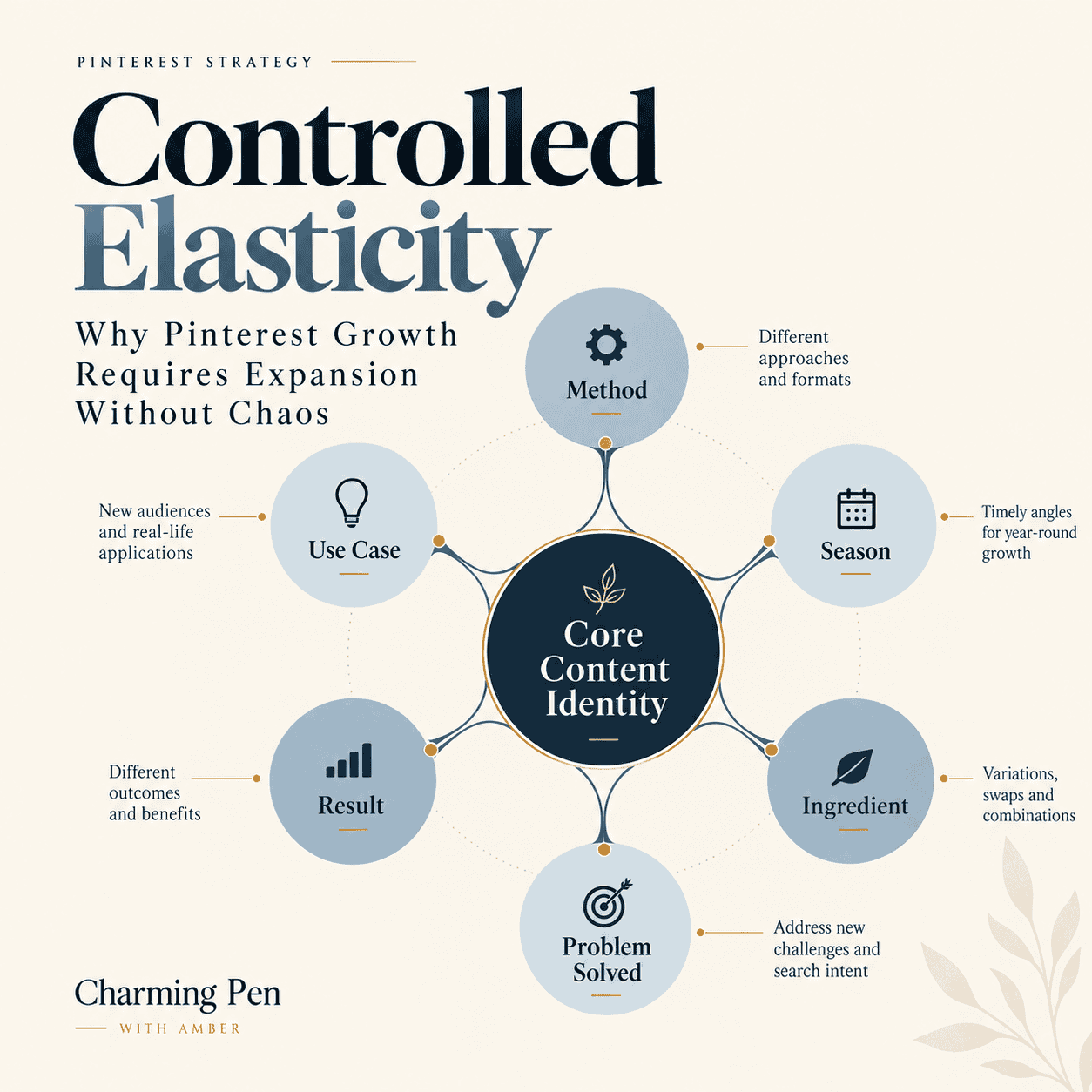
For me, being a Pinterest strategist has never meant memorizing a fixed list of Pinterest rules and repeating them indefinitely.
That wouldn’t be strategy.
My job is to continually educate myself, test when testing is warranted, refine where appropriate and make sound choices for my clients.
Pinterest changes, so I have to keep learning.
When new tools appear, I investigate them.
Business Assistant itself is a perfect example.
It appeared on my account.
I tested it.
I pushed it beyond the obvious questions.
I looked at what it could access.
I looked at what it couldn’t access.
Then Pinterest released additional information about the tool, and I adjusted my own understanding of what it appears to be designed to do.
That’s part of strategy too.
You don’t decide what something means once and then defend that position forever.
You learn. Test. Observe. Refine.
When Pinterest behaviour changes, I pay attention.
When I develop a theory, I look for evidence.
When testing is warranted, I test it.
When the evidence doesn’t support the hypothesis, I refine it.
And when the evidence suggests leaving something alone, that’s a strategic decision too.
Not every fluctuation requires action.
Not every new feature requires a new strategy.
Not every trend belongs on every account.
Not every high-volume keyword is the right keyword.
More information doesn’t eliminate the need for judgment.
I Will Absolutely Use Business Assistant If It Helps Me
I’m certainly not opposed to Pinterest Business Assistant because it’s AI.
If the tool gives me useful first-party Pinterest information, I’ll use it.
Why wouldn’t I?
If it helps identify trends faster, exposes useful performance information, helps troubleshoot something or gives me another piece of evidence to consider, that makes it another tool in my workflow.
A strategist’s value shouldn’t depend on refusing to use technology that makes the work better.
The value is knowing how to use the information appropriately.
Because access to information doesn’t automatically answer:
- which information matters
- whether it applies to this particular account
- whether a pattern is significant or noise
- whether the recommendation fits the business
- when to test
- what to test
- what not to change
- how long to allow a test to develop
- when the evidence supports the hypothesis
- when it doesn’t
- and what to do next
Pinterest Business Assistant may become exceptionally good at telling marketers what Pinterest knows.
My job as a strategist is deciding what to do with that information.
Where AI Probably Does Change Pinterest Management
There are areas of Pinterest management that I absolutely think AI will make harder to sell.
Basic information is one.
Things like:
“Put relevant keywords in your Pin title.”
“Create vertical Pins.”
“Save the Pin to a relevant board.”
“Use Pinterest Trends.”
That information is increasingly easy to obtain.
Business Assistant already gives fairly standard recommendations about titles, descriptions, boards, landing-page relevance, trends and creative best practices.
That isn’t where a professional Pinterest strategist should be creating most of their value anyway.
Basic reporting may eventually change too.
Within advertising, Pinterest is already positioning Business Assistant as a way to understand campaign performance and receive personalized recommendations.
If that capability eventually becomes equally strong for organic Pinterest Analytics, then simply putting numbers into a report becomes considerably less valuable.
The value needs to move higher.
From reporting numbers to interpreting them.
From finding keywords to understanding retrieval opportunities.
From following Pinterest tips to building strategy.
From making Pins to understanding what should be tested and why.
And from telling a business what to do to actually managing the work.
More Information May Actually Make Strategy More Important
There’s another possibility.
AI may eventually give business owners access to considerably more information.
But more information doesn’t automatically create better decisions.
Sometimes it creates more noise.
Imagine having:
- Pinterest Analytics.
- Pinterest Trends.
- Business Assistant.
- AI recommendations.
- Website analytics.
- Keyword tools.
- Competitor observations.
- Historical Pin performance.
- Dozens of metrics.
- Several platforms.
And several different tools telling you several different things.
Someone still has to decide what matters.
A strategist isn’t supposed to react to everything a dashboard shows.
We’re supposed to determine what’s meaningful.
What I’m Watching Next
Pinterest says it is adding new capabilities to Business Assistant, so I don’t consider what I’m testing today the finished product.
But I now think there are two separate questions worth watching.
The first is:
How sophisticated will Pinterest Business Assistant become within advertising?
Pinterest already wants it to help advertisers understand performance, optimize campaigns, investigate trends and decide what to do next.
That’s significant.
The second question is even more interesting to me:
Will Pinterest eventually extend this type of first-party AI analysis deeply into organic Pinterest?
That’s when the implications for bloggers, creators and organic Pinterest managers become much larger.
If that happens, I’ll want to know:
Does it simply summarize metrics?
Can it recognize patterns across Pins?
Can it understand different Pins pointing to the same URL?
Can it explain distribution changes?
Can it surface useful search and topic associations?
Can it distinguish seasonality from account problems?
Can it understand the history of an individual account?
Can it determine when its own recommendation shouldn’t be followed?
And how much information will Pinterest actually choose to reveal?
Those are very different levels of capability.
Is Pinterest Business Assistant Replacing Pinterest Managers?
Not today.
And based on Pinterest’s own description of what Business Assistant currently does, I don’t think that’s what this version of the product is trying to do.
It’s an AI assistant for advertisers.
For advertisers, it could become a very useful one.
For organic Pinterest management, the current product doesn’t come remotely close to replacing the research, interpretation, critical thinking and execution involved in managing an account.
Could that change?
Absolutely.
That’s why I’m paying attention.
But my responsibility as a strategist isn’t to worry every time a new tool arrives.
It’s to understand the tool.
Test it.
Figure out where it helps.
Recognize where it doesn’t.
Refine my process where appropriate.
And continue making sound strategic choices for the businesses that trust me with their accounts.
The tools will change.
Pinterest will change.
AI will change.
The need for critical thinking, informed judgment and good execution doesn’t disappear with them.
And I’ll continue testing Pinterest Business Assistant as it evolves.
If you need help with your Pinterest account, I’m available to chat. Whether you’re trying to understand what’s happening with an existing account, need a stronger Pinterest strategy or simply want someone to take the day-to-day management off your plate, get in touch and we can talk about what your account needs.