Pinterest search has never been quite the same as Google search.
People aren’t always arriving with a perfectly formed question. They might begin with pumpkin muffins, click a few Pins, refine what they’re looking for, save an idea and eventually end up looking for easy pumpkin muffins for breakfast.
Pinterest has to understand all of those signals while deciding which Pins are relevant enough to retrieve and ultimately show.
A recent Pinterest Engineering update gives us an interesting look at how that process may become considerably more precise.
Pinterest is piloting multi-vector Late Interaction retrieval within Manas, its large-scale retrieval infrastructure. Manas supports retrieval systems used across Pinterest surfaces including Search, Home Feed and Related Pins.
The important part for Pinterest creators isn’t the technical terminology.
It’s what Pinterest is trying to accomplish:
Understand more of the information contained inside a query instead of reducing everything to one broad topic.
And I think that should change the way we think about Pinterest search strategy and keyword research.
Pinterest Is Moving Toward More Precise Retrieval
Imagine someone searches:
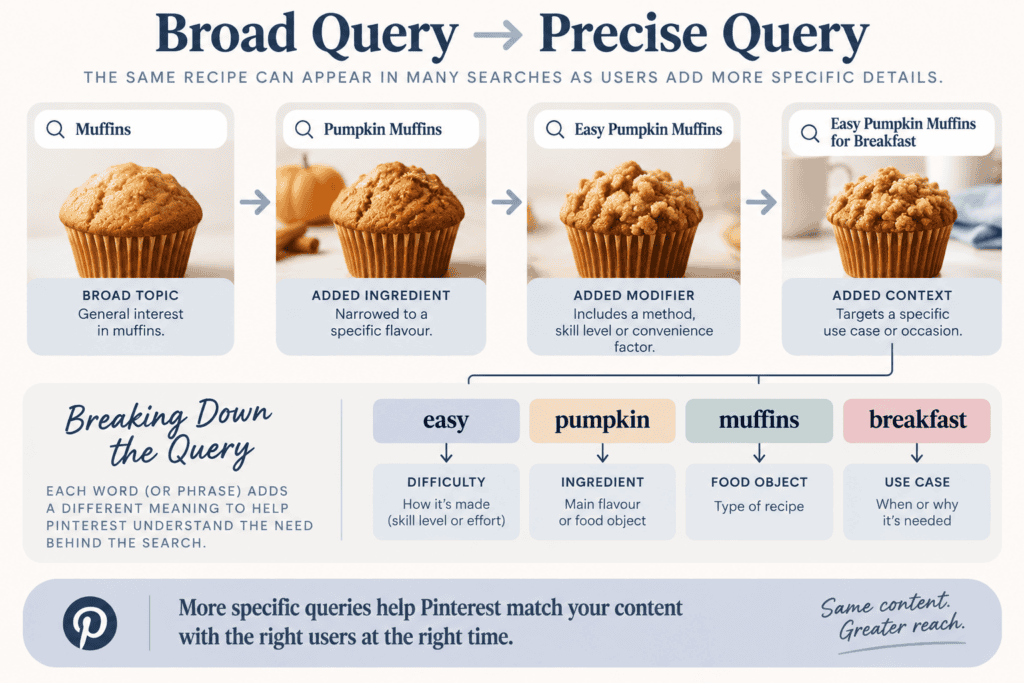
Easy pumpkin muffins for breakfast
There is an obvious primary food object:
Pumpkin muffins
But the rest of the query matters.
Easy tells us something about the desired method or difficulty.
Breakfast tells us something about the intended use.
A system that primarily understands the broad topic could effectively interpret the search as pumpkin muffin recipe.
Pinterest’s experimental Late Interaction approach is designed to preserve more granular information from different components of a query and compare those representations against potential results.
That could eventually make the difference between Pinterest understanding:
Pumpkin muffins
And understanding:
easy + pumpkin + muffins + breakfast
Pinterest describes this implementation as a production pilot, so this should not be interpreted as confirmation that every Pinterest search is currently ranked this way.
But it gives us an important indication of where Pinterest’s retrieval technology is heading.
And it raises a much bigger strategic question.
Maybe We’ve Been Thinking About Modifiers the Wrong Way
Keyword research tends to treat modifiers as words we attach to a primary keyword.
We find:
pumpkin muffins
And then start looking for variations:
- easy pumpkin muffins
- moist pumpkin muffins
- pumpkin breakfast muffins
- freezer-friendly pumpkin muffins
Technically, those are keyword variations.
But there’s another way to look at them.
Every modifier answers a question about the content.
That’s a much more useful way to think about Pinterest.
Instead of asking:
What other keywords can I attach to pumpkin muffins?
I can ask:
What questions can this pumpkin muffin recipe truthfully answer?
Suddenly the potential search landscape becomes much larger—and much more organized.
Start With Who, What, Where, When, Why and How
This is actually where I started thinking about Pinterest permeation years ago.
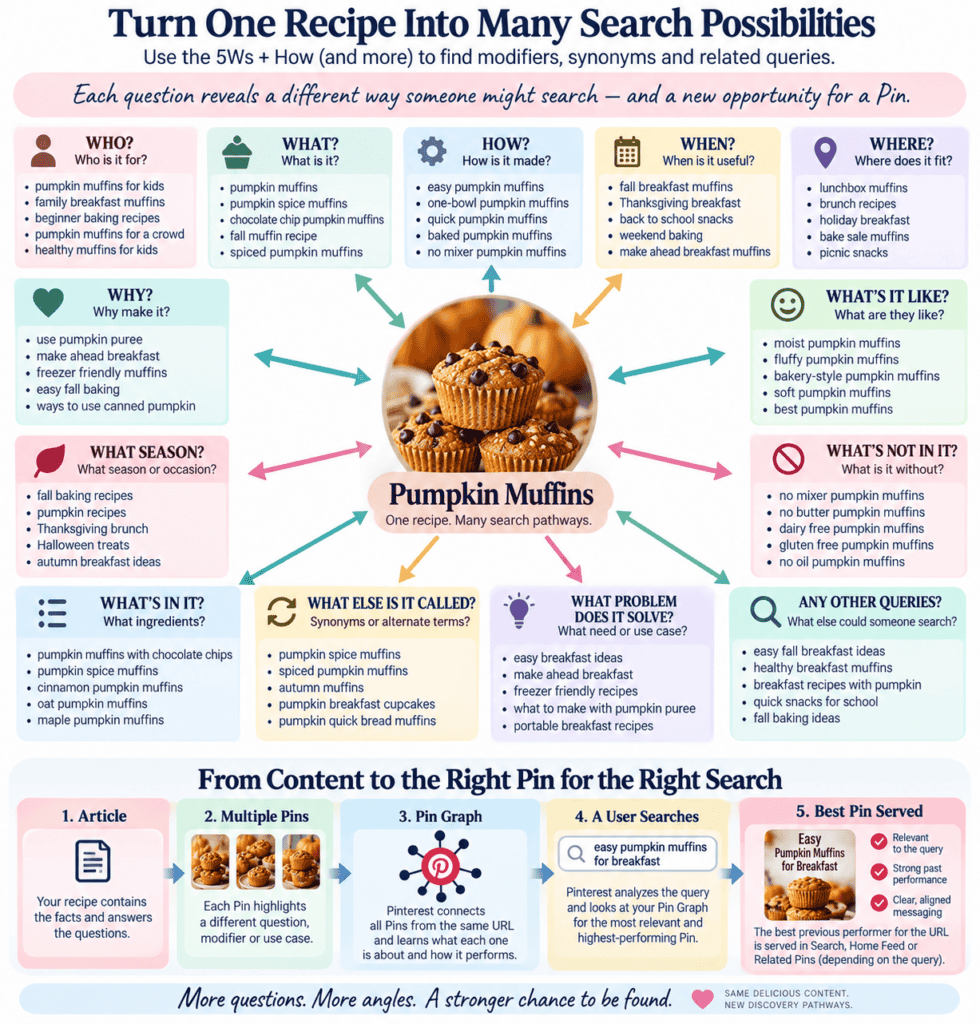
The traditional 5Ws + How provide a remarkably useful framework for discovering how one piece of content can satisfy different Pinterest searches.
Take a pumpkin muffin recipe.
What is it?
This establishes the primary entity and its closest variations.
Pumpkin muffins
Pumpkin spice muffins
Pumpkin chocolate chip muffins
The article itself determines which are legitimate.
How is it made?
Now we’re looking at method, difficulty and process.
- Easy pumpkin muffins
- One-bowl pumpkin muffins
- Quick pumpkin muffins
- No-mixer pumpkin muffins
Again, only when those statements are actually true.
When would someone want it?
This opens temporal and seasonal intent.
- Fall breakfast
- Thanksgiving breakfast
- Weekend baking
- Back-to-school snack
A recipe can be the same food object while solving very different needs throughout the year. This also fits with Pinterest’s work on personalized interest clusters, where the same piece of content can serve different use cases depending on the individual user’s interests and behaviour.
Where does it fit?
For food content, “where” often means context rather than literal geography.
- Lunchbox muffins
- Brunch recipes
- Bake sale muffins
- Holiday breakfast
These can represent entirely different discovery pathways.
Who is it useful for?
Depending on the recipe, this could reveal additional supported queries:
- Muffins for kids
- Family breakfast recipes
- Beginner baking recipes
This category needs particular care. We shouldn’t manufacture an audience simply because there’s search volume for it.
The article has to support the claim.
Why would someone make it?
This may be one of the most valuable questions.
Perhaps someone wants to:
use leftover pumpkin puree
or needs:
a make-ahead breakfast
or:
a freezer-friendly breakfast
They’re not necessarily searching for our recipe.
They’re searching for a solution.
Our recipe happens to be one possible answer.
But We Don’t Have to Stop at the 5Ws
This is where I think Pinterest keyword research becomes much more interesting.
The original Who / What / Where / When / Why / How framework still works.
We can simply keep asking questions for as long as the content provides legitimate answers.
What’s it like?
This reveals attributes and sensory modifiers.
- Moist pumpkin muffins
- Fluffy pumpkin muffins
- Soft pumpkin muffins
- Bakery-style pumpkin muffins
What’s in it?
Ingredient combinations create another set of possible searches.
- Pumpkin muffins with chocolate chips
- Cinnamon pumpkin muffins
- Pumpkin spice muffins
What’s not in it?
Absence can be meaningful too.
- No-mixer pumpkin muffins
- Pumpkin muffins without butter
But this is an area where accuracy becomes especially important.
A high-volume keyword doesn’t give us permission to attach a dietary restriction or ingredient exclusion that the recipe doesn’t actually meet.
What else might someone call it?
Now we’re dealing with synonym and vocabulary expansion.
People don’t necessarily describe the same thing in the same way.
Pinterest may encounter alternate terminology, regional language, singular/plural variations and different ways of constructing essentially the same request.
That means another useful question during research is:
Is there another way someone might say this?
But synonyms don’t necessarily create a new intent.
They may simply provide another linguistic route to approximately the same thing.
That distinction matters.
Synonym Expansion and Intent Expansion Aren’t the Same
Suppose we have:
- Pumpkin muffins
- Pumpkin spice muffins
- Spiced pumpkin muffins
Depending on the recipe, those could be alternate ways of describing essentially the same food object.
That’s lexical expansion.
Now compare:
- Pumpkin muffins
- Make-ahead breakfast muffins
- Freezer-friendly breakfast
- Fall breakfast ideas
- What to make with pumpkin puree
We’ve moved beyond alternate wording.
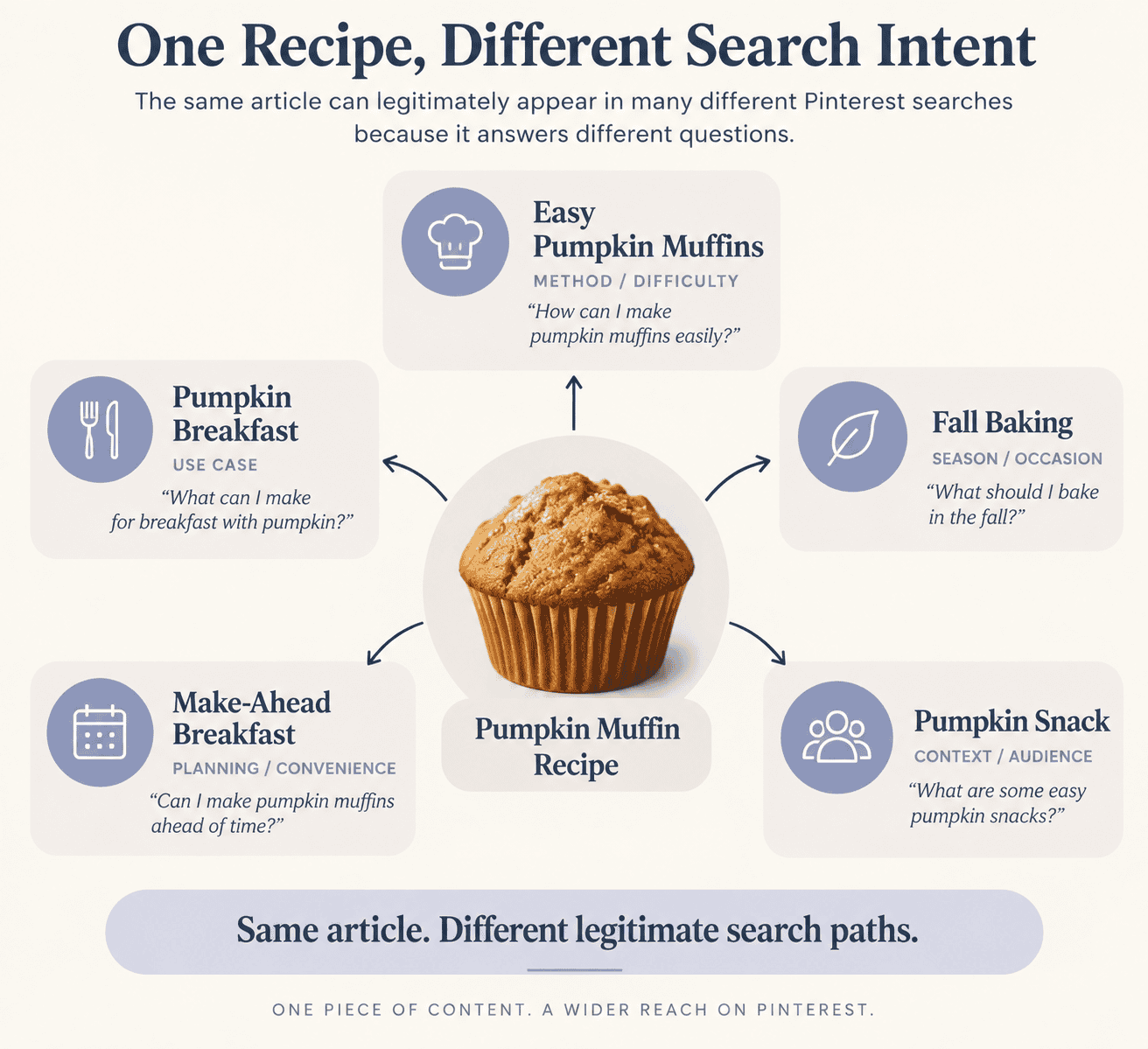
We’re discovering different questions for which the recipe can be a legitimate answer.
That’s intent expansion.
And I think intent expansion is where some of the most interesting Pinterest opportunities exist.
Ask One More Question: What Problem Does This Solve?
People don’t always search Pinterest knowing what they want to make.
Sometimes they know the problem.
They might have half a can of pumpkin in the refrigerator.
So they search:
what to make with leftover pumpkin puree
Someone else wants breakfasts they can prepare ahead:
make ahead breakfast ideas
Another person wants something they can freeze:
freezer friendly breakfast recipes
And someone else simply wants:
easy fall baking ideas
The same pumpkin muffin article might legitimately satisfy all four searches.
That doesn’t mean I should stuff all four phrases into one Pin description.
Quite the opposite.
Each could potentially represent a different retrieval pathway worth testing.
This Is Where Pin Permeation Comes In
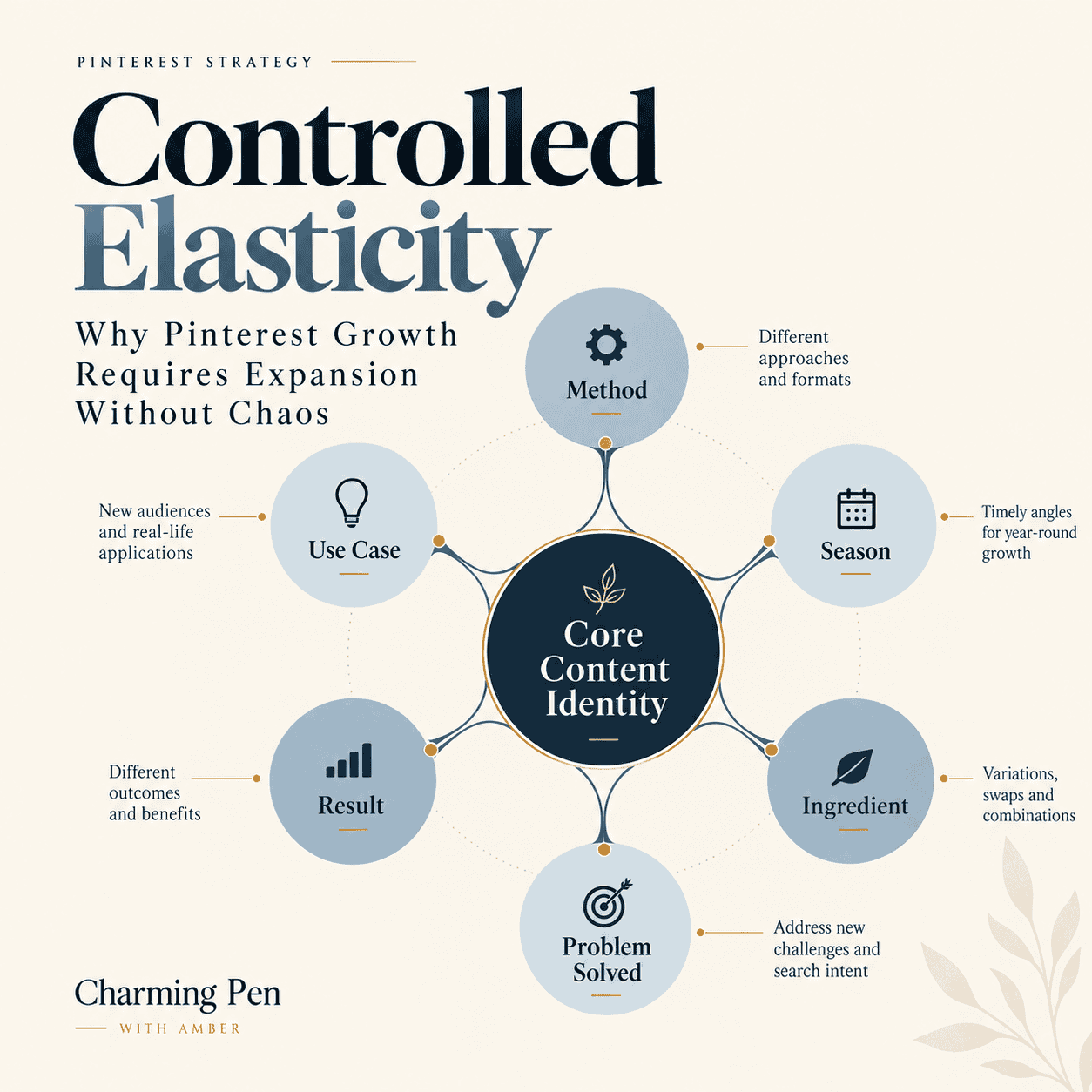
I use permeation to describe how far a piece of content can legitimately spread through Pinterest’s search and recommendation environment without losing its factual identity.
A recipe doesn’t necessarily have one keyword.
And it doesn’t necessarily have one audience, occasion or search pathway.
It has a query surface.
That surface can include:
- hierarchical expansion — broader and narrower descriptions of the food
- lexical expansion — synonyms and alternate ways of describing it
- attribute expansion — texture, flavour, ingredients and characteristics
- method expansion — how it’s prepared
- seasonal expansion — when it’s relevant
- context expansion — where or when it fits
- problem expansion — what need it solves
- intent expansion — other searches for which the article is a legitimate answer
The richer the article, the larger that surface may be.
One URL Can Therefore Support Many Legitimately Different Pins
This is why I don’t believe the useful question is:
How many Pins can I make for one URL?
Pinterest doesn’t publish a simple lifetime numerical limit for Pins pointing to one URL.
A better question is:
How many materially different questions can this article legitimately answer?
A very narrow recipe might exhaust its useful search surface quickly.
A broad evergreen recipe could support dozens of genuinely different creatives over its lifetime. This becomes particularly interesting alongside Pinterest’s work on giving fresh Pins an opportunity to enter and compete within its recommendation systems.
Those Pins don’t have to be copies.
One might communicate:
Easy Pumpkin Muffins
Another:
Pumpkin Muffins for Breakfast
Another:
Freezer-Friendly Pumpkin Muffins
Another:
What to Make With Pumpkin Puree
Another:
Easy Fall Baking
They lead to the same article, but they’re answering different questions.
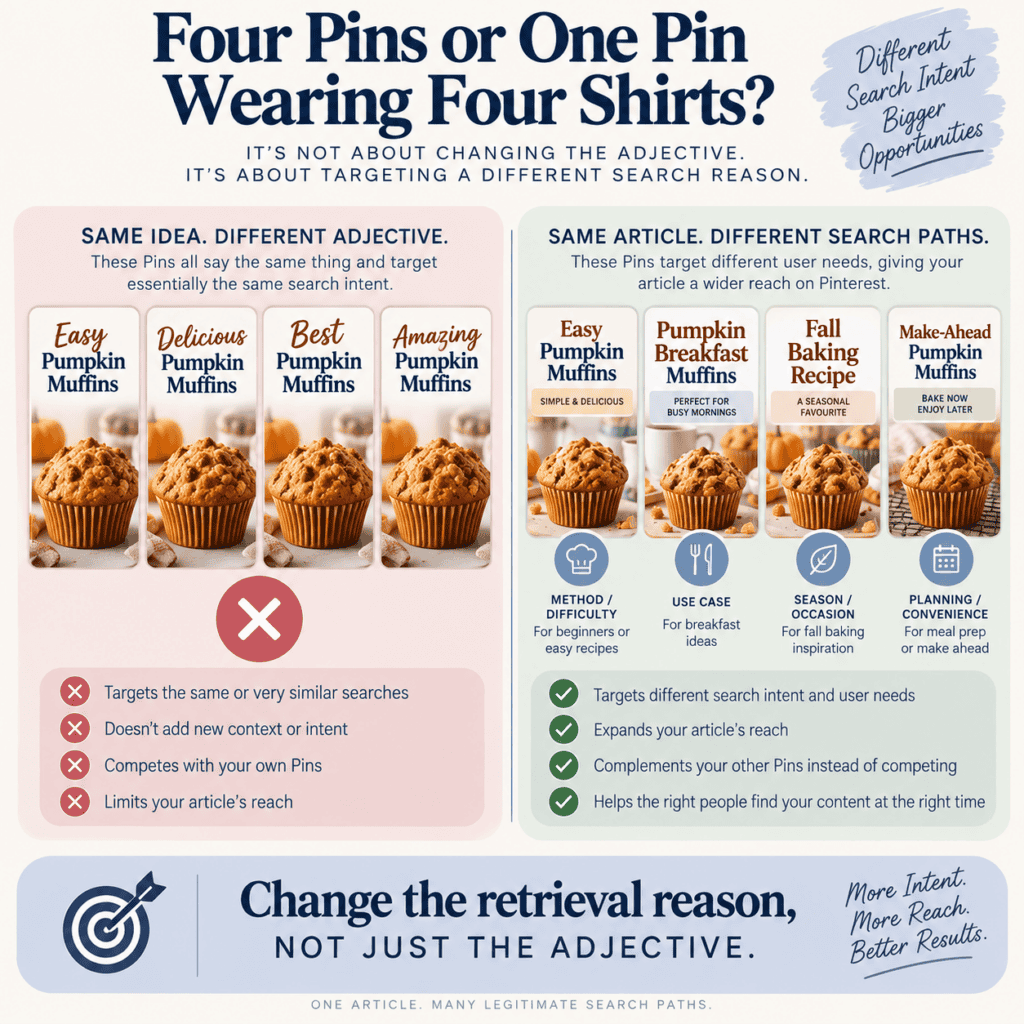
That’s very different from publishing:
- Best Pumpkin Muffins
- Amazing Pumpkin Muffins
- Delicious Pumpkin Muffins
- Yummy Pumpkin Muffins
Those are mostly cosmetic wording changes around essentially the same idea.
The Pin Graph Makes This Even More Interesting
As multiple Pins are created around a URL, Pinterest accumulates more information about the content.
Different images, text, boards, engagement patterns, related content and user interactions can contribute signals about what that content represents and when people find it useful.
Pinterest is already using multiple signals to classify content into search entities, which helps explain why the complete context surrounding a Pin matters.
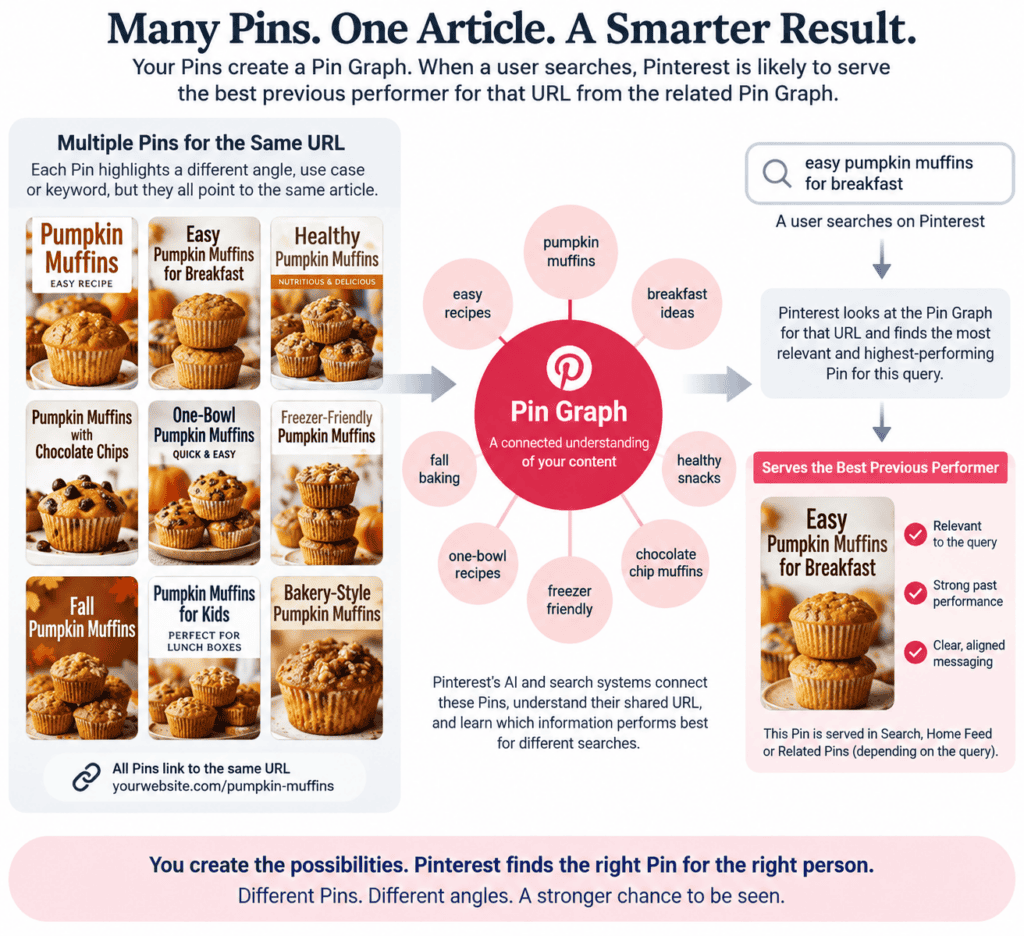
So I think about this as creating a Pin Graph around the article.
One URL may eventually have Pins associated with:
- pumpkin muffins
- breakfast ideas
- fall baking
- freezer-friendly recipes
- pumpkin recipes
- easy baking
- chocolate chip muffins
Those aren’t seven unrelated identities.
They’re interconnected descriptions and use cases surrounding the same underlying content.
When someone subsequently searches for something related to that graph, Pinterest has multiple historical Pin candidates and signals available to determine what is relevant.
That does not mean we can state that Pinterest will always select the historically best-performing Pin for a URL. Ranking involves many signals, and Pinterest does not publish a simple rule saying one URL’s Pins compete and the previous winner is automatically selected.
But strategically, it gives us a useful way to think about what we’re building:
We’re not simply making more Pins. We’re giving Pinterest more legitimate information about the circumstances in which a URL could be useful.
And That’s Why I Don’t Want Every Pin Targeting Everything
If a recipe has 20 possible retrieval pathways, the temptation is to squeeze them all into every Pin.
I think that’s backwards.
If I’m creating a Pin around:
Freezer-Friendly Pumpkin Muffins
I want the image, overlay, title and description to reinforce that idea.
If the next Pin is:
Easy Fall Breakfast
that creative can communicate that intent clearly.
And if another is:
Pumpkin Chocolate Chip Muffins
the food identity becomes dominant.
Each Pin contributes something understandable.
Collectively, they build a richer representation of the article. That representation can also include Pinterest annotations, the labels and associations Pinterest uses to help understand and categorize Pin content.
How This Changes Pinterest Search Strategy
A strong Pinterest search strategy shouldn’t begin and end with finding the highest-volume keyword. It should identify the different searches, problems, modifiers and use cases a piece of content can legitimately answer, then create Pins that communicate those pathways clearly.
I don’t want a keyword tool simply handing me the 20 largest phrases associated with pumpkin muffins.
I want to know:
What is Pinterest already associating with this content?
What are people currently searching for?
Which long-tail queries exist?
What modifiers appear repeatedly?
What questions do those modifiers answer?
What other ways could someone phrase the same request?
What additional problems could this article solve?
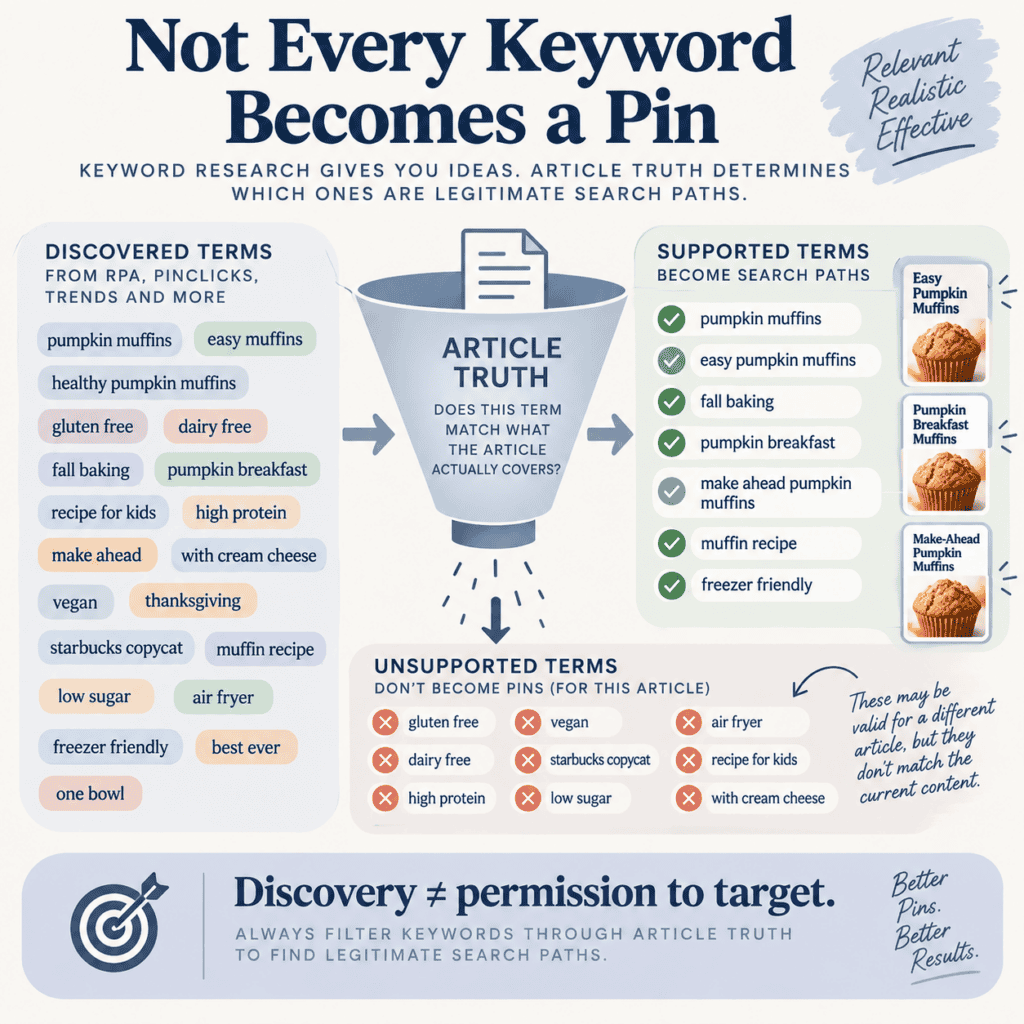
Which of those opportunities does the article actually support?
That’s why I’ve increasingly combined several research layers rather than relying on one keyword source.
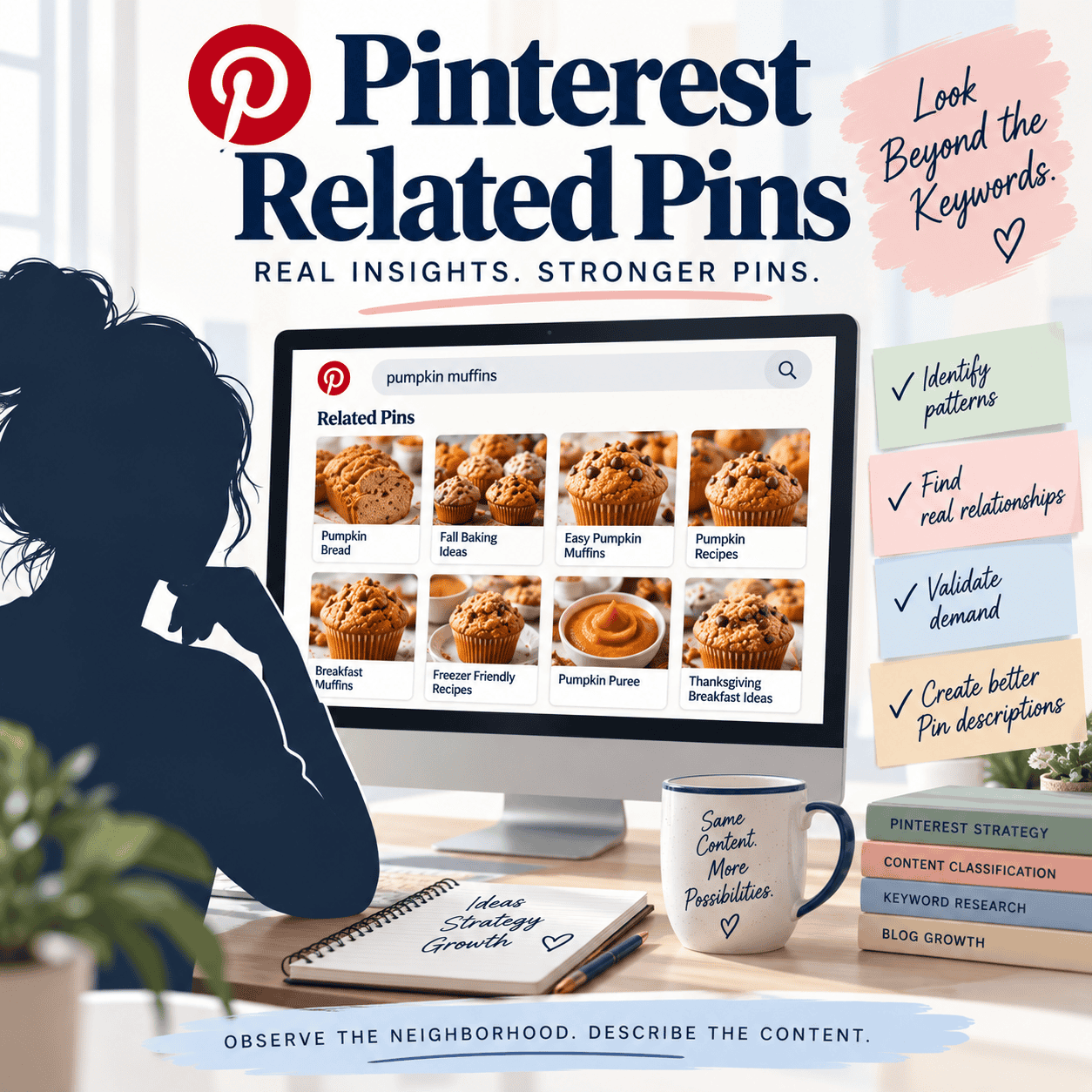
Related Pin Analysis helps reveal the semantic neighborhood Pinterest already associates with similar content.
Pinterest keyword and trend research helps establish whether demand exists and where it may be moving.
Long-tail Pinterest keyword research can reveal more specific queries that broad keyword research misses.
Then the article itself acts as the boundary.
Research can discover the opportunity.
It cannot change what the recipe actually is.
Search Volume Isn’t Enough
This is particularly important as Pinterest’s retrieval technology becomes more sophisticated.
The biggest keyword isn’t automatically the best keyword.
A smaller query with exceptionally strong article alignment may represent a better opportunity than a huge generic term where thousands of competing Pins satisfy the same request.
Pinterest’s Late Interaction research makes that possibility even more interesting because Pinterest is experimenting with retrieval technology specifically designed to preserve more granular information contained within queries rather than collapsing everything into one broad semantic representation.
That makes meaningful modifiers potentially very important.
Not because we should add more words.
Because those words can represent more precise intent.
A Simple Framework for Finding New Pinterest Queries
When I’m evaluating an article now, the process becomes:
Who is it for?
What is it?
Where does it fit?
When is it useful?
Why would someone want it?
How is it made?
Then:
What’s it like?
What’s in it?
What’s not in it?
What else might someone call it?
What problem does it solve?
What broader category could it answer?
What narrower query describes it?
And finally:
What else could someone search where this article would genuinely be a good answer?
That final question can uncover opportunities a conventional keyword list never will.
The Article Determines the Ceiling
This also gives us a better answer to another question Pinterest marketers frequently struggle with:
When have I created enough Pins for a URL?
I don’t think the answer should automatically be 4, 10, 20 or 40.
The article determines its own ceiling.
You reach that ceiling when you’re no longer discovering materially different, factually supported questions worth answering.
If new photography becomes available, search behaviour changes, a seasonal opportunity appears, Pinterest begins associating the content with another relevant semantic neighborhood, or research uncovers a previously overlooked long-tail, the URL can become interesting again.
That’s very different from refreshing a Pin simply because seven days have passed.
More Pins Isn’t the Strategy. More Understanding Is.
That’s ultimately what I take from Pinterest’s recent retrieval research.
Pinterest is investing heavily in systems designed to understand increasingly detailed relationships between queries, content, images, interests and user intent.
Our response shouldn’t be to throw more keywords at the platform.
It should be to become better at identifying the questions our content genuinely answers.
Start with:
Who. What. Where. When. Why. How.
Then keep asking questions for as long as the content gives you truthful answers.
Those answers reveal modifiers.
Modifiers reveal queries.
Queries reveal retrieval pathways.
And those pathways give us legitimate reasons to create different Pins.
That’s how I think about Pinterest permeation:
One piece of content. Many legitimate questions. Multiple discovery pathways. Each Pin gives Pinterest another clear reason to understand when that content might be the right answer.
That is a much more sustainable strategy than simply trying to find another way to say the same keyword.