There is a strange feeling spreading through the creator world right now.
Not just uncertainty, but the growing realization that the internet itself is changing faster than many creators can comfortably adapt to.
Even experienced bloggers, Pinterest managers, niche site owners, and long-time SEO professionals are openly admitting they feel uncertain about where the internet is heading next.
Traffic patterns are becoming increasingly unstable.
Long-time creators who once felt confident in their systems are suddenly watching reliable traffic decline, while newer creators struggle to understand what works at all.
Traditional search engines like Google are integrating AI-generated answers and AI Overviews directly into search results, while more users turn toward ChatGPT and other AI platforms for direct answers instead of navigating traditional search pages alone.
Pinterest creators are seeing unstable distribution, changing engagement behavior, delayed expansion, and recommendation patterns that no longer follow the old “do this, get that” style of platform advice.
And for many creators, the internet suddenly feels less predictable than it did even a year ago.
The truth is, the systems powering online discovery are evolving faster than most people realize.
The early internet rewarded:
- publishing first
- ranking for keywords
- scaling content quickly
- building traffic through search visibility
- staking your claim online early
But modern AI search systems work differently.
Today’s platforms are becoming more interpretive, behavioral, and recommendation-driven.
That means content creation itself is starting to change alongside them.
The Old SEO Era Was Built Around Indexing
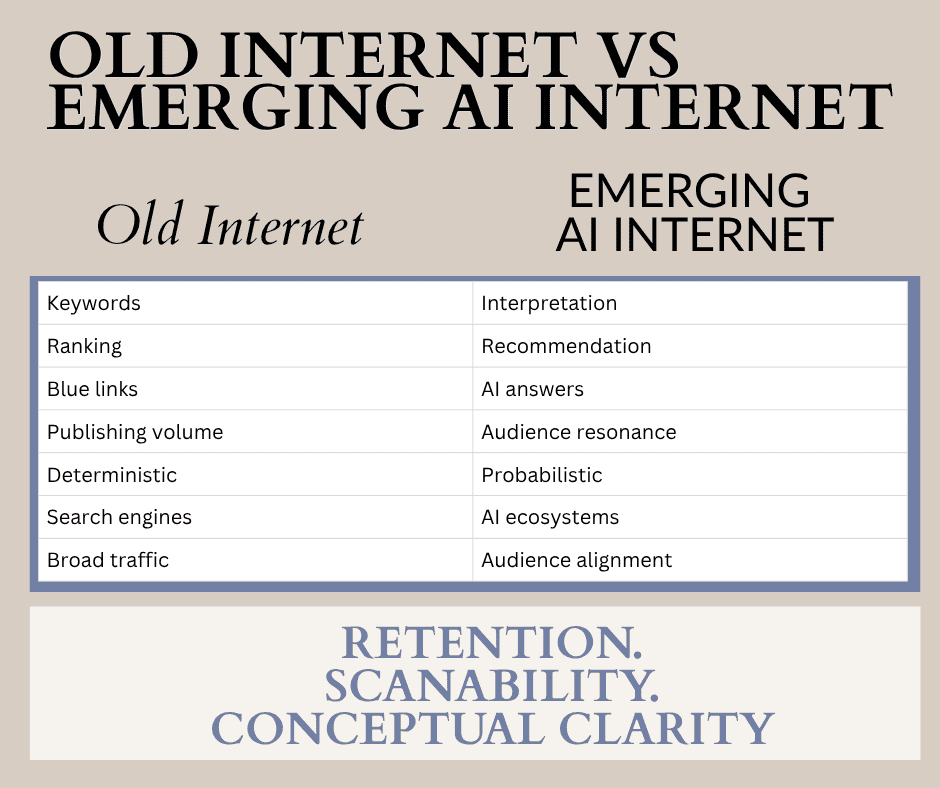
For years, most online visibility relied heavily on indexing systems.
Search engines scanned pages, matched keywords, ranked results, and returned lists of blue links.
Creators learned:
- keyword research
- title optimization
- metadata
- backlinks
- content structure
- topical relevance
Those things still matter.
But AI search optimization is changing how platforms retrieve, interpret, and distribute information.
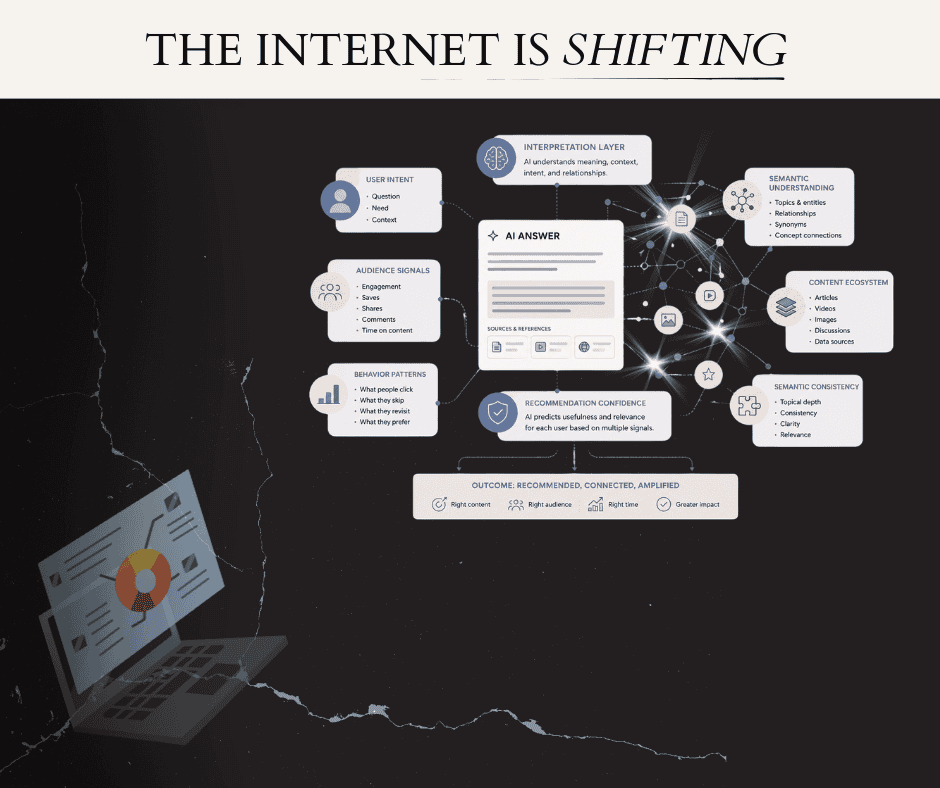
Modern AI-powered search engines try to understand:
- meaning
- relationships
- audience behavior
- semantic context
- user intent
- topical identity
- usefulness
- behavioral satisfaction
Instead of only asking:
“Does this page contain the keyword?”
AI systems ask:
“What is this content actually about?”
“Who is it useful for?”
“How confidently do we understand it?”
“What other topics, audiences, and behaviors relate to it?”
That is a major shift.
Why Content Creators Feel Lost Right Now
Many creators built successful websites during what felt like the wild west era of the internet.
You could:
- find a niche
- create content
- optimize for search
- grow traffic steadily over time
- build a recognizable site
The systems were not simple, but they often felt understandable.
Today, the internet feels different.
Google AI Overviews summarize information directly inside search results.
AI-generated answers reduce clicks to websites.
Many bloggers are now exploring answer engine optimization strategies to help their content remain visible as AI Overviews, AI assistants, and AI-driven search systems reshape how information is retrieved online.
Pinterest increasingly behaves more like a recommendation system than a traditional search engine.
Even large creators and experienced educators are publicly acknowledging uncertainty as platforms continue changing underneath them.
That uncertainty does not mean creators are failing.
It means the systems driving visibility are evolving.
Modern Platforms No Longer Behave Like Simple Search Engines
Platforms like Google, Pinterest, YouTube, TikTok, and AI chat systems now rely heavily on:
- AI systems
- recommendation engines
- behavioral modeling
- semantic relationships
- audience prediction
- AI-generated search results
- user behavior analysis
- confidence scoring
This changes how content gets discovered.
Visibility is no longer only about ranking for exact keywords.
It is about:
- interpretability
- topical clarity
- audience alignment
- behavioral reinforcement
- semantic consistency
- trusted expertise
- recognizable identity
This is one reason many creators feel like old strategies suddenly stopped working.
The internet itself is becoming more dynamic, predictive, and probabilistic.
Content that explains ideas clearly, answers questions directly, and maintains strong topical structure may become easier for AI systems to interpret and retrieve confidently.
The Shift From Deterministic To Probabilistic Systems
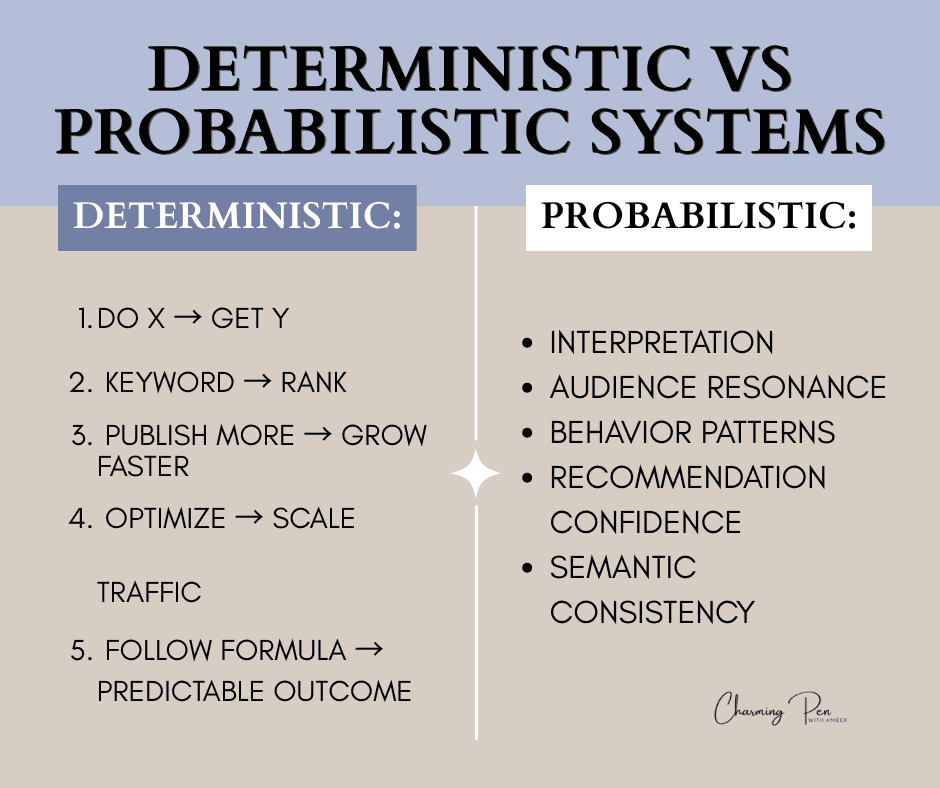
Older internet thinking often felt deterministic.
- Do X.
Get Y. - Use the keyword.
Rank the article. - Create more pins.
Get more traffic.
But modern AI systems operate through probability and confidence instead of rigid rules.
Platforms now appear to continuously estimate:
- what content most likely represents
- which audience clusters respond positively
- which topics connect together
- which creators consistently satisfy users
- which content deserves broader distribution
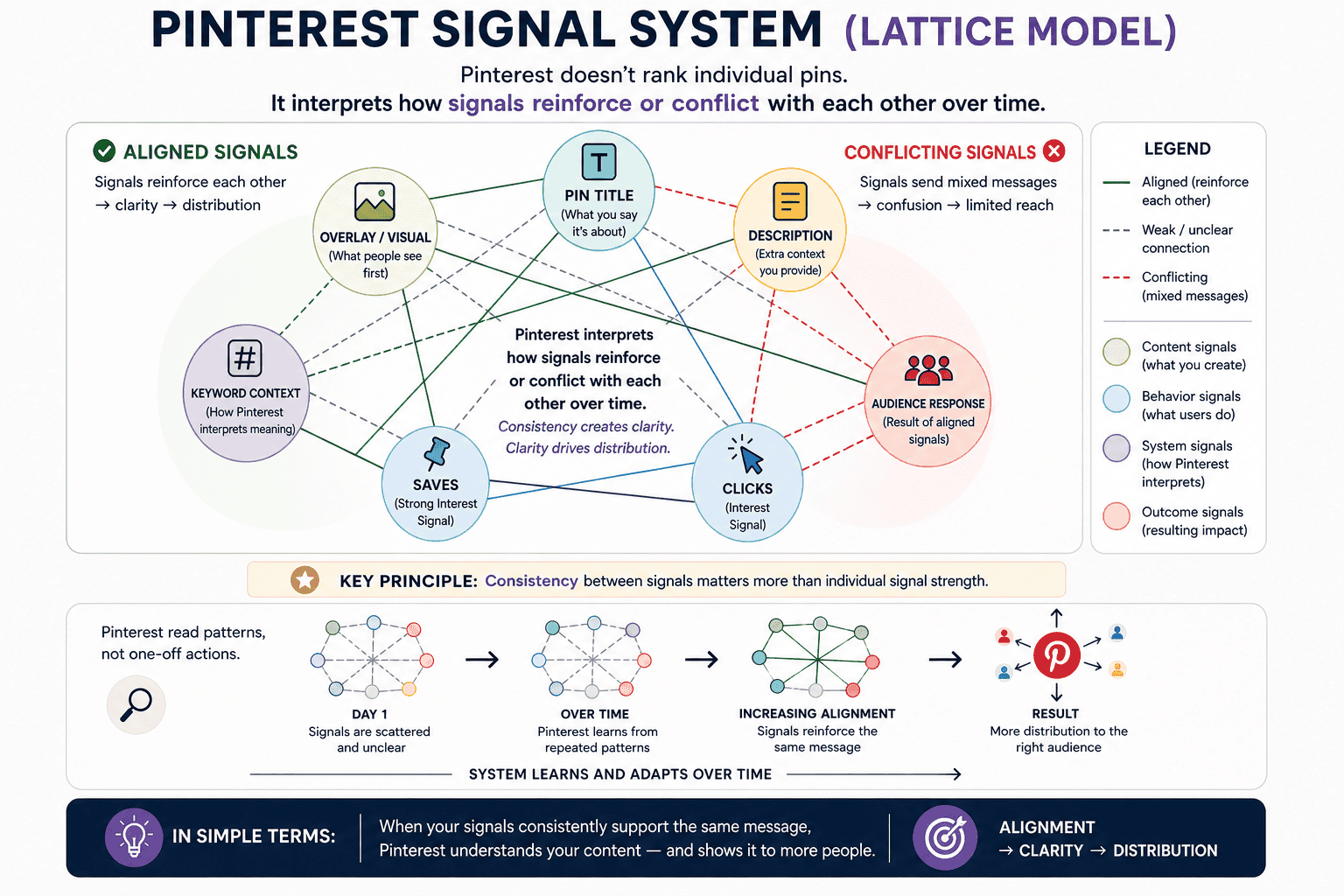
Modern Pinterest distribution appears tied to confidence, audience reinforcement, behavioral consistency, and how clearly the platform understands where content belongs inside larger recommendation systems.
That means modern systems often reward:
- repeated clarity
- consistent identity
- recognizable expertise
- semantic reinforcement
- audience resonance
more than chaotic experimentation.
This is one reason many creators are beginning to realize there may be an important layer between simple ranking and actual distribution visibility on Pinterest.
This is especially visible on Pinterest right now.
Many creators are noticing that tightly aligned content ecosystems often perform more consistently than broad, highly varied posting strategies.
That does not necessarily mean creativity is dead.
It means AI systems prioritize confidence and interpretability before expansion.
Why Audience Targeting Matters More Than Ever
One of the biggest shifts happening right now is that platforms are increasingly trying to understand not only what content is — but who consistently responds positively to it.
This is where audience targeting becomes much more important in modern content strategy.
Classification helps platforms understand:
what your content is.
Audience targeting helps platforms understand:
who is most likely to value and reinforce it.
That distinction matters.
A practical comfort food blog may attract:
- nostalgic home cooks
- busy families
- budget-conscious parents
- beginner cooks
A polished wellness recipe account may attract:
- health-focused millennials
- meal preppers
- high-protein recipe savers
Both may publish dinner recipes, but the behavioral audiences interacting with them are very different.
Modern AI systems appear to organize content through these kinds of audience and interest relationships.
On Pinterest, annotation systems likely play an important role in helping the platform connect content to related interests, audience behaviors, and recommendation pathways over time.
Pinterest’s taste graph system appears to function as a large-scale interest and relationship mapping system that helps Pinterest understand how content, users, behaviors, and interests connect together over time.
In many ways, Pinterest behaves less like a traditional search engine and more like a generative recommendation ecosystem capable of connecting related ideas, audiences, behaviors, and content patterns together dynamically over time.
What Pinterest Taste Graphs Actually Suggest
Pinterest introduced the idea of taste graphs to describe how the platform connects people with related interests and content preferences.
For many creators, the explanation felt abstract or overly technical.
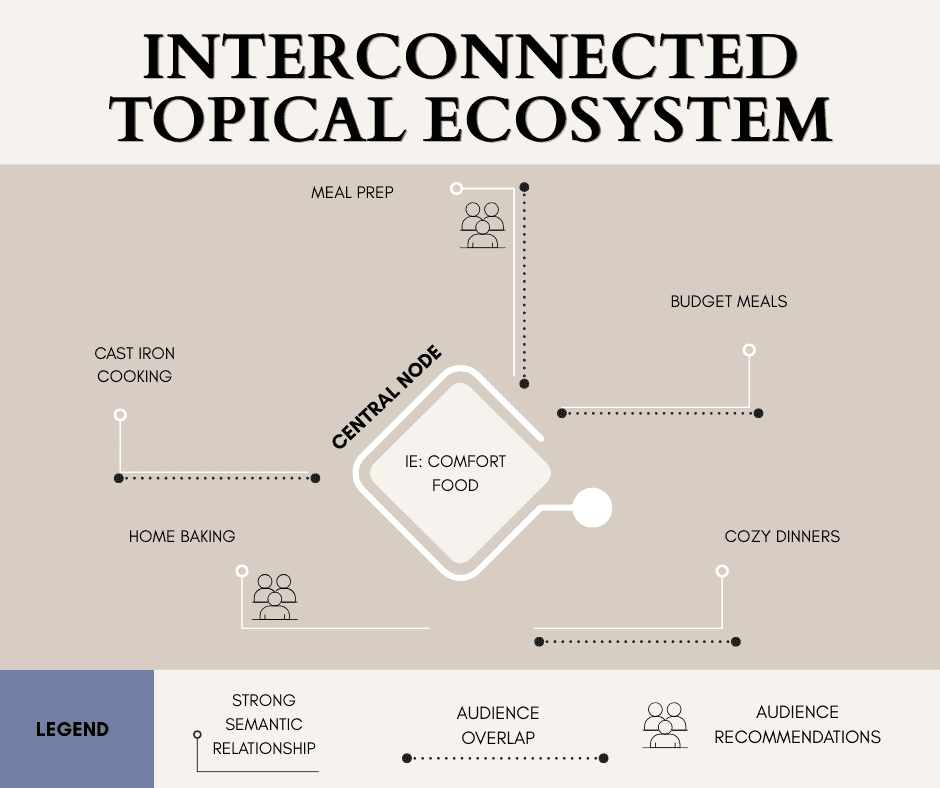
But simplified, taste graphs likely represent relationship networks between:
- interests
- behaviors
- visuals
- saves
- topics
- audience patterns
- semantic similarities
In other words:
Pinterest is not only trying to understand keywords.
It is trying to understand:
- what type of content this is
- which audiences consistently engage with it
- which interests overlap together
- which recommendation pathways consistently perform well
This is one reason audience resonance matters so much now.
Content that repeatedly attracts the same engaged audience may strengthen platform confidence over time.
That does not mean creators should become repetitive or robotic.
But it does suggest that:
- clear identity
- consistent topical structure
- recognizable expertise
- aligned audience signals
- semantic consistency
may matter more than ever.
Audience Targeting Is Becoming More Important Than Broad Visibility
One of the biggest shifts happening across platforms right now is that visibility appears tied to audience resonance rather than broad exposure alone.
Modern recommendation systems do not simply distribute content randomly.
They attempt to understand:
- who consistently engages positively
- which audiences reinforce certain topics
- which users repeatedly save, click, or interact with similar content
- which content ecosystems feel behaviorally aligned
This is one reason audience targeting matters more now than it did during earlier SEO eras.
Classification helps platforms understand:
what your content is.
Audience targeting helps platforms understand:
who is most likely to positively reinforce it.
That distinction is becoming more important across recommendation-driven systems like Pinterest, especially as the platform continues expanding its use of multimodal and layered AI systems to better understand content, users, and behavioral relationships over time.
Why Trust And Expertise Matter More In AI Search
As AI-generated content expands across the internet, trust and expertise are becoming vital signals inside modern search and recommendation systems.
Traditional SEO often focused heavily on:
- keywords
- rankings
- backlinks
- search visibility
Those things still matter.
But AI search systems appear to prioritize whether content feels:
- reliable
- useful
- understandable
- topically consistent
- behaviorally reinforced over time
This is one reason recognizable expertise matters more now than it did during earlier search eras.
Modern AI systems are trying to determine:
- who consistently creates useful information
- which sites demonstrate clear topical authority
- which creators repeatedly satisfy audience intent
- which sources appear trustworthy enough to retrieve and summarize confidently
That does not necessarily mean creators need formal credentials to succeed.
But it does mean creators benefit from building:
- clear expertise signals
- recognizable topical identity
- strong audience relationships
- practical experience
- consistent content ecosystems
For many creators, this shift may actually become an advantage.
AI can reproduce generic content very quickly.
What it struggles to replicate consistently is:
- lived experience
- recognizable perspective
- practical insight
- original observation
- niche expertise
- regional knowledge
- real-world testing
- trusted identity
The internet spent years rewarding large-scale content production and aggressive optimization tactics.
But AI-driven search systems seem to favor:
- structured usefulness
- direct answers
- practical expertise
- consistent topical reinforcement
- trustworthy experience
- recognizable authority
In many ways, this shift may push creators back toward building stronger identities instead of simply publishing larger volumes of content.
The creators most likely to adapt well may not be the ones trying to out-produce AI.
They may be the creators who:
- explain clearly
- teach practically
- build recognizable expertise
- maintain strong topical identity
- create genuinely useful experiences
- understand the audiences they consistently help
That is especially true for creators with:
- real-world experience
- specialized knowledge
- practical workflows
- distinctive voice
- established trust with their readers
In other words, creators who genuinely understand their topics may become easier for AI systems to interpret and trust over time.
And honestly, that may be one of the healthiest long-term shifts happening across the internet right now.
How AI Search Systems Retrieve Information Differently
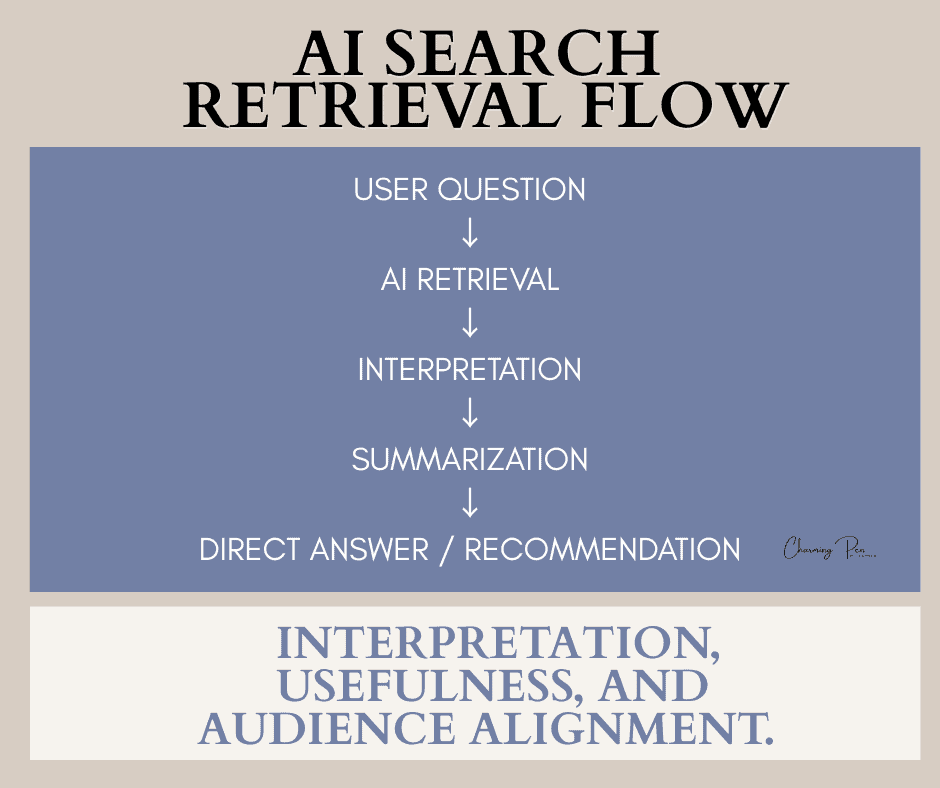
Modern AI search systems do not simply rank pages the way traditional search engines once did.
They retrieve, summarize, and reorganize information into direct answers, recommendations, and AI-generated search results.
That means content itself is becoming more extractable and interpretation-driven.
Content that:
- answers specific questions clearly
- organizes information logically
- maintains strong topical structure
- explains ideas directly
may become easier for AI systems to retrieve and summarize confidently.
This is one reason creators are hearing more discussions around:
- answer engine optimization
- AI visibility
- direct-answer formatting
- structured content ecosystems
The future of search may rely less on isolated keyword ranking and more on how effectively AI systems can retrieve and interpret useful information from across the web.
What Creators Should Focus On Now
The creators adapting best to this shift are not necessarily the ones publishing the most content or chasing every new platform trend.
Increasingly, they are the creators building clearer, more recognizable content ecosystems that modern AI systems can interpret confidently.
That does not mean creators need to become machine learning engineers.
But it does mean the internet is rewarding slightly different skills than it did during the earlier SEO era.
Right now, creators should focus on:
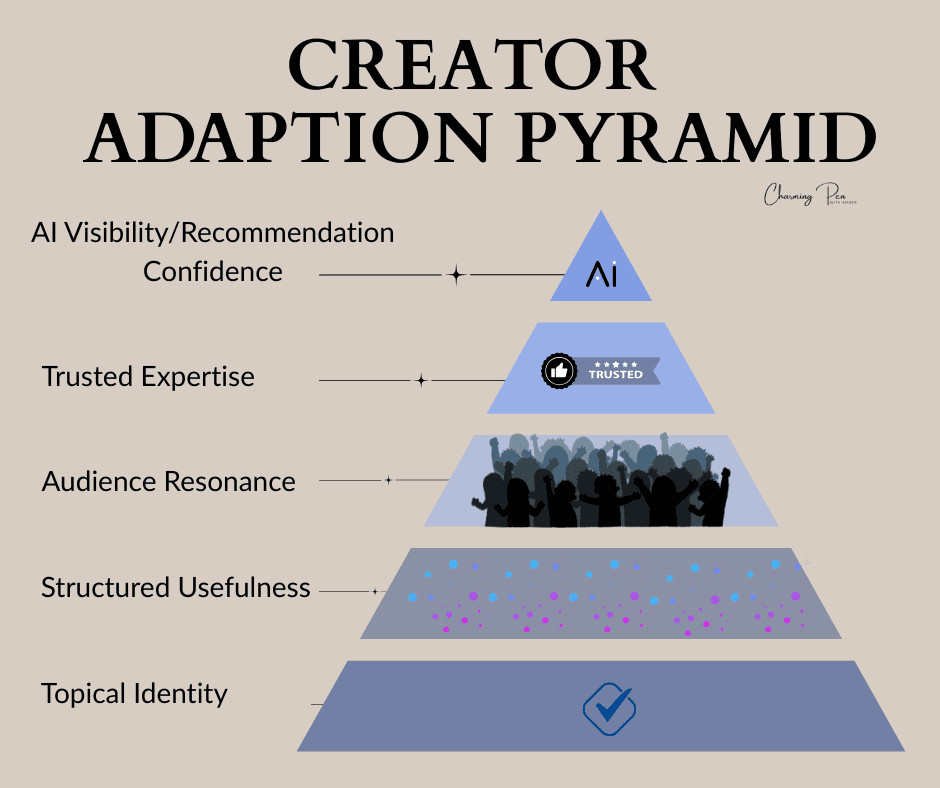
- building recognizable topical identity
- creating consistent content ecosystems
- answering specific questions clearly
- strengthening audience resonance
- reinforcing trusted expertise
- maintaining semantic clarity across platforms
- improving content structure and interpretability
- creating genuinely useful experiences for readers
Modern AI search systems also appear to reward content that is:
- easy to understand
- behaviorally reinforced
- topically consistent
- clearly structured
- experientially grounded
- connected to recognizable expertise
This is one reason broad, chaotic content strategies are becoming harder to sustain long-term.
The internet is becoming more interpretive.
Platforms are trying to determine:
- what your content is
- who it helps
- how trustworthy it appears
- which audiences repeatedly engage with it positively
- where it belongs inside larger recommendation ecosystems
That means creators who build:
- clearer identity
- stronger audience alignment
- more consistent expertise
- more structured usefulness
may have a stronger foundation moving into the future of search.
The old internet rewarded visibility first.
The emerging future of AI search rewards interpretability, trusted expertise, audience resonance, structured usefulness, and content that AI-powered search systems can retrieve, summarize, and confidently surface across recommendation ecosystems and AI-driven search results.
Creators who adapt to AI-driven search tools and recommendation systems early may have a stronger foundation as the future of search continues evolving