
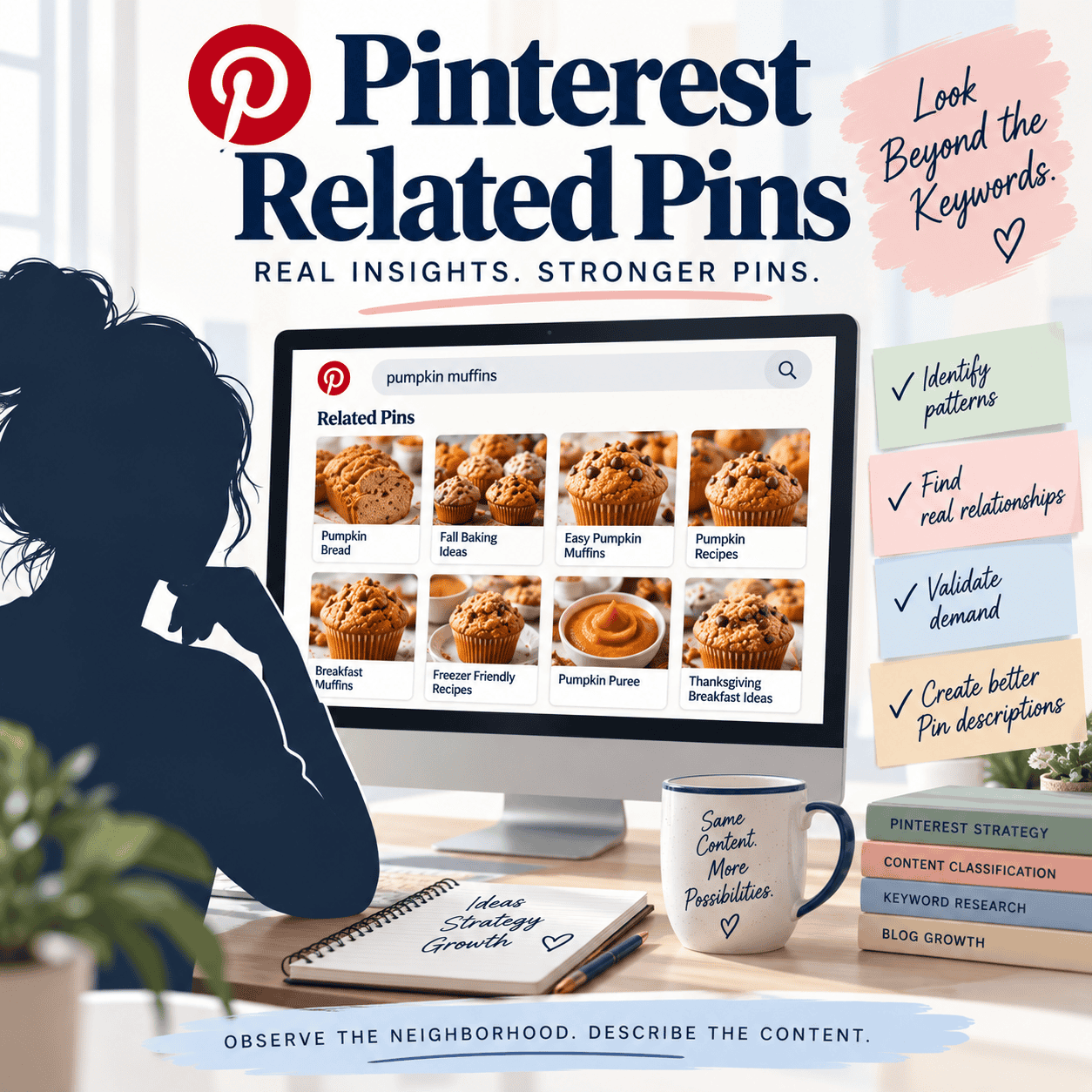
Pinterest Related Pins can tell us considerably more than which recipes, products or ideas Pinterest considers visually similar.
I use Pinterest Related Pins as a research layer to investigate how Pinterest appears to classify, connect and group information around a piece of content. Instead of opening one Pin and simply collecting keywords from the Pins underneath it, I look at the broader Related Pin neighborhood and ask what keeps appearing.
What food objects repeat? Which ingredients? Methods? attributes? occasions? use cases? audiences? problems?
Those patterns can give us clues about the semantic neighborhood Pinterest has built around a topic and give me another way to investigate how Pinterest classifies content.
I call this process Related Pin Analysis, or RPA.
RPA has become an important part of my Lattice System™ because it helps answer a question that ordinary keyword research can’t answer on its own:
What is Pinterest already telling us about how it groups this content?
I can then use those observations to inform keyword research, Pin positioning and, importantly, how I build Pin descriptions.
The goal isn’t to copy words from Related Pins.
It’s to understand the relationships Pinterest is showing us and use that information to describe our own content more accurately.
What Are Pinterest Related Pins?
Pinterest Related Pins are recommendations Pinterest presents around an individual Pin to help users continue discovering relevant content.
From a user’s perspective, they’re simply more ideas to explore.
From a strategist’s perspective, they’re also an observable research environment. Technically, however, Related Pins are recommendations—not a keyword database. Pinterest’s published engineering work describes Related Pins as a recommendation system involving candidate generation and ranking, which is one reason I don’t treat every neighboring Pin as a keyword recommendation.
If I open a Pin for pumpkin muffins and Pinterest surrounds it with Pins about pumpkin bread, fall baking, breakfast muffins, pumpkin puree recipes and Thanksgiving breakfast ideas, I’m looking at more than a list of possible keywords.
I’m looking at a network of relationships. That idea has precedent in Pinterest’s own engineering work. Pinterest has historically modeled Pins and boards as a graph, using neighboring information to add context and help distinguish content that may appear visually similar but be semantically different. I can’t see Pinterest’s internal graph, of course, but the principle is important: relationships can contribute information that the individual Pin alone doesn’t reveal.
That collection of surrounding content is what I refer to as the Related Pin neighborhood.
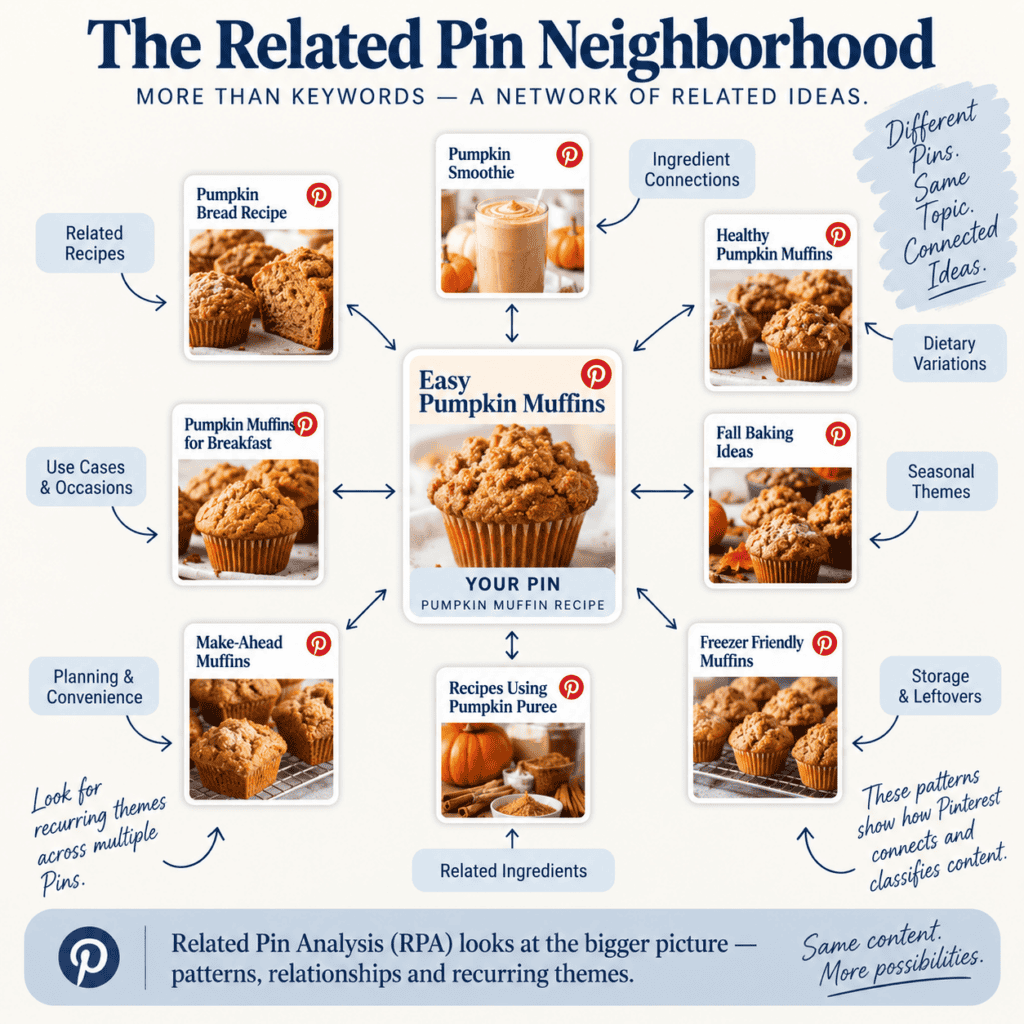
One neighboring Pin doesn’t tell me very much. But when concepts begin repeating across multiple independent Pins and Related Pin neighborhoods, I pay attention.
Those recurring relationships can help me investigate how Pinterest is connecting information around the underlying content.
Pinterest Related Pins Aren’t Simply a Keyword List
This distinction is important because it’s very easy to misuse Related Pins for keyword research.
You could open a successful Pin, scroll through the recommendations and start copying phrases.
That’s not RPA.
Pinterest’s recommendation systems can connect content for numerous reasons. Pinterest has documented the use of signals including annotations for understanding Pins, while its engineering work on Related Pins describes a much broader recommendation and ranking system. Visual similarity has also historically contributed to Related Pin recommendations.
So I don’t assume:
This Pin appeared here, therefore Pinterest considers its title a keyword for my Pin.
Instead, I ask:
What patterns are emerging across this neighborhood?
That’s a much more useful question.
If fall baking appears once, I record it as an observation.
If fall baking concepts repeatedly appear around independent Pins related to my content, I now have a stronger relationship worth investigating.
RPA is about the pattern, not the isolated Pin. That distinction separates RPA from simply harvesting Related Pin keywords.
I’m not assuming every neighboring Pin provides a keyword I should use. I’m looking for repeated relationships across independent Pins, then asking whether those relationships are supported by my destination content and validated by other Pinterest research.
The Related Pin Neighborhood Helps Me See the Lattice
This is where RPA connects directly to my Lattice System™.
I don’t think of a piece of Pinterest content as belonging to one keyword.
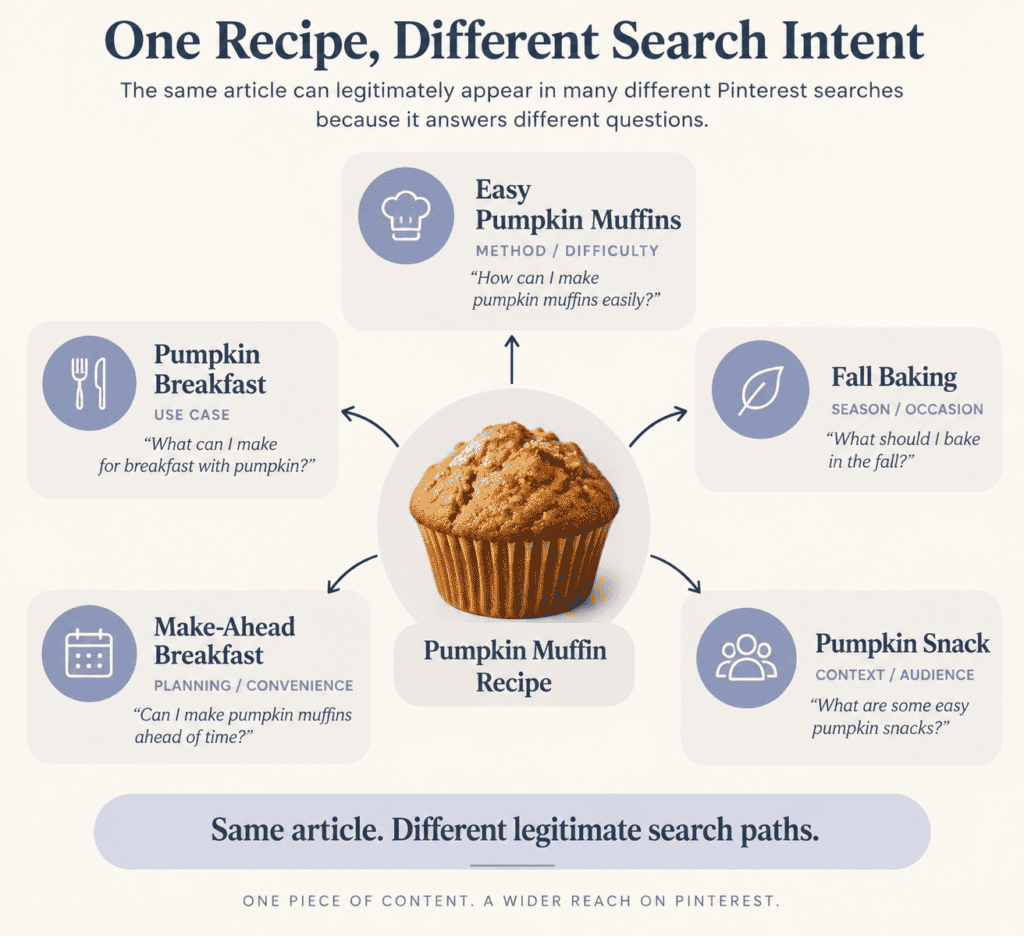
A pumpkin muffin recipe might sit at the intersection of several legitimate classifications:
- Pumpkin recipes.
- Muffin recipes.
- Breakfast recipes.
- Fall baking.
- Pumpkin baking.
- Easy baking.
- Make-ahead breakfast.
- Recipes using pumpkin puree.
Those relationships don’t all mean exactly the same thing.
Some describe what the content is.
Some describe what it contains.
Some describe how it is made.
Some describe when someone might want it.
Others describe why someone might need it.
The Lattice System gives me a way to think about those intersecting classifications.
RPA gives me observational evidence that helps investigate which parts of that lattice Pinterest itself appears to be connecting around similar content.
That’s a very different starting point from taking a large keyword and generating synonyms around it.
What I’m Looking for During Related Pin Analysis
When I analyze a Related Pin neighborhood, I’m not collecting every phrase I can find.
I’m looking for recurring semantic families.
For food content, for example, those commonly include:
Food object:
pumpkin muffins, breakfast muffins, pumpkin bread
Primary ingredients:
pumpkin puree, cinnamon, chocolate chips
Method:
one-bowl baking, easy baking, no-mixer recipes
Attributes:
moist muffins, fluffy muffins, bakery-style muffins
Season:
fall recipes, autumn baking, Thanksgiving
Occasion:
holiday breakfast, brunch, back-to-school
Use case:
make-ahead breakfast, freezer breakfast, lunchbox snack
Audience:
family breakfast, kids’ snacks, beginner bakers
Problem or need:
what to make with pumpkin puree, use leftover canned pumpkin
Those categories help turn what initially looks like a chaotic collection of Pins into something much more structured.
I’m not just seeing words anymore.
I’m seeing relationships between concepts.
Repetition Across Independent Pins Matters
One of the strongest principles in my RPA process is recurrence.
Suppose I’m analyzing a muffin recipe and find one Related Pin targeting:
make-ahead breakfast
That’s interesting, but I don’t have enough information to do much with it.
Now suppose I examine another Pin.
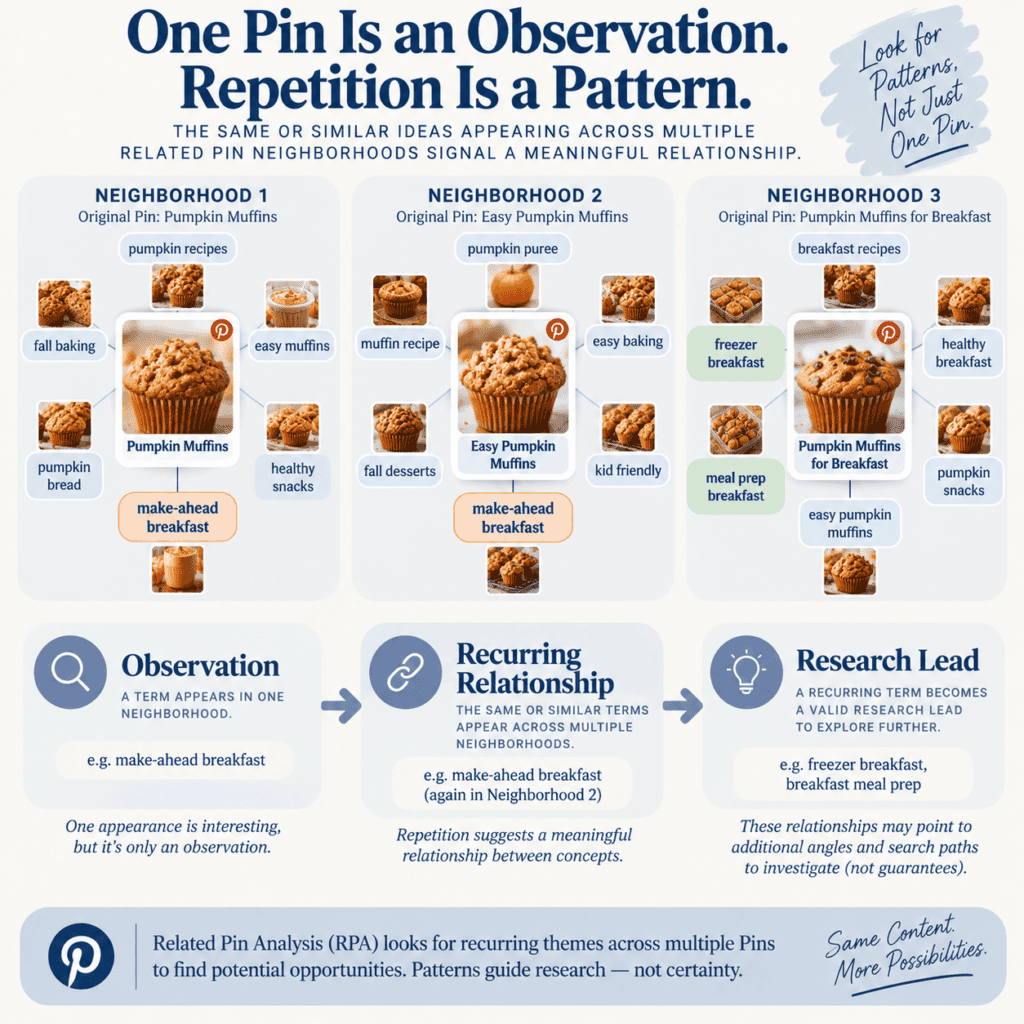
Make-ahead breakfast appears again.
I move into another part of the Related Pin neighborhood and find freezer breakfasts, meal-prep breakfasts and breakfast-prep ideas.
Now a semantic family is beginning to emerge.
That doesn’t prove Pinterest has formally classified my recipe as a make-ahead breakfast.
It does tell me that the relationship is appearing often enough in the visible Pinterest environment to justify further investigation.
I treat that as evidence, not certainty.
That distinction is fundamental to RPA.
Original-Pin Language and Neighborhood Language Aren’t the Same Evidence
I also separate what appears on the original Pin from what repeatedly appears around it.
Suppose the original Pin uses:
Easy Pumpkin Muffins for Busy Mornings
That’s useful language.
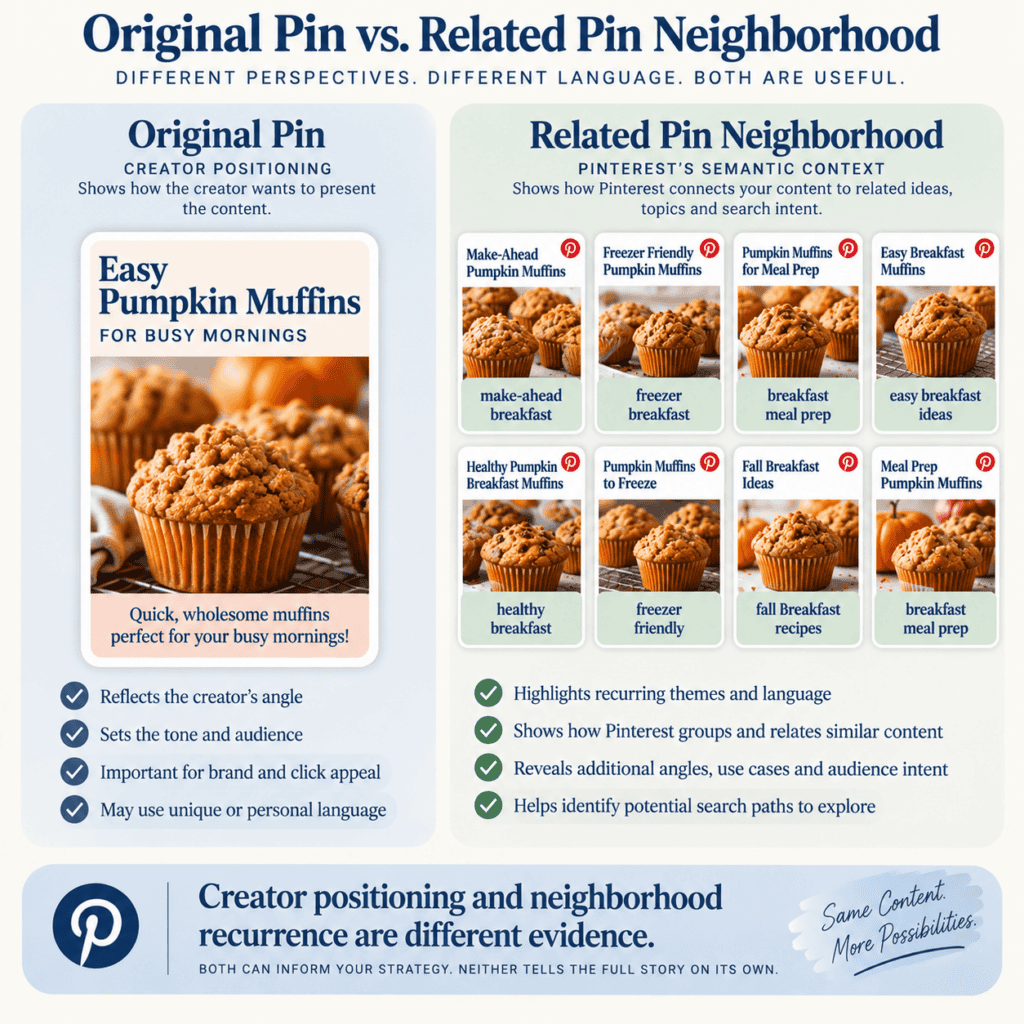
But perhaps none of the surrounding Pins mention busy mornings.
Instead, the neighborhood repeatedly contains:
make-ahead breakfast
freezer breakfast
easy breakfast ideas
breakfast meal prep
Now I have two different pieces of information.
Original-Pin language tells me how one creator chose to position the content.
Neighborhood recurrence tells me which concepts repeatedly appear around that type of content.
Both can lead to useful research.
But I don’t treat them as equivalent evidence.
RPA Helps Me Understand Classification Before I Write the Description
This is where Related Pin Analysis becomes particularly useful in my day-to-day Pinterest work.
I don’t want to write a Pin description by starting with a keyword list and asking:
How many of these phrases can I fit into 500 characters?
I want to understand the content first.
Then I want to understand the neighborhood.
Only then do I build the description.
Suppose I’m working with a pumpkin chocolate chip muffin recipe.
The article establishes that these are:
pumpkin muffins, made with pumpkin puree, made with chocolate chips, easy to prepare, appropriate for breakfast, freezer-friendly, and particularly relevant during fall.
RPA might then show strong recurring relationships around:
pumpkin baking, fall breakfast, easy muffin recipes, pumpkin chocolate chip recipes, make-ahead breakfast,and canned pumpkin recipes.
Now I have considerably more context for building the description.
Not because I’m going to cram every one of those terms into it.
Because I understand the semantic neighborhood in which I’m trying to position the Pin.
A Pin Description Should Reinforce a Clear Classification
A description isn’t simply a container for keywords.
It’s an opportunity to give Pinterest coherent information about:
what the content is,
what it’s about,
what characteristics matter,
and in what context it may be useful.
For example, I could write something like:
These easy pumpkin chocolate chip muffins are made with pumpkin puree, warm fall spices and plenty of chocolate chips. Make a batch for an easy fall breakfast or afternoon snack, or freeze the muffins for a make-ahead breakfast later.
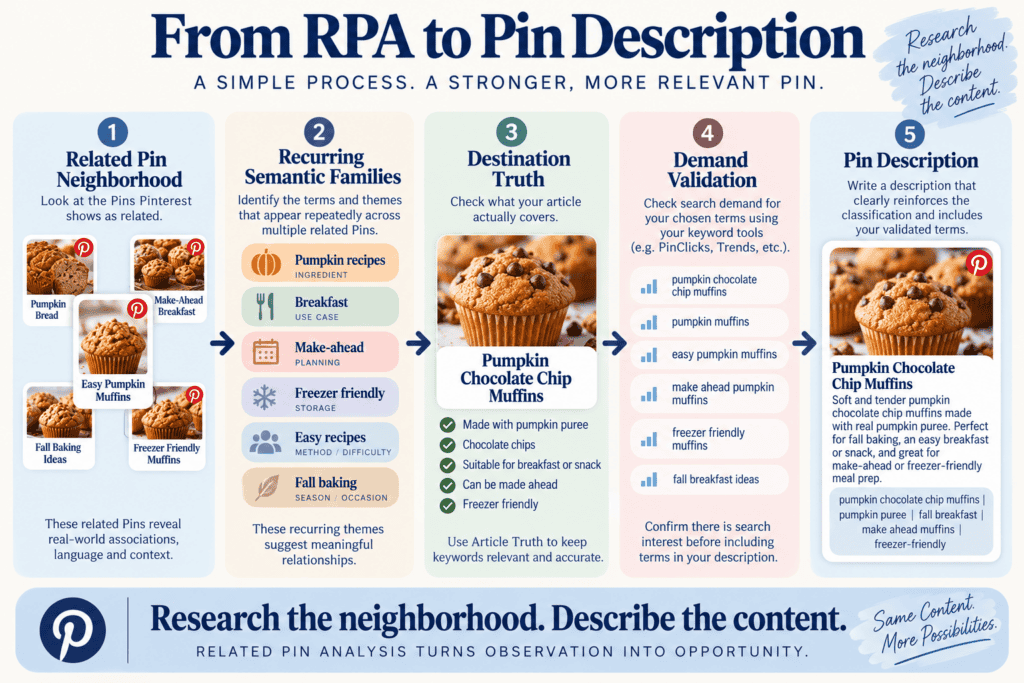
The primary food object—pumpkin chocolate chip muffins—remains unmistakable, while pumpkin puree, fall, breakfast, snacks, freezing and make-ahead use provide supported context around it.
That is what I want from an RPA-informed description: a clear primary identity supported by relevant context, not a collection of unrelated high-volume keywords.
The Primary Food Object Still Has to Stay Dominant
RPA can uncover a surprisingly large neighborhood, but that doesn’t mean every relevant relationship belongs in one Pin.
The Pin still needs a clear primary identity. Pinterest’s own publishing tools reinforce the importance of topical context. Creators can currently add up to 10 related topics to a Pin, which Pinterest says can help people searching for similar ideas find it. That doesn’t mean Related Topics and Related Pins are the same system, but it is another visible example of Pinterest organizing content through relationships rather than one isolated keyword.
If the Pin is primarily targeting pumpkin chocolate chip muffins, that food object should remain dominant.
The surrounding terms provide supporting context.
If I want to explore what to make with leftover pumpkin puree, that may deserve a different Pin with a different creative and description.
If I want to target make-ahead fall breakfast, that could be another.
RPA can reveal the neighborhood without requiring every Pin to represent the entire neighborhood.
That distinction is important.
RPA Can Reveal Description Language I Wouldn’t Have Thought to Research
This is one of the reasons I find the process so useful.
Traditional keyword research often starts with language I already know.
If I’m researching pumpkin muffins, I type:
pumpkin muffins
Then I find variations of pumpkin muffins.
But what if Pinterest’s Related Pin neighborhood repeatedly introduces:
leftover pumpkin puree
I may never have entered that phrase into my keyword tool because I wasn’t thinking about the problem the recipe solves.
Or perhaps the neighborhood repeatedly introduces:
freezer breakfast
Now Pinterest has shown me another relationship worth researching.
RPA can therefore move keyword research sideways rather than simply outward.
Instead of finding another synonym for the food object, I can discover another dimension of the content.
Article Truth Is the Boundary
This is where the Lattice System becomes essential again.
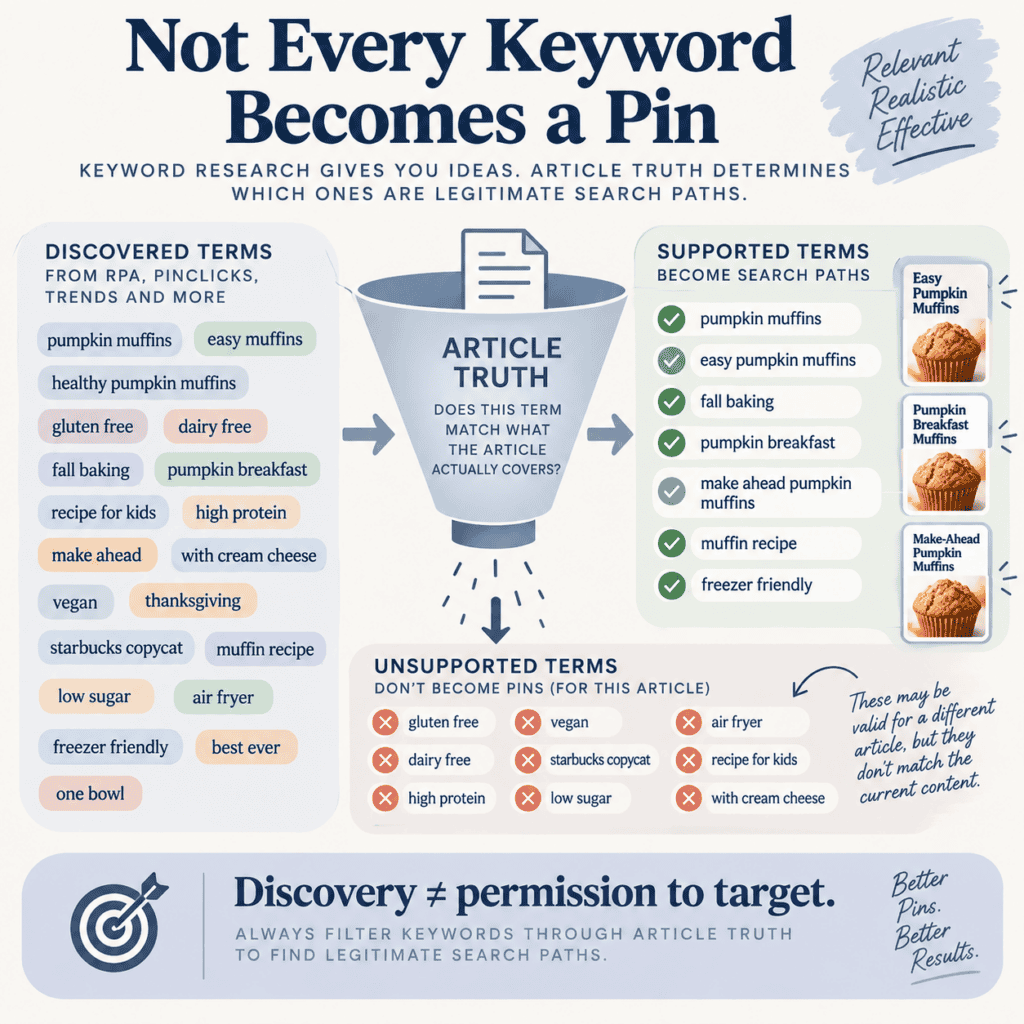
Pinterest might place gluten-free pumpkin muffins in the same Related Pin neighborhood as conventional pumpkin muffins.
That doesn’t make my recipe gluten-free.
I might see:
high-protein muffins, vegan pumpkin muffins, healthy breakfast muffins, or dairy-free baking.
None of those terms belong in my description unless the destination content actually supports them.
That isn’t simply because I want the Pin description to be accurate—although obviously I do.
It’s also about semantic consistency.
Pinterest isn’t limited to the handful of words I place in a Pin description. Pinterest Engineering has documented systems specifically designed to measure Pin and linked-page relatedness. Its Pin Cohesion work compared information from the Pin with the text and images on the linked webpage and used those signals across Search, recommendations and Home Feed.
That matters because the destination isn’t necessarily separate from Pinterest’s understanding of the Pin. It can contribute to the overall classification picture.
That’s why I don’t want the Pin promising one thing while the destination page communicates something substantially different. Pinterest’s current Business guidance reinforces this connection. Pinterest recommends allowing Pinterestbot to retrieve information from a website so Pinterest can understand where Pins are linking. It also advises publishers to make sure the images, text and keywords used in a Pin match the details on the landing page and that the Pin links to a page containing clearly related content.
If my Pin says:
gluten-free pumpkin muffins
but the recipe contains regular wheat flour, I’ve created more than a bad experience for the person who clicks.
I’ve also created conflicting information about the identity of the content.
The same principle applies when the mismatch is less obvious.
If Pinterest Related Pins repeatedly connect pumpkin muffins with high-protein breakfasts, that association is useful information about the broader neighborhood. But if my recipe isn’t meaningfully high in protein and the article doesn’t support that positioning, I don’t use high-protein breakfast simply because Pinterest showed me the relationship.
This is what I call the “Destination Truth Lock” within my Lattice System.
The destination controls what the Pin is allowed to claim.
RPA can show me how broad the surrounding semantic neighborhood is. Keyword research can show me where demand exists. Trends can show me what is gaining momentum.
None of those sources gets to rewrite the destination.
Ideally, the article, image, overlay, Pin title and description reinforce the same underlying content identity while each contributes useful context. Pinterest’s earlier annotation work also found that annotations derived from multiple sources tended to be higher quality than those appearing in only one source. While that doesn’t tell us how Pinterest’s current models weight these signals, it reinforces why I prefer semantic agreement across the Pin and destination rather than relying on one keyword placement.
This isn’t only a theoretical concern. Tailwind’s current Pinterest keyword-research documentation specifically advises that Pinterest checks the linked page for consistency with the Pin and warns that low consistency can affect distribution and the visibility of the Visit Site button.
The article is the factual boundary; the Related Pin neighborhood is the expansion layer.
RPA and Search Volume Answer Different Questions
RPA also keeps semantic relevance separate from search demand.
RPA asks:
What appears to be related?
Search-volume research asks:
What are people actually searching for?
Those aren’t interchangeable questions.
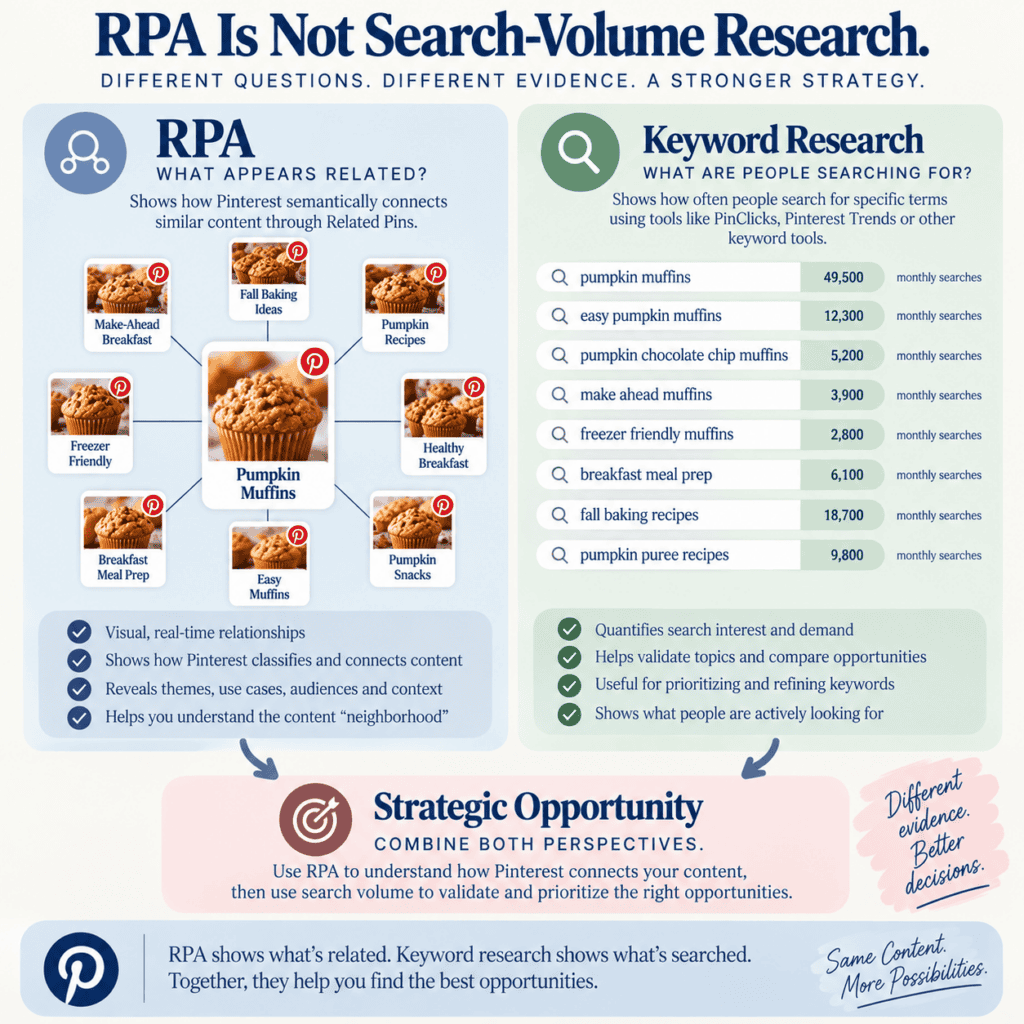
A concept might appear repeatedly throughout a Related Pin neighborhood but have very little current search demand.
Another phrase might have enormous search volume but be only weakly related to my article.
Neither number nor relationship alone makes the strategic decision.
That’s why RPA sits alongside other research layers in my workflow.
Once RPA gives me a promising hypothesis, I can investigate:
Pinterest autocomplete and search suggestions, Pinterest Trends, current Pinterest search results, long-tail keyword data, search volume, seasonality, and existing account performance.
Each layer answers a different question. This is where my broader Pinterest keyword research process comes back into the workflow.
RPA Helps Me Build Better Search Paths
There’s another reason this research matters.
A Related Pin neighborhood may reveal that one article legitimately sits inside several different information groups.
Take our pumpkin muffin example.
One searcher might want:
pumpkin chocolate chip muffins
Another:
easy fall baking
Another:
make-ahead breakfast
Another:
what to make with pumpkin puree
Those aren’t simply four keyword variations.
They’re different reasons someone might want the same underlying content.
This connects directly to the way I think about Pinterest search paths.
RPA helps identify potential relationships.
Keyword and trend research helps validate demand.
The article determines whether the relationship is truthful.
Then the Pin itself can communicate one clear retrieval reason.
That gives me a much stronger strategic foundation than simply producing another Pin with a slightly different adjective.
RPA Can Also Help Me Spot Changes in the Neighborhood
Related Pin Analysis becomes even more interesting when I repeat it.
Pinterest isn’t static. New content enters the platform, user behaviour and seasonality change, and recommendation systems evolve.
The same topic may therefore develop different visible relationships over time.
Perhaps a recipe previously appeared primarily around generic dinner ideas but begins showing stronger meal-prep associations.
Perhaps a pumpkin recipe begins developing stronger Thanksgiving relationships as the season approaches.
Perhaps an article with a vague Related Pin neighborhood begins developing a much clearer topical identity.
I don’t treat that as proof that Pinterest has formally reclassified a URL.
But I do treat a meaningful neighborhood change as a reason to investigate.
In my workflow, that can become a reclassification or momentum signal.
It tells me:
Something here may have changed.
Then I can look at Search, trends, analytics and current performance to find out whether anything actionable is happening.
What Pinterest Related Pins Cannot Tell Us
RPA is observational research. There is another complication: Related Pins can be personalized. Pinterest Engineering has documented Related Pin ranking systems that incorporate both the context of the Pin being viewed and signals about the individual Pinner’s interests and recent behaviour. So the neighborhood I observe should not automatically be treated as a universal neighborhood that every Pinterest user will see.
That means I need to be very careful about what I claim from it.
A Related Pin neighborhood cannot tell me exactly why Pinterest retrieved each individual Pin.
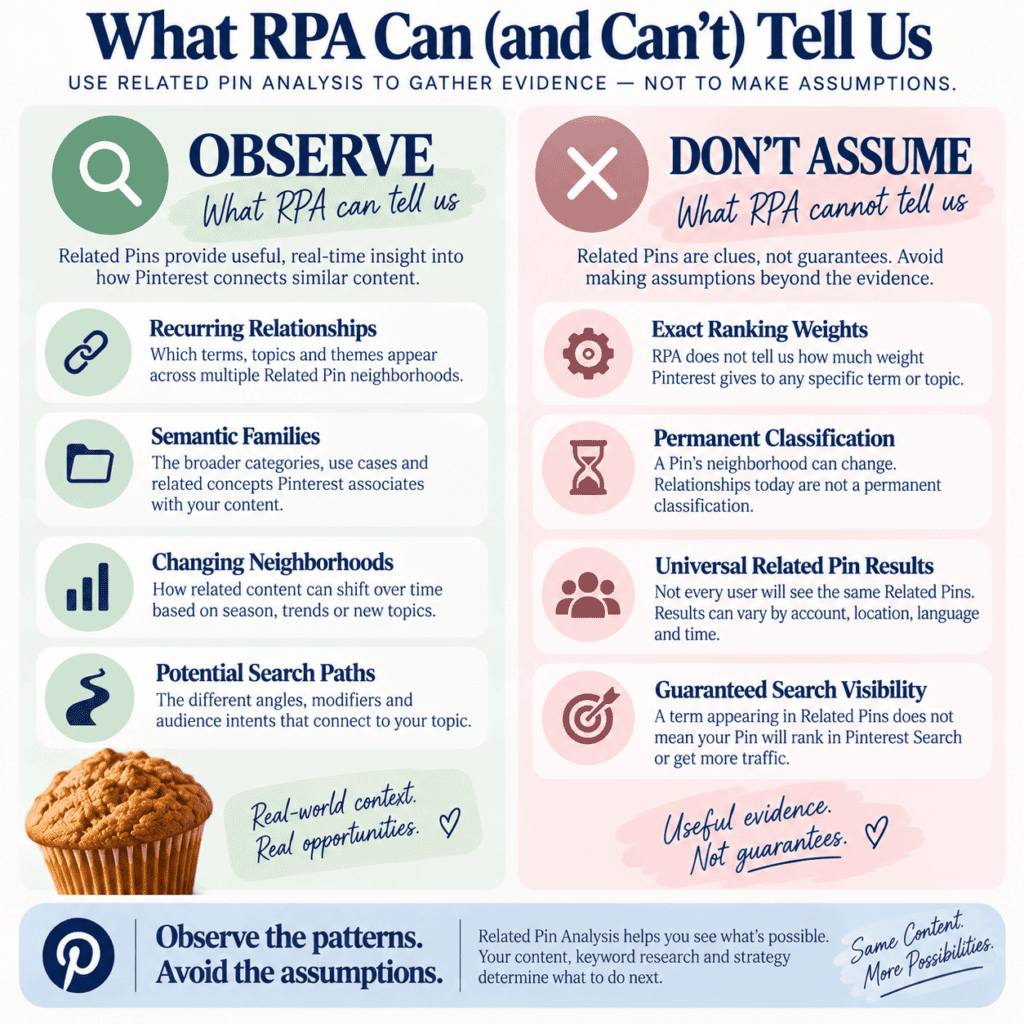
It cannot tell me the weighting Pinterest assigned to an image, annotation, board, description, engagement signal or user behaviour.
It cannot prove two concepts have been permanently classified together.
And it cannot guarantee that a relationship appearing in Related Pins will translate directly into Pinterest Search visibility.
What it can give me is something much more defensible:
Observable evidence of relationships Pinterest is currently displaying around the content.
I can compare those relationships, identify repetition and use those observations to decide what deserves further research.
My Related Pin Analysis Process
When I’m using Pinterest Related Pins for an article or recipe, I generally work through the research in this order.
Establish article identity first.
Before expanding anything, I need to know exactly what the destination content is and what it can truthfully claim.
Examine the Related Pin neighborhood.
I look beyond the original Pin and examine the surrounding content.
Look for repetition across independent Pins.
One interesting recommendation is an observation. Repeated relationships are much more useful.
Separate original-Pin language from neighborhood recurrence.
Unique language and repeated relationships can both matter, but they tell me different things.
Group the findings into semantic families.
I look for food objects, ingredients, methods, attributes, seasons, occasions, audiences, use cases and problems.
Apply the article-truth filter.
Unsupported relationships do not become targeting terms.
Identify potential classification pathways.
I ask what the surviving patterns tell me about where the content appears to fit.
Validate demand separately.
I use search, trends, long-tail research and other data to determine whether a relevant relationship also represents a useful opportunity.
Use the findings to inform the creative.
That includes how I build the overlay, Pin title and description—not merely a keyword list.
The end result isn’t:
Here are 30 keywords.
It’s:
Here is what this content is, here is the neighborhood Pinterest appears to place around it, and here are the parts of that neighborhood this particular Pin should clearly communicate.
Related Pin Analysis Is About Context
That’s ultimately why I built RPA into the Lattice System.
Pinterest keyword research tells me what people search for. Pinterest Related Pins give me another window into the relationships Pinterest is displaying around that content.
By studying the Related Pin neighborhood, I can investigate how Pinterest appears to connect food objects, ingredients, methods, attributes, seasons, occasions, use cases and problems.
Then I can compare those observations with the factual content of the article.
The overlap is where things get interesting.
That’s where RPA can help me build more coherent descriptions, identify overlooked search opportunities and understand which parts of a content lattice Pinterest may already be showing me.
I don’t need to guess every possible way Pinterest could classify the content.
I can start by paying attention to the neighborhood Pinterest is already showing me.


