If you have been publishing on Pinterest for a while, you probably have a few pieces of content that consistently attract attention. You may also have others that seem equally useful but barely move.
You can see the difference in your analytics. What is harder to understand is what that difference should tell you about your next move.
Should you create more content about the successful topic? Make another Pin? Change the wording? Update the article? Or investigate whether something less obvious connects the content people respond to?
Those are decisions bloggers and business owners face regularly. They take time, and getting them wrong can mean spending weeks creating content that never produces the response you expected.
This is where content intelligence becomes useful.
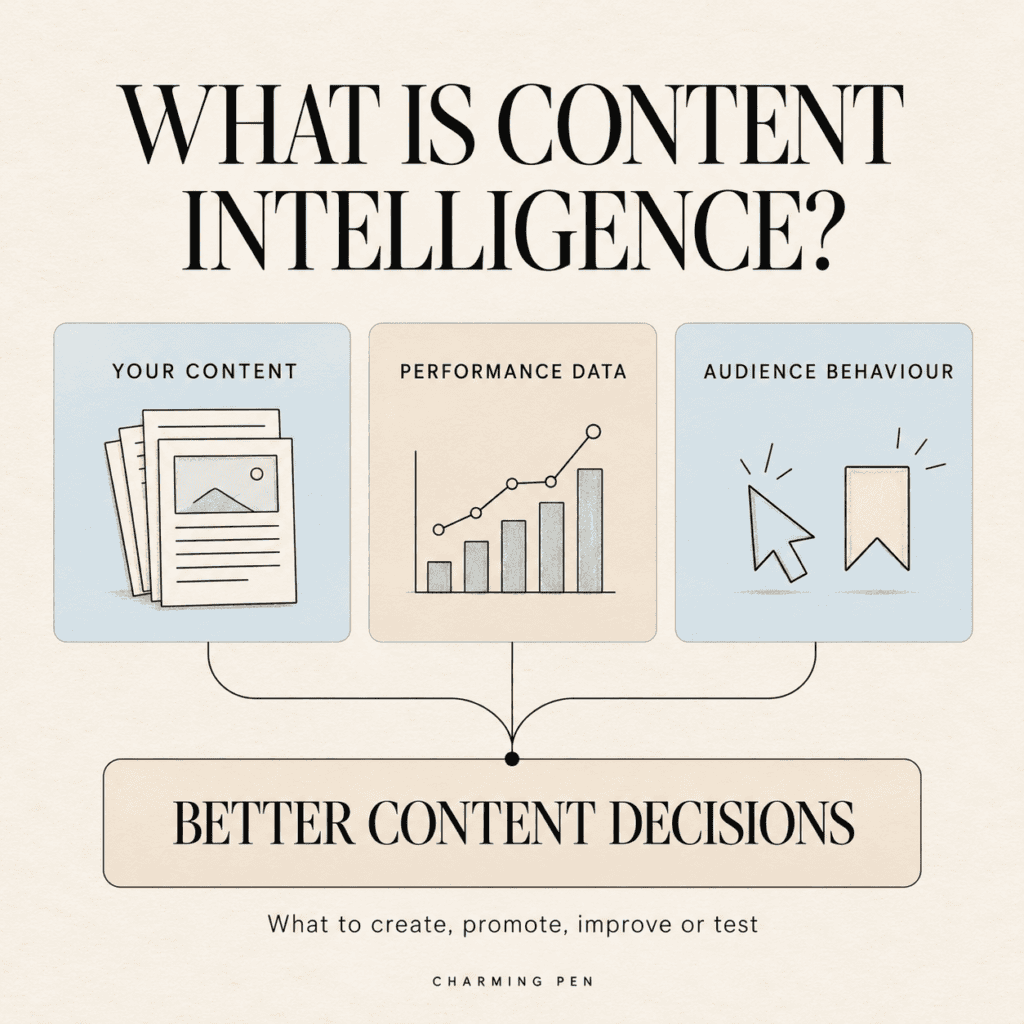
Content intelligence brings together information about your content, its performance, and audience behaviour to help you make better decisions. It gives you a way to move from noticing that something worked to investigating what you can learn from it—and how to apply that knowledge.
On Pinterest, the platform supplies part of that information through the content it distributes and the actions people take. Your website supplies another part through what visitors do after they arrive. Your knowledge of the content itself helps connect those observations.
A rising trend can tell you that interest in a subject is growing. Content intelligence asks what the available evidence means for your particular content and business. An opportunity may involve a growing topic, but it may also be sitting quietly inside an older article that keeps attracting the right readers.
In this guide, I’ll walk you through that process: what to examine, how to look for meaningful connections, how to avoid jumping to conclusions, and how to turn an observation into a useful test. We’ll start by defining the process, then work through an illustrative recipe example before exploring how the same approach can apply to travel, home décor, and service businesses.
What Does Content Intelligence Mean?
Before we look at the Pinterest example, it helps to understand what information we are bringing together—and what makes it useful.
Content intelligence is a systematic way of turning information about content and its use into decisions. Those decisions can include updating a page, testing a different presentation, promoting an overlooked resource, investigating an audience need, or choosing a new article.
There are several definitions across the industry. In its explanation of content intelligence, Content Science describes a process involving systems, software, analysis, people, and measurable impact. Its framework moves through collecting information, interpreting it, and taking action.
Forrester’s Getting Smart on Content Intelligence similarly connects data about content and its consumption with customer understanding and meaningful performance measurement.
For an independent blogger or business owner, the practical question is straightforward: what can the available evidence help you decide?
You might discover that several successful articles solve the same practical problem despite covering different topics. You might find that a popular Pin attracts people who leave the destination page quickly. You might uncover a useful article that has never received a clear, relevant Pinterest presentation.
Each finding points toward a different action. The value comes from making that connection accurately.
How Content Intelligence, Analytics, and Strategy Work Together
Content analytics supplies measurements. Content analysis examines what the content contains and promises. Content strategy sets priorities around the audience and the business. Content intelligence connects these activities in an ongoing decision process.
Consider a Pin that receives more outbound clicks than your other Pins. Analytics records that difference. Content analysis examines its subject, wording, image, format, and destination. Strategic interpretation considers whether the result supports your goals and deserves further investment.
You still need to investigate alternative explanations. The Pin may have been distributed more widely, published earlier, or promoted during stronger seasonal demand. A higher total alone cannot identify the cause.

| Activity | Question it helps answer | Pinterest example |
|---|---|---|
| Content analytics | What happened? | Which Pins generated outbound clicks? |
| Content analysis | What characteristics are present? | Which recipes use familiar methods and traditional ingredients? |
| Audience research | What needs or preferences might matter? | What do reader comments and observed behaviour suggest? |
| Content intelligence | What does the combined evidence support doing next? | Test an existing traditional recipe with a relevant Pin angle. |
| Content strategy | Where should effort go? | Allocate part of the publishing plan to that test. |
This process can be modest. A spreadsheet, a content library, Pinterest Analytics, and your website analytics can provide a useful starting point. The quality of the question matters more than the size of the software stack.
Content Intelligence Goes Beyond Chasing Trends
A rising trend tells you something about changing interest within the population and period the tool measures. Account performance tells you something about the content Pinterest has exposed to people and the responses recorded in that context.
These sources answer different questions.
If interest in a holiday dessert is growing, that may help you plan timing. It does not establish that the dessert suits your website, that your current audience wants it, or that publishing it will produce useful traffic.
Equally, an older recipe can remain valuable without being part of a fast-growing trend. Repeated response to familiar, practical content may deserve attention even when there is no dramatic upward line on a trend chart.
Pinterest’s Trends documentation describes regional search, save, and shopping information, with some audience-specific features where available. Search charts use indexed values rather than raw search counts. A chart reaching 100 therefore does not mean 100 searches.
Trend research can support content intelligence by helping evaluate demand and timing. It cannot replace investigating what your content is doing and whether that response serves the business.
The sequence I recommend is to identify a meaningful question, examine your own evidence, develop a plausible explanation, and then use demand research to assess a relevant next step. A trend can strengthen that decision. A trend alone does not make the decision.

Pinterest Supplies Signals Through Distribution and Response
Pinterest provides observable evidence through impressions, saves, clicks, audience information, and changes over time. These measurements help you study what happens when content meets people on the platform.
Pinterest’s guide to Pin statistics distinguishes impressions, saves, Pin clicks, and outbound clicks. Impressions record appearances on screen; outbound clicks record clicks toward the destination URL. Those measures represent different activities.
A widely distributed Pin may receive relatively few website visits. A less widely distributed Pin may send a useful stream of visitors. A heavily saved Pin may remain relevant to planning behaviour without producing immediate clicks.
None of those patterns automatically reveals someone’s motivation. Saving could reflect future intent, visual inspiration, comparison, or another purpose. Your interpretation needs supporting evidence.
The people reached are also broader than your followers. Pinterest’s Audience Insights documentation distinguishes engaged and total audiences and explains that interest information draws on platform behaviour, including searches and saves.
When I refer to an account’s audience here, I mean the people reached or engaged within the measurement context. That group can change as distribution changes. It should not be treated as a fixed community whose preferences you have completely decoded.
For a related discussion of interpretation, read Pinterest Signals: What Your Analytics May Actually Be Telling You.
An Example: Looking Beneath a Successful Bran Muffin Recipe
Imagine a food blogger whose old-fashioned bran muffins with raisins consistently perform well on Pinterest. They develop a wider bran muffin cluster, expecting related recipes to attract a similar response.
The broader cluster doesn’t gain the same traction. That makes the original explanation worth reconsidering.
Looking across their other successful content, they notice date squares and coconut macaroons with cherries for Christmas. These recipes have something else in common: they are familiar, traditional bakes.
Could that familiarity contribute to their appeal? The shared appeal may sit across several recipe categories. A keyword cluster groups content by topic; this investigation asks whether different topics serve a similar preference or need. That distinction can change which existing articles deserve promotion and which new articles are worth considering.
It is a possibility worth investigating. The muffin recipe could also have stronger imagery, clearer wording, more distribution history, or a better search match. The Christmas macaroons have a seasonal context that needs separate consideration.
The useful next question becomes: do other traditional recipes show a similar response when they receive an appropriate opportunity?
That question creates a direction for a manageable test using existing content. It doesn’t yet justify rebuilding the editorial calendar around traditional baking.
Step 1: Choose the Decision Before Opening the Dashboard
Start with a decision you need to make. Otherwise, it is easy to collect interesting figures without changing anything useful.
For a food blogger, the question might be which existing recipes deserve fresh Pinterest promotion. A travel publisher might be deciding whether practical itinerary content deserves more effort. A service provider might be investigating which articles attract potential clients.
Write the question narrowly enough that the evidence can inform it. “How do I grow?” is difficult to investigate. “Which existing articles should receive the next four Pin designs?” gives you a defined choice.
Choose a primary outcome alongside the question. Website visits, email subscriptions, qualified inquiries, and product purchases require different measurements. Impressions can help explain exposure, but they should not quietly replace the outcome you intended to improve.
Also identify the resource at stake. Are you allocating a few design hours, commissioning photography, or writing a new article? Begin with evidence proportionate to that commitment. An uncertain idea may justify a small test well before it justifies an expensive production project.
Step 2: Build a Content Inventory You Can Compare
A content inventory connects performance to the actual material on your website. Without it, your analysis can collapse into a list of Pin titles that hides the relationships between them.
Create one record for each destination URL. Record its title, main topic, factual characteristics, reader problem, seasonal relevance, and business purpose. Then connect the Pins promoting it to that record.
For a recipe, useful attributes might include preparation method, key ingredients, storage suitability, meal role, and whether the recipe is genuinely traditional. For travel, they might include pace, accessibility information, transport, trip length, and cost.
Keep observable facts separate from interpretations. “Uses pantry ingredients” can be checked against the recipe. “Makes people nostalgic” is an audience hypothesis unless readers have actually expressed that response.
Avoid turning every possible quality into a column. Begin with the characteristics relevant to your question and add more when the investigation requires them.
| Record | Factual information | Possible interpretation to investigate |
|---|---|---|
| Bran muffins with raisins | Bran muffin recipe containing raisins | Familiar baking may contribute to appeal |
| Date squares | Date-filled baked squares | Traditional recipes may share an audience connection |
| Cherry-topped coconut macaroons | Coconut cookies with a Christmas use case | Familiar holiday baking may matter alongside seasonality |
These examples record a possible connection. They do not establish that the same people engaged with every recipe.

Step 3: Gather Performance Data With Comparable Context
Pick a reporting period and record it. Keep track of geography, organic versus paid activity, Pin age, publication history, and any major website or publishing changes that could affect the comparison.
An older Pin has had more time to accumulate distribution than a new one. A Christmas recipe measured in December faces different demand from the same recipe in June. Ten designs promoting one URL provide a different amount of opportunity from one design promoting another.
Use recent performance to understand the current situation, then review longer history where available. Short windows can highlight emerging movement; longer windows help reveal recurring seasonality and durable response. Neither automatically explains the other. A short-term increase also needs context. Before treating it as lasting progress, examine whether your Pinterest growth reflects a meaningful change or a baseline bump.
Pinterest’s Analytics guide explains how filters change the content included in reports. Record the filters you use so later comparisons describe the same scope.
Keep Pin-level and URL-level questions distinct. Pin-level analysis helps examine presentation. URL-level analysis helps evaluate the destination across its supporting Pins. Check the reporting scope before combining figures so you do not double-count overlapping statistics.
For website outcomes, compare Pinterest reporting with your site analytics. The figures may differ because a platform click and a recorded website session are different events. Use them to investigate the journey rather than expecting a perfect one-to-one match.
Step 4: Read Reach, Response, and Website Outcomes Together
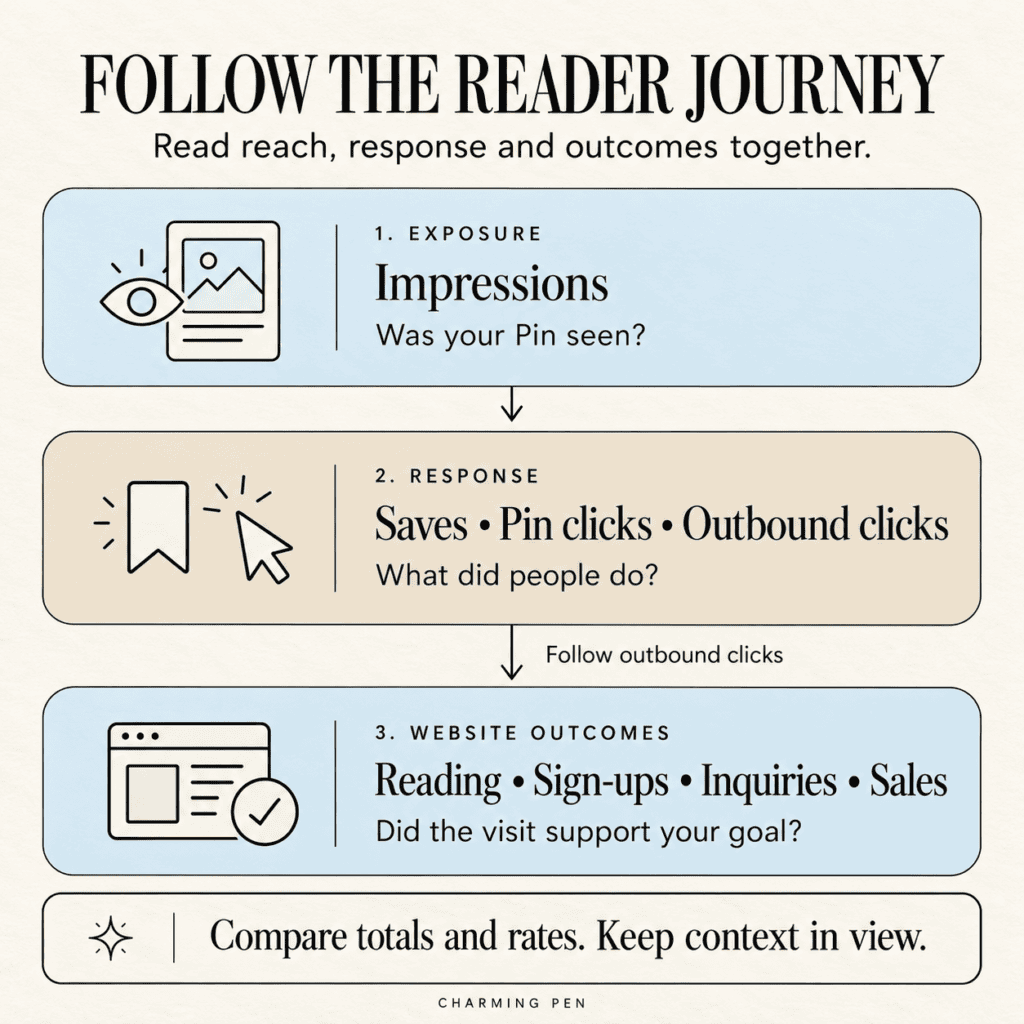
A useful analysis follows the reader’s path as far as your measurement allows.
First, examine exposure. Did the Pin receive enough impressions to tell you much about response? Very limited distribution leaves considerable uncertainty. A low click total under those conditions cannot establish that people rejected the content. If exposure is the immediate problem, start by investigating why your Pinterest Pins aren’t getting views before drawing conclusions about audience preferences.
Next, examine actions in relation to exposure. For a consistent reporting scope, outbound click rate can be calculated as outbound clicks divided by impressions, multiplied by 100. Save rate can be calculated in the same way using saves.
Suppose one Pin produces 100 outbound clicks from 10,000 impressions and another produces 15 from 500. Those illustrative rates are 1% and 3%. The second deserves investigation, while the first still supplies more total clicks. Neither figure alone settles which deserves more investment, and the smaller sample is less stable.

Finally, examine what happens after arrival. Are people reading, viewing another relevant page, subscribing, or making an inquiry? The appropriate outcome depends on the page and business model.
Treat rates and totals as complementary. A high rate from a handful of impressions is fragile evidence. Strong traffic without useful website behaviour can reveal a different problem. Repeated patterns across comparable content give you a firmer basis for decisions than an isolated percentage.
A Published Example: High Traffic Concealed Weak Reading
Message Lab’s Content Intelligence, Deconstructed describes a technology client whose blog attracted substantial traffic. Closer measurement showed that about 60% of visitors left within five seconds. Message Lab reports identifying a user-experience problem and recommending layout changes.
Message Lab reports this example from its own client work. It illustrates why examining what happens after the click can reveal a problem that traffic totals alone miss.
The lesson for a Pinterest publisher is to follow a promising click through to the destination. If arrivals do not lead to the intended engagement, investigate the page experience, traffic quality, and the match between the Pin’s promise and what readers find.
Making more Pins would not automatically resolve a problem further along that journey.
Step 5: Look Across Winners, Ordinary Results, and Misses
Build a comparison group that includes successful content, typical content, and weaker performers. Studying only winners makes almost any explanation look convincing.
If you suspect traditional recipes have an advantage, look for traditional recipes that struggled. Then inspect successful recipes that lack that quality. Ask whether the proposed pattern still helps explain anything once those counterexamples are included.
Compare characteristics at several levels: the exact topic, the practical problem, the preparation or delivery method, and the way the content is presented. A shared ingredient may be less informative than a shared use case. A recurring headline promise may explain more than a broad category.
Record differences in opportunity as well. A weak result from a poorly exposed URL belongs in a different category from a weak response after substantial exposure.
You are looking for a pattern worth testing, with its exceptions visible. The goal is to improve your next decision, not to force the whole content library into a tidy story.
Step 6: Write a Hypothesis and Its Alternatives
A workable hypothesis names the proposed connection and the outcome you expect. For example: “Familiar, traditional baking may attract stronger outbound response than comparable baking content in this account.”
That statement remains provisional. Write down competing explanations beside it: stronger photography, seasonal timing, differences in Pin age, clearer recipe wording, or broader distribution could explain part of the observed result. Presentation deserves its own review. Check for Pin design mistakes that can hurt clicks, particularly when comparing content promoted through noticeably different layouts.
Identify what would weaken your hypothesis. If several suitable traditional recipes receive meaningful exposure and repeatedly show ordinary response, the idea becomes less useful. If the pattern appears only in one visual template, presentation deserves more attention.
This discipline helps prevent a plausible interpretation from hardening into a supposed audience fact.

Nielsen Norman Group’s overview of quantitative research methods explains how analytics records observable activity, such as where people go and what they click. To investigate motivation, add reader feedback, interviews, or other appropriate research where practical.
A short reader question about why someone uses a recipe may contribute context. A few replies still do not represent everyone Pinterest reaches, but they can help you ask better questions of the numerical evidence.
Step 7: Check Demand and Existing Content Before Expanding
Once the hypothesis is clear, examine whether there is a sensible way to test it. Start with your website. You may already have relevant content that needs better promotion or a clearer presentation.
Then research exact topics, related search language, seasonality, and competing content. Pinterest search, Pinterest Trends, and keyword tools can help identify how people describe the subject. Record whether figures are platform estimates, indexed trends, or measurements from your own account. For a practical research process, see how to find more Pinterest keywords for one blog post. Use those terms to investigate relevant opportunities while keeping the article’s factual identity intact.
A content gap should connect an audience need, evidence of opportunity, your ability to serve it, and a business reason to invest. A missing keyword alone is a limited reason to produce an article.
Keep every proposed angle truthful. A traditional recipe is not automatically cheap, quick, healthy, or freezer-friendly. Its ingredients, method, and tested results set the boundaries for promotion.
This is also where controlled expansion matters. Explore a relevant neighbouring idea while preserving the content’s identity. My article on Controlled Elasticity develops that principle further.
Step 8: Design a Small Test You Can Interpret
Choose a manageable set of existing articles that fits the hypothesis, plus a comparison group where practical. Give both reasonable publishing opportunities while keeping the main conditions as consistent as you can.
To test the traditional-baking idea, the blogger could select suitable existing recipes, create clear Pins using accurate wording, and compare their response with other baking content. They would record the designs, publication dates, boards, and any changes to the pages.
For example, the blogger could begin with three existing traditional baking recipes and three other baking recipes with broadly similar seasonal relevance. This would be a small exploratory comparison, not a statistically conclusive experiment.
Each recipe could receive one new Pin using the same layout family and a similar publishing schedule. The wording would accurately describe each recipe, and the Pins would go to relevant boards. The blogger would record impressions, outbound clicks, outbound click rate, and available website engagement measures.
At review, they would examine each recipe individually as well as the two groups. If one recipe accounted for nearly all the improvement, that would weaken a broad explanation about traditional baking. If several traditional recipes showed a similar response, the pattern could justify another small test. Recipes receiving very little exposure would remain inconclusive.
Write down the primary outcome and review conditions before publishing. For example: review outbound response once the content has accumulated enough exposure to make comparison useful, while also checking website engagement. There is no universal number of days that makes every Pinterest test conclusive. The Pinterest growth timeline provides further context for evaluating progress without expecting every new Pin to produce an immediate answer.
Change one main factor where possible. If the subject, template, wording, publishing volume, and destination all change together, the result becomes difficult to interpret.
Organic Pinterest publishing does not normally provide a randomized experiment with identical audiences. Treat this as structured learning under imperfect conditions. You can still improve your decisions by recording what changed, what happened, and what remains uncertain.
Step 9: Review, Decide, and Keep the Learning
At review, choose among expanding the idea, revising the explanation, pausing the test, or continuing observation. Insufficient exposure can justify an inconclusive result.
If several appropriate recipes show useful response across more than one review, the pattern may justify a little more investment. That could mean another existing URL, a stronger internal link, or one carefully selected new recipe.
If attention rises but website outcomes weaken, inspect the promise and landing page. If only one design succeeds, revisit presentation. If the comparison group improves just as much, broader conditions may be contributing.
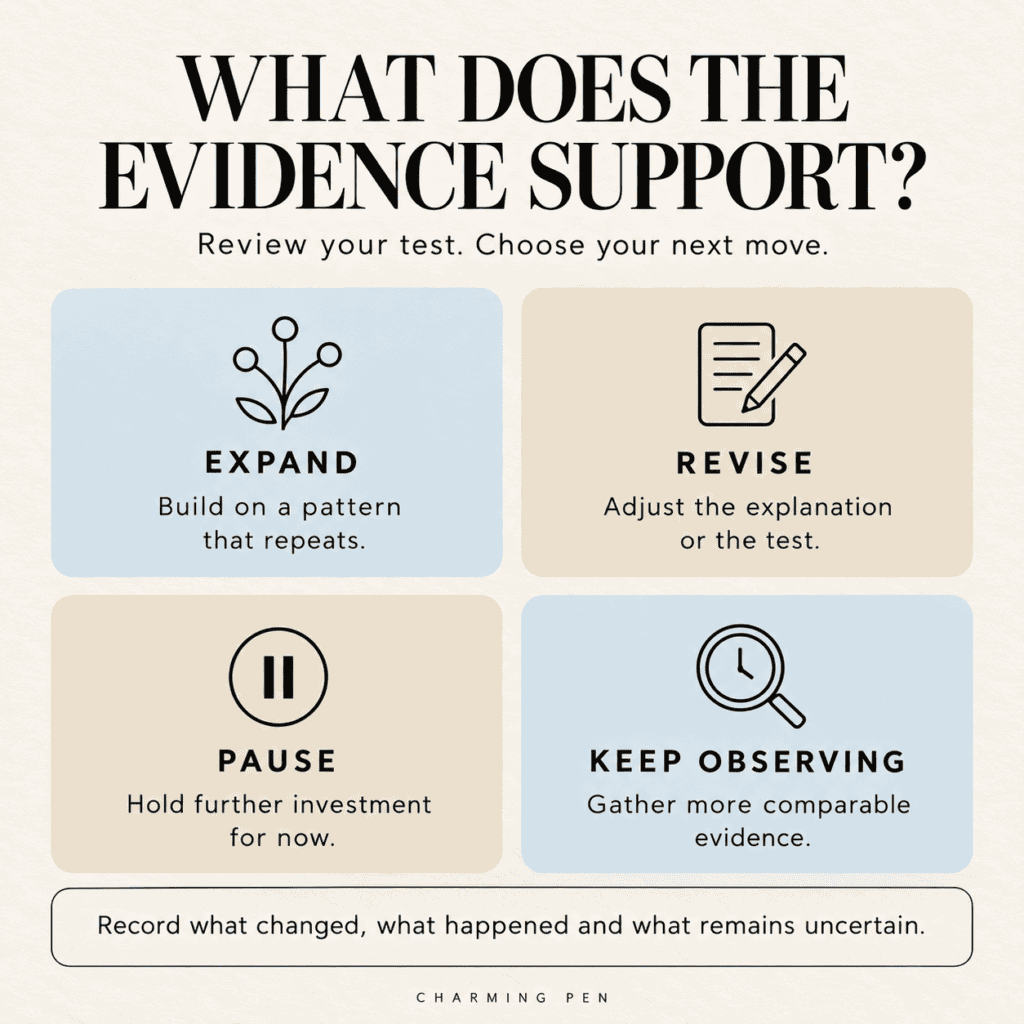
Keep a short decision record: the question, evidence, interpretation, action, result, and remaining uncertainty. This preserves the reasoning when a manager changes or when you revisit the topic months later.
Repeated, documented learning builds a more useful content strategy than a succession of disconnected publishing experiments. It also helps identify when an old explanation has stopped matching the evidence. That continuing review is part of why your Pinterest marketing strategy should never be finished: each round of evidence can inform the next decision.
Can This Work Beyond Food?
Yes. The same questions can be applied wherever you have content, observable response, and decisions to make. The following are hypothetical examples, intended to demonstrate the method.
A travel publisher sees good results from a quiet coastal itinerary, a slower-paced city visit, and a guide to uncrowded gardens. The useful connection might involve manageable pacing rather than a single destination. The next test could explore that possibility through accurate, existing itineraries.
A home décor business finds that a small-entryway guide, a narrow-room layout, and a compact desk setup perform well. Practical use of limited space may be worth investigating alongside the visual style. A new colour trend would answer a different question.
A service provider attracts traffic with broad advice, but detailed diagnostic articles appear more often in the paths leading to inquiries. The business could investigate whether those articles help readers recognize a problem and decide to seek support. It would need to check attribution and avoid assuming every inquiry resulted from one page.
Each example looks beneath the category while keeping the explanation testable.
A Retail Example of Testing an Adjacent Opportunity
Walgreens Advertising Group’s first-party data case study describes finding a potential beauty audience through purchases in related health and wellness categories. The team tested the audience before extending the campaign.
The study also discusses a broader self-care trend. Its useful contribution here is the additional work: examining observed purchasing, identifying a specific adjacent audience, and testing the opportunity.
This retail case involves paid advertising and purchase data, so its results cannot be applied directly to organic Pinterest. The useful principle is to investigate an adjacent opportunity through observed behaviour, then test it before expanding.
Where AI and Content Intelligence Tools Help
Artificial intelligence can assist with tagging a content inventory, grouping similar articles, comparing attributes, summarizing exports, and proposing alternative explanations. Software can also help maintain consistent reporting and identify unusual changes.
Human review remains necessary. An AI system may classify unrelated recipes as nostalgic, overlook an important ingredient, or turn a tentative association into a confident claim about the audience.
Give it a defined task: “Separate observed facts from possible explanations, identify counterexamples, and suggest the smallest useful test.” Ask it to retain URLs, reporting dates, and source labels so you can check the work.
Use Pinterest’s own reporting for platform activity, website analytics for on-site outcomes, and keyword tools for discovery research. A content intelligence platform may combine several functions, but check its actual inputs and capabilities before relying on its recommendations.
The workflow should leave you better able to explain your decision. A polished automated summary is of limited value if you cannot trace the supporting evidence.
When a Pinterest Audit Becomes Useful
The difficult part is often deciding which explanation deserves attention. Similar symptoms can come from different situations: limited exposure, poor presentation, seasonal demand, a weak destination page, or content that attracts interest without supporting the business.
A useful Pinterest audit examines those connections. It brings the website, content library, publishing history, search opportunity, and audience response into the same investigation, then sets out priorities and practical tests.
If you can see movement in your account but are unsure what to do next, my Pinterest strategy audit examines those connections and identifies practical priorities. You’ll have a clearer basis for deciding which content deserves attention, what needs further investigation, and which opportunities are worth testing.
You Asked, Amber Answers
Pinterest advice can get complicated fast. Here are my quick answers to a few of the most common questions around this topic.

Yes—this image was made with AI. As a small business owner wearing a lot of hats, I don’t always have the time to arrange a professional photo shoot, so this is one way I create polished visuals for my business.