I used to think a good Pinterest marketing strategy was something you built, documented, and then followed.
You did the keyword research, organized the boards, planned the pins, wrote the descriptions, created the assets, scheduled everything, and watched the analytics. There was obviously strategy involved, but the production side of Pinterest management was relatively straightforward.
I could whip up a good pin description and create the pin itself in a couple of minutes. Planning 20 or more pins for a client was a cinch. Multiply that by ten clients and yes, you had yourself a full-time job, but it was a manageable full-time schedule. Pricing for Pinterest management reflected that kind of workload.
That is not remotely how I work now.
Pinterest has changed. The tools available to research it have changed. AI has changed how much information I can collect and evaluate. And, maybe most importantly, my understanding of what I actually need to know before I publish a pin has changed substantially since I first became a Pinterest manager.
Somewhere along the way, “Pinterest manager” stopped adequately describing the work I was doing.
The strategy itself also stopped feeling like something that could ever really be finished.

I Was Already Iterating, Then an AI Engineer Put Words Around Why It Matters
I had already started treating my Pinterest systems this way when I read Cristobal Santana’s “Prompt Engineering: Why the Tricks Keep Expiring”.
Cristobal writes Strange Machines on Substack. He is a physicist by training and an AI engineer by trade, and he builds these systems in production rather than watching them from the sidelines. His work looks at the stranger parts of modern machine learning, particularly the gap between something that appears to work in a clean test and what happens once it meets the real world.
His article did not introduce me to iteration. By the time I read it, I had already revised my own Pinterest systems repeatedly because testing kept showing me places where the system could be better.
What his article did was cement the logic behind what I was already doing.

A technique can work very well and still not deserve to become permanent doctrine. The underlying model changes. Capabilities change. Better ways of evaluating the output become available. Something that solved a problem six months ago can become unnecessary, or a new tool can expose a weakness you simply could not see before.
That sounded awfully familiar.
In 2026 alone, I have made at least a dozen meaningful changes to the Pinterest frameworks I use. I am not counting little wording changes inside a prompt. I mean changes to the way I research Pinterest, choose retrieval pathways, control distribution, evaluate related pins, build keyword inventories, test visual treatments, and decide when the system should expand or stay tightly anchored to the content.
By spring I was already on what I considered my fourth major macro architecture. Since then I have added and changed layers around retrieval depth, entity reinforcement, annotation clusters, related-pin neighborhoods, controlled elasticity, long-tail inventory, visual memory, distribution controls, and RPA testing.
The systems I used earlier were not failures. They are part of the reason the current systems exist.
An earlier version worked, produced information, exposed a limitation, and made the next version possible.
That is iteration.
Then AI Put Tool Development on Fast Forward
There is another thing happening at the same time.
AI is making it easier for people to build their own tools.
Someone who might not have been able to develop a specialized research application a couple of years ago can now use AI to help write code, connect APIs, build an MCP server, automate part of a workflow, or create a tool around one very specific problem.
Wonderful.
Swell.
More research for me.

Because the fact that a new tool exists does not mean I should immediately bolt it onto my Pinterest workflow.
Every one creates another set of questions. Is it actually valuable to what I am doing? Where is its information coming from? Is that source reputable? Can I verify the output? Does the tool show me something I cannot already see? Does it save enough time or reveal enough useful information to justify the cost? If I add it to my process, what exactly does it bring to the table?
Before I can answer any of those questions, I need to understand Pinterest well enough to know whether the information matters.
AI does not remove the need for domain knowledge. In my experience, having access to more AI tools has made domain knowledge even more important because there is simply more information to judge. That part requires heavier critical thinking. A tool can surface data, find patterns, or accelerate research, but it cannot automatically tell me whether that information matters to the Pinterest account in front of me. I still have to understand Pinterest well enough to question the source, compare the evidence, recognize when something does not fit, and decide whether acting on it is likely to improve the strategy.
A tool can give me 100 keywords. That does not mean I have 100 useful keywords.
It can identify an apparent pattern. That does not mean the pattern deserves to become a rule.
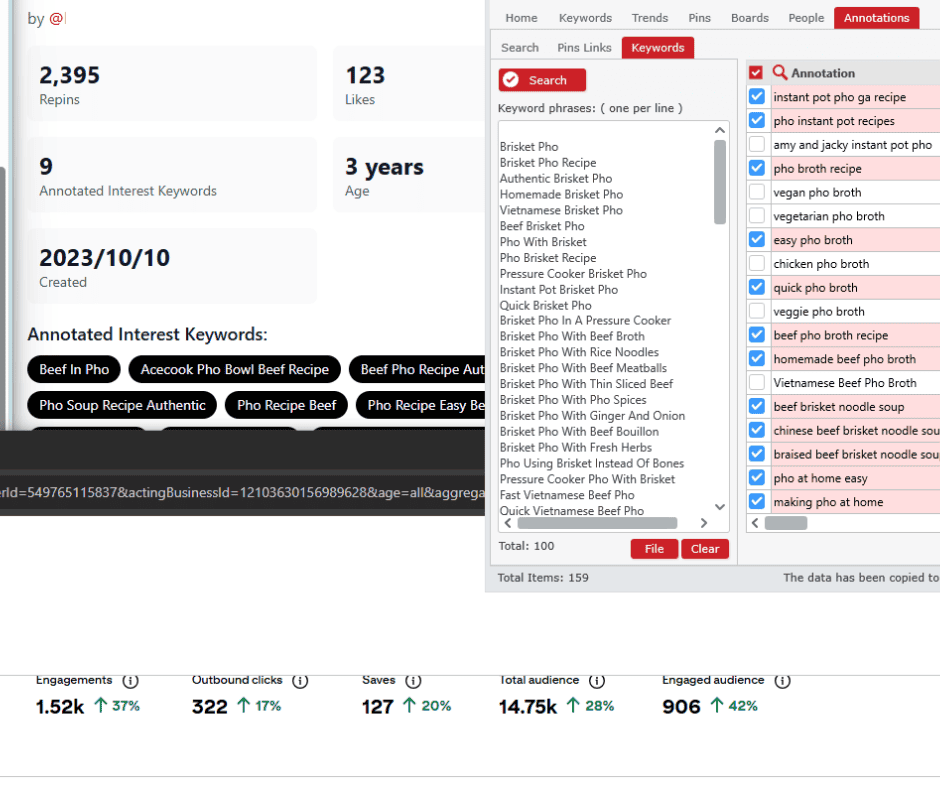
It can show me annotations around a pin. That does not mean every annotation belongs in my strategy.
Someone still has to know enough about the system to decide what the evidence means.
Which Brings Me to the Descriptive Bubbles
This is where I think there is a growing divide in Pinterest strategy.
There are still managers and strategists building much of their keyword planning around the descriptive or guided-search bubbles Pinterest makes visible around searches.
I understand why. I used them too, and I still think they have value.
Those bubbles can show you how Pinterest is organizing language around a topic. They can expose adjacent concepts, modifiers, and semantic relationships that are difficult to see if you are staring at one keyword in isolation.
What I no longer believe is that they are enough.

We actually worked through this distinction in my own research some time ago: a semantic neighborhood is not automatically a retrieval door.
The neighborhood can help explain what concepts Pinterest sees around something. It does not necessarily tell me which specific pathway I should ask a particular pin to enter.
That difference has become increasingly important.
If I search for a recipe and Pinterest gives me a neat row of descriptive bubbles, those bubbles are one visible artifact of a system that is doing considerably more behind the scenes.
Pinterest’s own engineering publications make that pretty hard to ignore.
Pinterest has described recommendation systems where billions of possible Pins are narrowed through retrieval and ranking stages, with learned retrieval incorporating user engagement and embeddings rather than relying only on simple heuristic or text-based systems. Pinterest has also discussed frequent model retraining specifically to capture changing user behavior and recent trends.
Its engineers have described Home Feed retrieval using multiple feature types and learned representations designed to capture patterns in user engagement.
Pinterest Search has incorporated large language models into relevance work, including evaluating semantic relevance between a search query and Pins.
More recently, Pinterest has written about using multimodal PinCLIP representations and hierarchical Semantic IDs to reason about content similarity and semantic overlap while also controlling diversity in the Home Feed.
Even Pinterest’s much older engineering work around annotations makes the point. Annotations have been used as important signals across search, Home Feed, Related Pins, ads, and other surfaces, but even then they were part of a larger machine-learning system rather than a standalone keyword recipe.
So if Pinterest itself is using learned retrieval, visual and textual representations, engagement signals, semantic relevance, multiple ranking stages, and constantly evolving models, I do not think my research can stop at, “Pinterest showed me this descriptive bubble, so I will use that phrase.”
The bubble is evidence.
It is not the whole investigation.
Which Brings Me Back to the Descriptive Bubbles
I still use Pinterest’s descriptive search bubbles. What has changed is how I use them.
Years ago, it was easy to treat those bubbles almost like a ready-made keyword list. Search the main topic, collect the relevant phrases Pinterest displayed, work them into your pin planning, and move on.
Now I am much more interested in what they can tell me about where the Pinterest SERP branches next.
I wrote about this more fully in “Pinterest SERPs: What They Are and How to Use Them to Refine Your Strategy,” because ranking for a keyword changes the research question. Once I already have a pin performing in one SERP, I don’t necessarily need another pin trying to win exactly the same piece of ground.
Say I already rank for lemon cake. I can look at the semantic bubbles Pinterest presents around that search and see whether there is another supported direction I haven’t captured yet. Maybe Pinterest is surfacing something like lemon cake in an 8×8 pan, and my recipe actually uses an 8×8 pan.
Now that bubble has become interesting.
I’m not simply adding “8×8 pan” to my next description because Pinterest showed it to me. I’m asking whether that refinement represents a different SERP I can legitimately enter with the same piece of content.
That is the distinction.
The bubble helps me discover the possible neighborhood. Then I can actually look at that SERP, see what Pinterest is returning, determine whether my content belongs there, check whether I already have coverage, and decide whether it is worth building a pin specifically for that entry point.
That is much more useful to me than collecting five bubbles and spreading all five across every pin.
The bubbles did not stop being valuable. The job I ask them to do changed.
One Pin, One Retrieval Door
This was one of the more important changes in my own system.

At one point, it was easy to treat Pinterest keyword research as a collection exercise. Find the relevant phrases, work them into titles and descriptions, rotate them around, and try to give Pinterest plenty of context.
Now I am much more interested in deciding what job each pin is supposed to do.
I may have several valid semantic neighborhoods around one article, but that does not mean I should cram all of them into every pin.
I want to know which retrieval door that particular pin is testing.
The main content identity has to remain clear. From there I can decide which article-supported pathway I want to reinforce, what context belongs around it, and what tempting adjacent language should be left alone because it risks dragging the content somewhere it does not belong.
That is why related-pin research has become so interesting to me.
Instead of only asking Pinterest, “What words occur around this topic?” I can start asking, “What does Pinterest repeatedly associate with Pins it already considers related to this one?”
Now I can look across multiple related pins for repeated annotations. I can group those terms into semantic families. I can look at which concepts are showing up independently across several pins instead of being repeated several times on one pin. I can compare that neighborhood to the article itself and decide whether Pinterest’s apparent association is useful, too broad, or simply wrong for what I am trying to do.
That is a very different question than choosing a descriptive bubble because it sounds relevant.
And sometimes the research tells me not to expand.
That matters just as much.
AI Did Not Make a Pin Take Two Seconds
There is a popular assumption that AI should make marketing faster.
Sometimes it absolutely does.
It also gives me the ability to do work I was never doing in the first place.
Those are not the same thing.
A single pin in my current process can take anywhere from about 20 to 40 minutes, depending on the article, the account, the amount of research required, and whether all my tools have decided they are speaking to one another that day.
Before I get anywhere near Canva, there can be several gates.
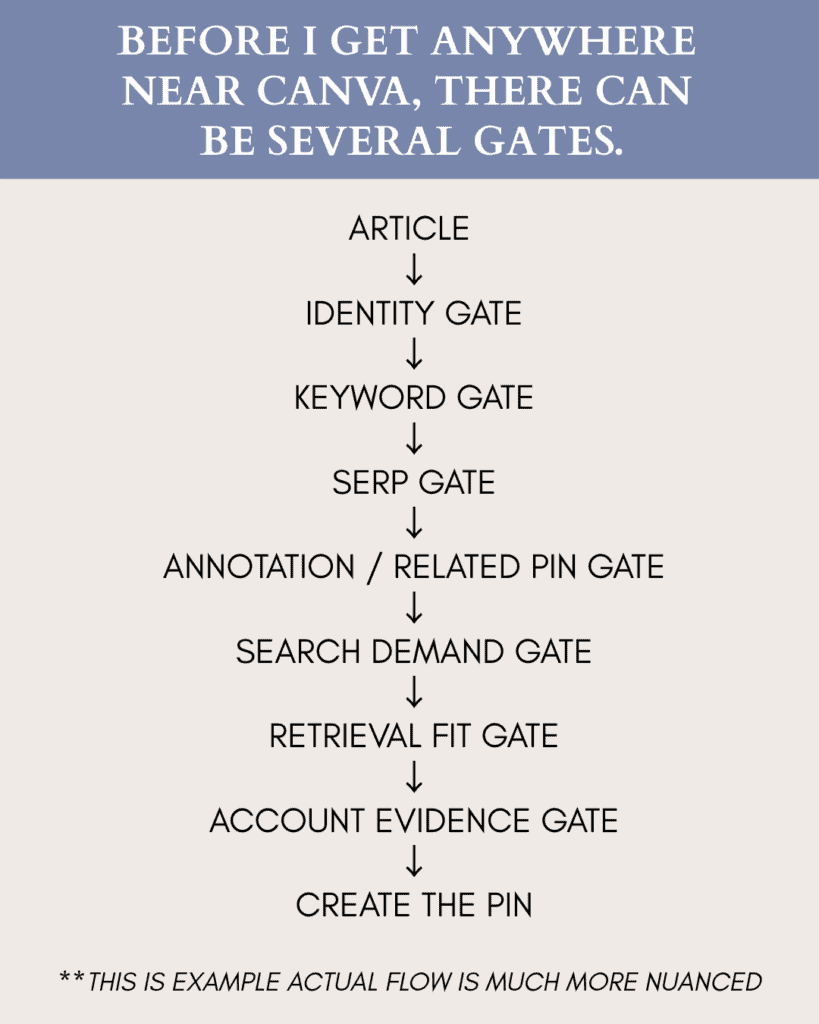
I need to understand what the article actually supports. I need the primary identity. I may look at Pinterest-assigned language, search volume, semantic neighborhoods, related-pin annotations, long-tail opportunities, trend information, existing account behavior, and previous testing. Then I have to filter that information rather than simply collecting it.
Is this keyword relevant, or merely adjacent?
Does this term reinforce the content object or pull it into another neighborhood?
Is there enough evidence to justify testing this direction?
Have I already exhausted the obvious retrieval path?
Would this pin add a new retrieval opportunity to the batch, or am I making four cosmetic versions of the same pin?
Only after those decisions do I create the thing someone scrolling Pinterest will actually see.
The asset is almost the final step now.
That has changed the economics of Pinterest work. Earlier Pinterest management pricing reflected a workflow where production volume made sense as a way to calculate the work. If a pin took a few minutes, 20 pins was one kind of workload.
Twenty pins at 20 to 40 minutes each, with the research and judgment happening before the asset exists, is another thing entirely.
AI has sped up individual parts of that workflow, but it has also made deeper investigation possible. More evidence can lead to better decisions, but somebody still has to evaluate the evidence.
“But I’m Not Seeing Much Outbound Traffic”
If you are a client reading this, or managing your own account, you may be thinking, This all sounds very impressive, but I am not exactly watching outbound traffic explode over here.
Fair question.

Outbound traffic matters to me too. I am not interested in creating beautiful Pinterest analytics charts that never send anyone to a website.
The difficult part is that the outbound click is the end result of a lot of things happening before it.
Pinterest first has to understand the content well enough to put it into useful retrieval and distribution pathways. The visual has to earn attention once it appears. The wording has to attract the right person rather than simply create impressions. The article has to deliver what the pin promised. Account history, competition, seasonality, content demand, Pinterest’s current distribution environment, user behavior, and the strength of the creative are all in play.
This is one reason I do not like judging the health of a strategy by a single metric in isolation.
Sometimes the problem is reach.
Sometimes the account has reach but the wrong audience.
Sometimes impressions move before clicks do.
Sometimes the classification needs tightening.
Sometimes the visual is the weak point.
Sometimes Pinterest is correctly retrieving the content but the search demand itself is small.
Sometimes the strategy works, but it could work better.
That last one is important.
It is not enough for me to create a strategy, see that it technically functions, and leave it untouched for six months.
I need to continually ask whether the best iteration of what I know is actually the version being used.
A keyword framework I wrote three months ago might still generate impressions, but if newer research has shown me a more precise way to control retrieval, why would I deliberately keep using the old one?
A pin-production rule might still work, but if testing across multiple accounts has exposed where it fails, that belongs in the next version.
A research method might have been my best option in January. Then a new tool gives me access to a layer of evidence I could not reasonably collect before.
The old method did not suddenly become stupid. I simply know more now.
This Is Why a Lattice Audit Includes Four Macro Updates
This is also why I do not hand over a Lattice Audit and pretend the macro attached to it has been carved into stone.
The initial macro is the strongest operating model I can build from the evidence available at the time of the audit.
Then it has to meet reality.

Once it is being used, we may discover that the account needs tighter distribution controls, different keyword density, a stronger long-tail inventory, changes to visual testing, clearer retrieval boundaries, or a different balance between stability and expansion.
That is why my Lattice Audits include four macro updates.
Those updates are not corrections because I expect to be wrong four times.
The updates are part of the audit.
Version one gives us something structured to deploy. Deployment gives us new information. That evidence gives us a reason to change or not change something. The updated macro carries what we learned into the next round.
That process is very close to what struck me in Cristobal’s article about AI systems. Once you stop treating the current technique as permanent truth, versioning stops looking like indecision and starts looking like responsible system design.
I would be much more concerned if my Pinterest system had not changed this year.
So What About the Strategist Still Using the Bubbles?
I do not think using Pinterest’s descriptive bubbles makes someone a bad Pinterest manager.
I think stopping there is increasingly hard to defend.
The bubbles are fast. They are convenient. They are visible. They also come from a time when that level of research could form a much larger percentage of the work.
Pinterest’s own technology has moved considerably beyond a simple keyword-matching view of discovery. My tools for studying it have moved forward too. Once I know I can examine retrieval neighborhoods, related-pin annotations, account response, search demand, trend behavior, visual memory, semantic relationships, and long-tail pathways, I cannot unknow that and go back to pretending one row of bubbles tells me everything I need.
The question is no longer just, “What keywords describe this pin?”
I want to know what Pinterest appears to think the pin is, where it is likely to retrieve it, which neighboring concepts are helping or hurting, what the account itself has already taught me, and which available pathway gives this particular pin a useful job to do.
That takes longer.
It requires more tools.
It requires more judgment.
It has absolutely made my work more complicated than it was when I first started managing Pinterest accounts.
It has also made the work much more interesting.
And that is probably the clearest reason I now call myself a Pinterest strategist rather than simply a Pinterest manager.
I did not become a strategist because I changed the title on my website.
The work changed first.

I Don’t Want a Finished Pinterest Strategy
At this point, I am suspicious of a strategy that claims to be finished.
Finished according to what?
The version of Pinterest we understand today?
The tools we had when the audit was created?
The account behavior we had seen up to that point?
The research methods that happened to exist when the macro was written?
I want something different.
I want a Pinterest marketing strategy with enough structure to create consistency and enough flexibility to absorb better evidence when it appears. I want it to tell me what to watch, what deserves a response, what does not, when to hold a direction, when to expand it, and when the smartest thing I can do is leave it alone.
That is what I mean when I call the strategy versioned.
It does not mean changing things every Tuesday because impressions looked funny.
It means refusing to confuse working now with true forever, or even working with working well.
I have already changed my own frameworks more than a dozen meaningful times this year, and I fully expect there will be more versions to come.
Given how quickly AI, research tools, and Pinterest itself are evolving, I think I would be doing my clients a disservice if there weren’t.