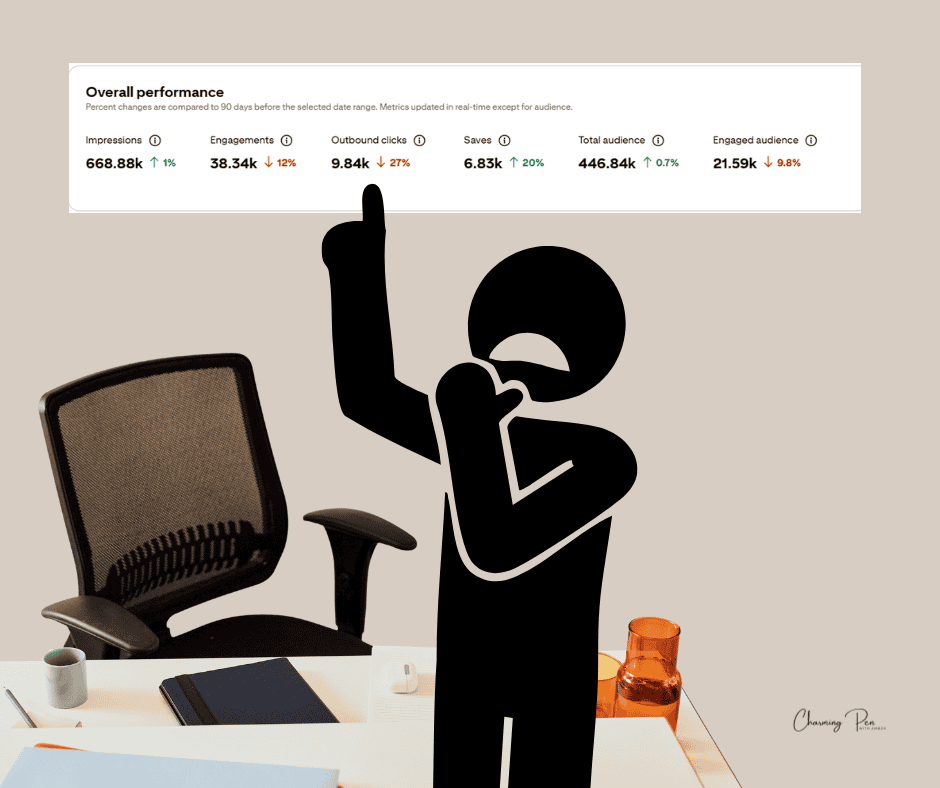
Pinterest traffic drops, unstable impressions, fluctuating outbound clicks, and changing recommendation behavior may all point toward a deeper shift in how Pinterest now distributes content.
There is a strange feeling spreading through the Pinterest creator world right now.
Not just frustration, but growing uncertainty.
Long-time Pinterest creators who once felt confident in their Pinterest strategies are suddenly watching traffic fluctuate, impressions stall, and distribution patterns behave in ways that no longer feel predictable.
Some Pinterest accounts surge unexpectedly.
Others flatten for weeks.
Some creators recover after tightening their Pinterest content strategy, while others continue publishing heavily with little visible traction.
And increasingly, Pinterest users are asking the same question:
Why does Pinterest suddenly feel so unstable?
If Pinterest traffic has felt unusually volatile lately, you are not alone. I recently explored how broader AI instability and Pinterest’s evolving recommendation behavior may still represent long-term opportunity for strategists willing to think beyond short-term panic.
→ Navigating Pinterest AI Growing Pains Will Pay Off (for Strategists Who Think Long Game)
Part of the answer may be that Pinterest itself is changing.
Older versions of Pinterest often felt more deterministic.
Use the right keywords.
Create fresh pins.
Post consistently.
Get traffic.
The system was never truly simple, but many Pinterest creators felt they could reasonably predict outcomes through repeated actions and established best practices.
Modern Pinterest now feels different.
Repeated tracking suggests visibility is now far more influenced by audience behavior, interpretation systems, topical consistency, user engagement patterns, recommendation behavior, content relationships, and audience alignment.
In other words:
The platform now often behaves less like a traditional visual search engine and more like an AI-driven discovery platform trying to understand what content belongs to which audience.
And that shift may explain why Pinterest traffic feels far less predictable than it used to.
For many bloggers, Pinterest has historically been a major traffic driver, a monetization funnel, a source of affiliate clicks, a way to grow email lists, and a long-term visibility engine.
For creators heavily dependent on Pinterest traffic, these shifts can feel especially unsettling when impressions, outbound clicks, and ranking behavior suddenly change without obvious explanation.
→ Pinterest Traffic Drops for Bloggers: Why Pins Are Suppressed
So when Pinterest traffic suddenly drops, the financial and emotional impact can feel significant.
About
This article is based on long-term Pinterest analytics tracking, repeated observation across accounts, and evolving platform behavior patterns — not private access to Pinterest’s internal systems.
The Old Pinterest Model Felt More Linear
For years, Pinterest strategy largely revolved around predictable tactical actions:
- use keyword-rich titles
- create fresh pins
- optimize board names
- publish consistently
- design beautiful pins
- use longer images
- follow Pinterest SEO best practices
Those strategies still matter to some degree.
But many Pinterest creators are discovering that Pinterest traffic no longer responds as consistently to isolated optimization tactics alone.
This is one reason so many creators feel confused right now.
The older Pinterest model often felt like:
Do X → Get Y.
More pins → More reach.
More keywords → More search visibility.
More fresh pins → More traffic.
Older Pinterest SEO advice often encouraged creators to focus heavily on relevant keywords, pin titles, longer images, clear text overlays, and consistent publishing schedules.
That older Pinterest model often revolved around isolated optimization tactics rather than broader audience interpretation and ecosystem behavior.
→ Pinterest SEO Tips: How Annotations Affect Pin Rankings
→ How Pinterest Pin Distribution Really Works
Today, Pinterest often seems to operate more through interpretation and platform confidence rather than rigid formulas alone.
Last year was when I personally started realizing something deeper had shifted.
At the time, I was building what eventually became my fourth major Pinterest macro framework. Initially, I thought I could build one larger system that would work across every Pinterest account the same way.
And for a while, it actually seemed to work.
Then the Christmas season hit and things started behaving strangely.
Some accounts compressed.
Others surged unexpectedly.
Some stabilized temporarily before flattening again.
At first, I wondered if it was simply seasonal traffic volatility.
But the more closely I tracked Pinterest analytics across accounts, the more I realized something deeper felt different.
The old linear “do X and get Y” Pinterest thinking no longer fully explained what I was seeing.
So I started tracking everything:
- impressions
- saves
- outbound clicks
- monthly views
- traffic dips
- distribution swings
- audience behavior
But honestly, that quickly became noise.
I realized the average human creator cannot split attention across dozens of constantly moving variables the same way AI systems can.
That was when I started simplifying my thinking.
I went back to the one thing every Pinterest creator already has access to:
their backend Pinterest analytics.
Those dang red downs and hopeful green ups.
And over time, repeated tracking across Pinterest accounts started revealing patterns that looked far less deterministic than older Pinterest advice suggested.
Deterministic Systems vs Probabilistic Systems
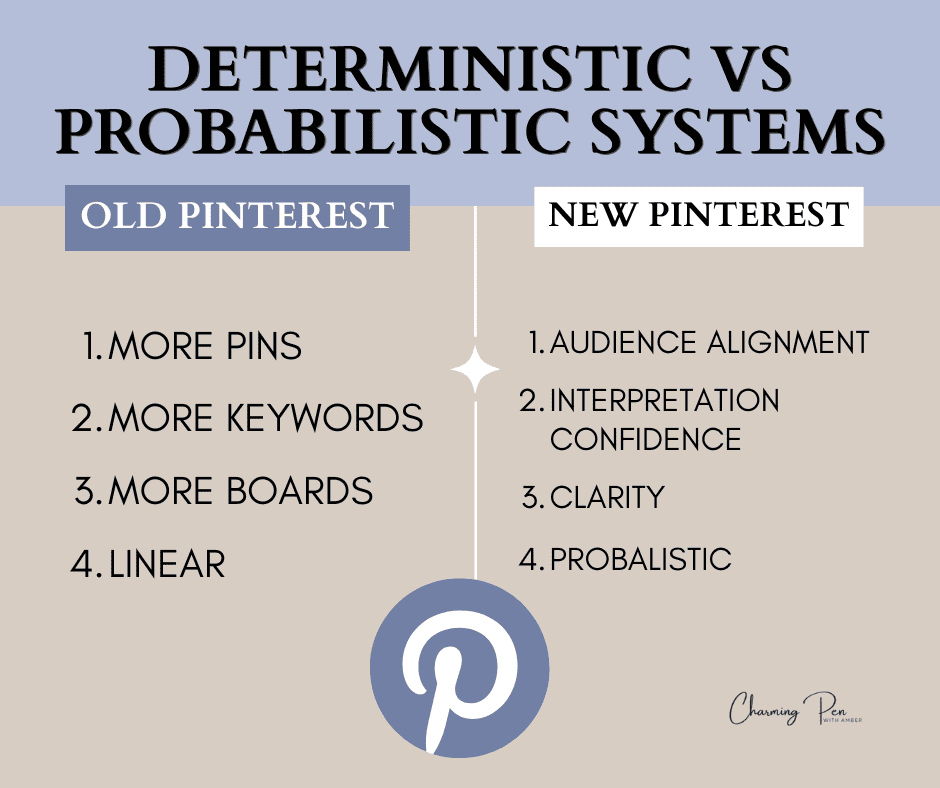
Older Pinterest thinking was largely deterministic.
Creators believed that if you followed the right steps consistently, predictable outcomes would follow.
Use the right keywords.
Create fresh pins.
Design longer images.
Post consistently.
Optimize board titles.
Get traffic.
The system felt more linear.
Do X → Get Y.
Even when results fluctuated, many Pinterest users still felt the platform mostly operated through visible cause-and-effect behavior.
Modern Pinterest now seems to operate differently.
Today, many creators are following older Pinterest best practices closely and still experiencing:
- unstable impressions
- fluctuating outbound clicks
- inconsistent pin distribution
- delayed traffic growth
- unpredictable reach patterns
That may be happening because Pinterest now often behaves more probabilistically than deterministically.
This framework is based on careful observation, long-term Pinterest analytics tracking, and repeated visibility analysis across accounts during major Pinterest algorithm changes — not private access to Pinterest’s internal systems.
Probabilistic systems do not operate through rigid formulas alone.
Instead of producing identical outcomes from identical actions every time, these systems appear to continuously adjust based on audience behavior, engagement patterns, and interpretation confidence.
Modern Pinterest now seems more focused on understanding what type of content something is, who consistently engages with it, which audiences overlap together, which behavioral patterns strengthen visibility, and where the content belongs.
This may also help explain why Pinterest search visibility and actual blog traffic no longer always move together cleanly.
→ Pinterest SERPs: The Missing Layer Between Ranking and Traffic
Instead of asking:
“Did this creator use the right keyword?”
Pinterest now seems more focused on asking:
“How confidently can this content be shown to the right people right now?”
That creates a very different strategic environment.
In probabilistic systems, more clarity may produce more confidence.
Amber Bondar, Pinterest strategist
In deterministic systems:
more actions often produced more results.
In probabilistic systems:
more clarity may produce more confidence.
One reason this distinction matters is because many creators still approach Pinterest growth using older deterministic assumptions about volume, fresh pins, and aggressive expansion.
→ Pinterest Blanket Statements: Why You Should Question Them
That is one reason many Pinterest creators are discovering that tighter content ecosystems, stronger audience targeting, clearer topical consistency, and more recognizable content identity often perform more reliably than broad, chaotic experimentation.
This does not mean creativity is dead.
It means modern discovery systems may now prioritize interpretability, user behavior, and audience confidence before expansion.
Why Controlled Expansion Matters
One thing repeated Pinterest tracking suggests is that growth does not always come from aggressive expansion.
In many cases, Pinterest appears to respond more reliably when creators expand gradually while still preserving a recognizable content identity.
I often think of this as controlled elasticity.
Controlled elasticity is the process of carefully expanding outward into closely related topics, audience interests, and content patterns without completely destabilizing the core identity of an account.
That kind of expansion may allow broader discovery, additional audience entry points, and increased visibility opportunities without completely confusing Pinterest about what the account actually represents.
This may be one reason some creators experience unstable distribution after rapidly jumping between unrelated content directions, aggressive trend chasing, or sudden large-scale strategy changes.
For example, an account built primarily around easy family dinners may naturally expand into meal prep, budget cooking, freezer meals, or lunchbox ideas more easily than jumping abruptly into luxury travel, finance content, fitness trends, or unrelated viral topics.
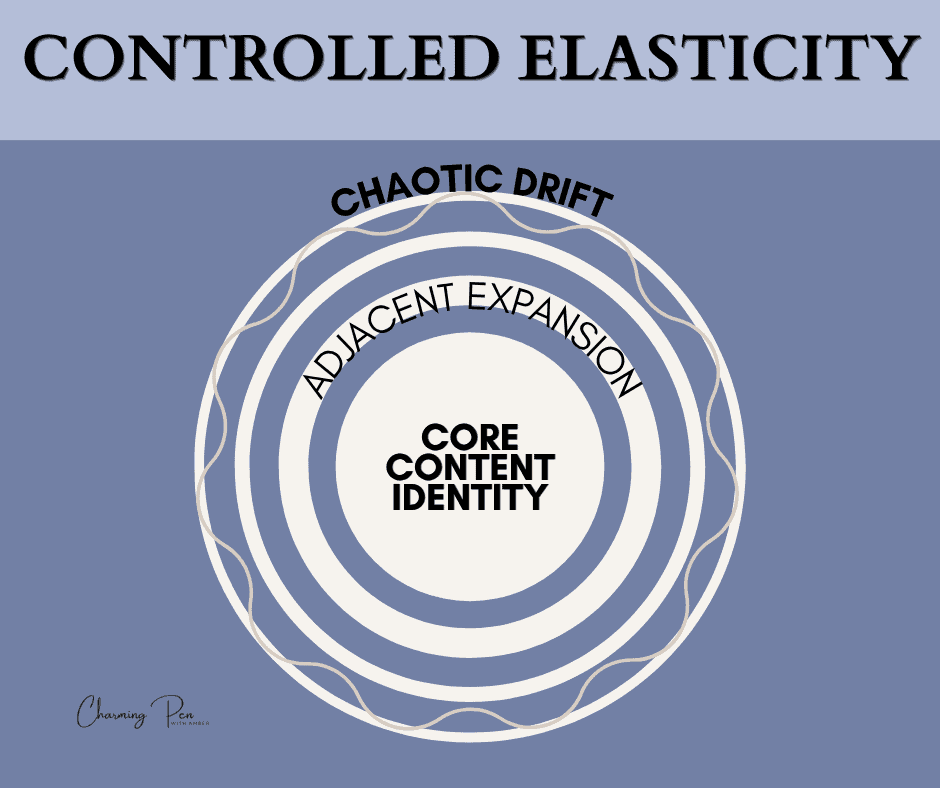
The expansion remains adjacent rather than chaotic.
This kind of adjacent expansion may also overlap heavily with emerging “taste graph” behavior, where Pinterest appears to connect closely related audience interests and content patterns together over time.
→ Reverse-Engineering Pinterest: Ideas to Process for Success
Repeated tracking also suggests that Pinterest may periodically test content into nearby audience groups after stronger reinforcement and stabilization periods.
In other words, visibility growth may not always happen through immediate large-scale expansion.
Sometimes Pinterest appears to gradually widen distribution outward once stronger audience alignment and clearer account identity have already been established.
At the same time, excessive repetition may also create problems.
Too much expansion can create instability.
But too much repetition may eventually create narrowing, stagnation, or plateau behavior.
Too much expansion can create instability. Too much repetition can create stagnation.
Amber bondar, pinterest strategist
Healthy Pinterest growth often appears to involve a balance between reinforcement and gradual expansion over time.
And honestly, that balance may be one reason Pinterest growth often feels less linear and far more phase-based than many creators expect.
What Probabilistic Pinterest Behavior Actually Looks Like
Across Pinterest accounts, many creators are starting to notice behavior that no longer fully matches older Pinterest expectations.
For years, Pinterest strategy often emphasized fresh pins, consistent publishing, keyword-rich descriptions, optimized pin titles, beautiful pin designs, longer images, and steady scheduling as the foundation for predictable Pinterest traffic growth.
Those Pinterest best practices still matter.
But many Pinterest users are now seeing highly optimized pins suddenly stall while simpler pin designs outperform polished graphics. Older pins sometimes regain traction months later, outbound clicks fluctuate heavily, and impressions rise without matching traffic growth. Some creators are even watching blog posts from last summer suddenly outperform brand-new content with almost no obvious explanation.
This may also explain why overly polished Pinterest graphics sometimes struggle against more authentic-looking content during periods of AI saturation and audience fatigue.
→ AI Food Images on Pinterest: How Bloggers Compete
Search visibility now often shifts more unpredictably, with seasonal blog posts resurfacing long after publishing while some Pinterest content suddenly explodes and other blog posts barely move at all.
Some of the strongest clues about this shift appear inside Pinterest analytics themselves.
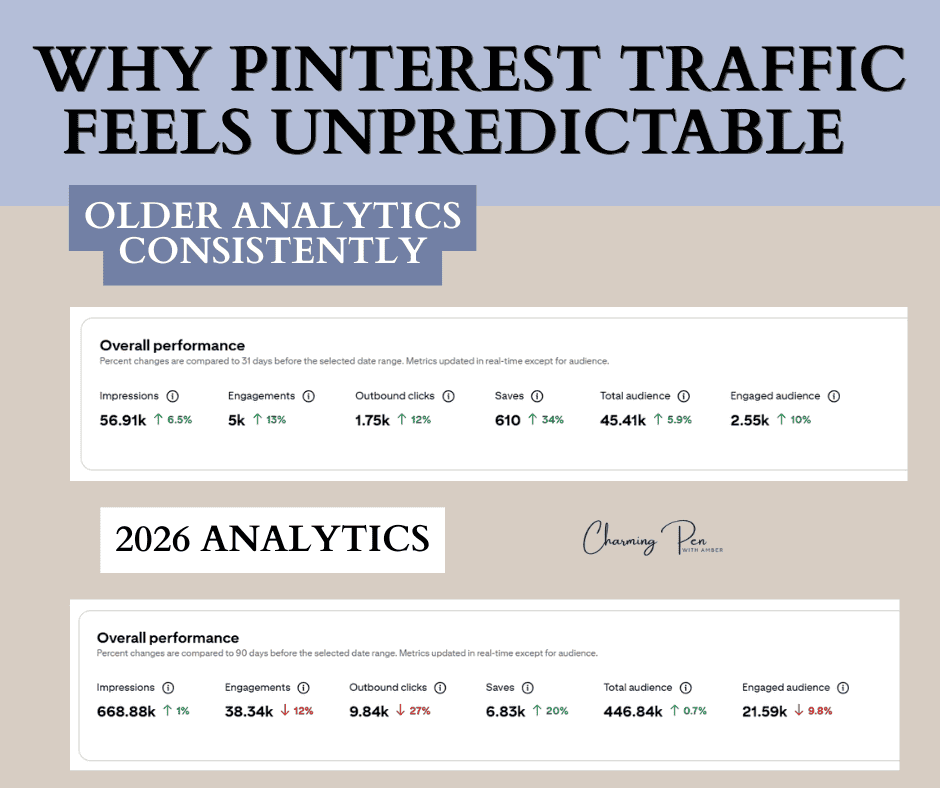
Many creators are noticing that Pinterest metrics no longer move together cleanly.
One metric rises while another falls.
Impressions go up while outbound clicks drop. A creator may log into Pinterest analytics feeling excited about rising monthly views only to realize their blog traffic barely changed at all.
Saves increase while distribution weakens.
Monthly views climb without matching traffic growth.
Pinterest analytics can start to feel less like isolated numbers and more like a marionette system.
Pull one string and the others react.
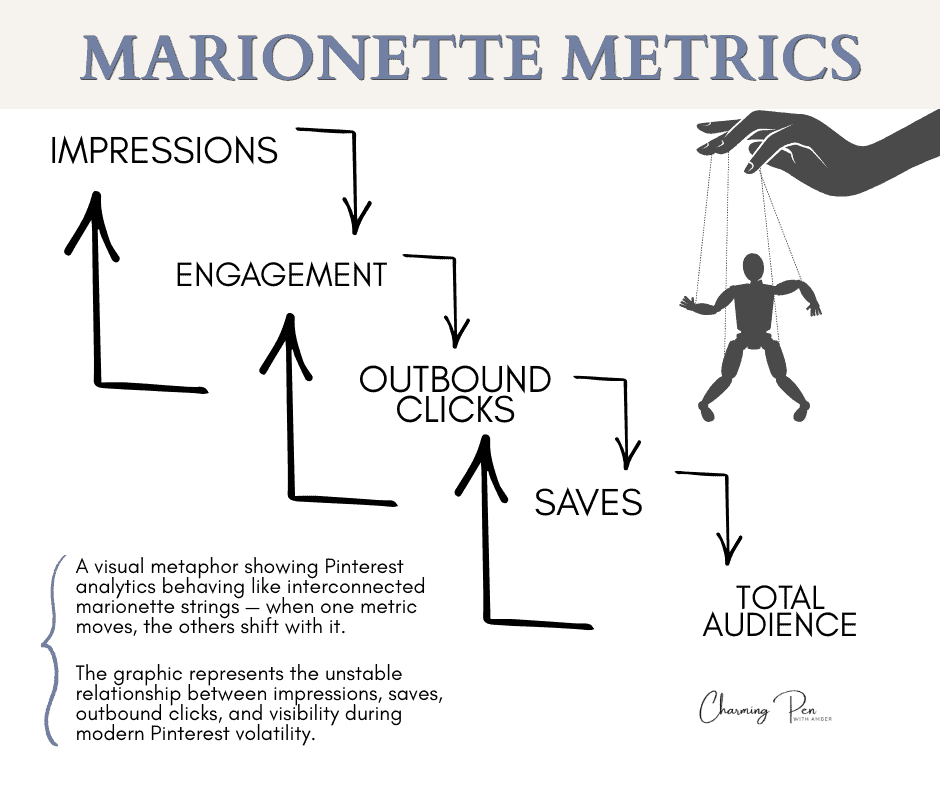
Shift one signal too aggressively and another metric may weaken unexpectedly.
That disconnect between impressions, outbound clicks, saves, and ranking behavior is one reason Pinterest growth tracking has become far more complex than simply watching monthly views alone.
→ Pinterest Growth Stats: How to Tell If It’s Real or Just a Baseline Bump
And honestly, that may be one reason so many Pinterest creators feel modern Pinterest traffic behaves less predictably than it once did.
For example:
A creator may spend significant time:
- creating new pins
- optimizing keyword-rich titles
- updating board descriptions
- improving Pinterest SEO
- tracking Pinterest analytics
and still experience:
- unstable pin distribution
- inconsistent monthly views
- traffic dips
- fluctuating search results
- slower Pinterest growth than expected
Meanwhile, another Pinterest account may suddenly gain traction from:
- older pins
- simpler pin designs
- a narrower target audience
- more consistent topical alignment
- stronger audience response patterns
And honestly, many Pinterest users seem to be sensing this shift even if they cannot fully explain it yet.
That may be one reason so many creators feel Pinterest’s algorithm has changed dramatically during the past few years.
What Creators Should Focus On Right Now
If your Pinterest traffic suddenly dropped, your Pinterest growth stalled, or Pinterest impressions are falling in ways that feel difficult to explain, that does not automatically mean your Pinterest account is permanently failing. And it does not necessarily mean Pinterest is broken or that creators should immediately abandon their entire content strategy.
And honestly, this is one reason Pinterest feels confusing for so many creators right now.
Older Pinterest advice often trained creators to react quickly:
- publish more fresh pins
- redesign everything
- chase new keywords
- overhaul boards
- widen content aggressively
But modern Pinterest algorithm changes may require a calmer and more observational approach instead.
A creator may panic after a Pinterest traffic drop and immediately redesign every pin on their account, when the real issue may have been temporary instability or audience recalibration instead.
Rather than reacting emotionally to every unstable week inside Pinterest analytics, creators may need to start thinking more in terms of recovery phases, visibility stabilization, and long-term distribution patterns.
That does not mean ignoring problems.
There absolutely are situations where Pinterest traffic gets stuck long-term, content strategies weaken, audience alignment breaks down, and visibility declines over time.
But repeated tracking across accounts suggests that chaotic overcorrection often makes instability worse instead of better.
One reason random Pinterest hacks often fail long-term is because unstable experimentation can sometimes create even more mixed signals inside an already shifting system.
This is also one reason many creators unknowingly destabilize their accounts by rapidly switching strategies, changing management styles too frequently, or constantly chasing short-term platform hacks.
→ Pinterest Traffic Dropping? Why Most Strategies Fail
Every new pin is also telling Pinterest: ‘This is what my account is about.’
-Amber Bondar, Pinterest strategist
If Pinterest traffic suddenly dropped, one of the most useful things creators can do right now may be tightening topical clarity, reinforcing stronger audience alignment, studying which pins still receive saves and outbound clicks, reducing scattered experimentation temporarily, and tracking Pinterest analytics over longer periods instead of reacting emotionally to daily swings.
In many cases, rebuilding Pinterest distribution may depend less on sudden aggressive action and more on restoring clearer signals over time.
That is one reason visibility recovery may now look slower, steadier, and more phase-based than many creators expect.
How Pinterest Appears To Understand Content Now
Pinterest now appears to function as both a visual search engine and an AI-driven discovery platform.
That distinction matters.
The platform no longer seems focused only on matching exact keywords.
Pinterest now seems to interpret individual pins, blog posts, images, overlays, pin titles, pin descriptions, saves, click patterns, audience behavior, and overall Pinterest account identity together rather than as isolated ranking signals.
This is one reason tightly aligned Pinterest accounts often perform more consistently than broad, highly scattered content strategies.
Pinterest now seems more focused on understanding what type of content something is, who consistently engages with it, which audiences overlap together, which behavioral patterns strengthen visibility, and where the content belongs.
And honestly, that changes how creators need to think about Pinterest strategy moving forward.
Pinterest annotations may also reflect part of this interpretive shift.
Many Pinterest users initially treated annotations like simple keywords.
But annotations now appear far more contextual than traditional keyword matching alone.
They may function more like topical relationship signals that help Pinterest understand what content represents, where it belongs, which audiences may respond positively to it, and how related Pinterest content clusters together over time.
That distinction may help explain why annotation patterns now seem to matter far more across modern Pinterest traffic behavior.
Pinterest creators are not crazy for feeling like the platform behaves differently now.
The systems themselves appear to be evolving quickly.
And increasingly, creators who learn how to observe patterns, strengthen audience alignment, and adapt strategically during different visibility phases may be the ones best positioned for long-term Pinterest growth moving forward.
These broader shifts may also reflect something larger happening across the internet itself as AI-driven discovery systems increasingly reshape how creators approach traffic, visibility, search behavior, and content interpretation overall.
→ How AI Search Optimization Is Changing Content Creation
→ SEO vs Answer Engine Optimization (AEO) vs GEO: What Bloggers Need to Know in 2025
→ Pinterest as a Generative Engine
Creators who navigate long-term Pinterest volatility successfully are often the ones willing to study changing platform signals over time, recognize when visibility phases are shifting, and adapt their strategies without emotionally overcorrecting to every short-term swing.